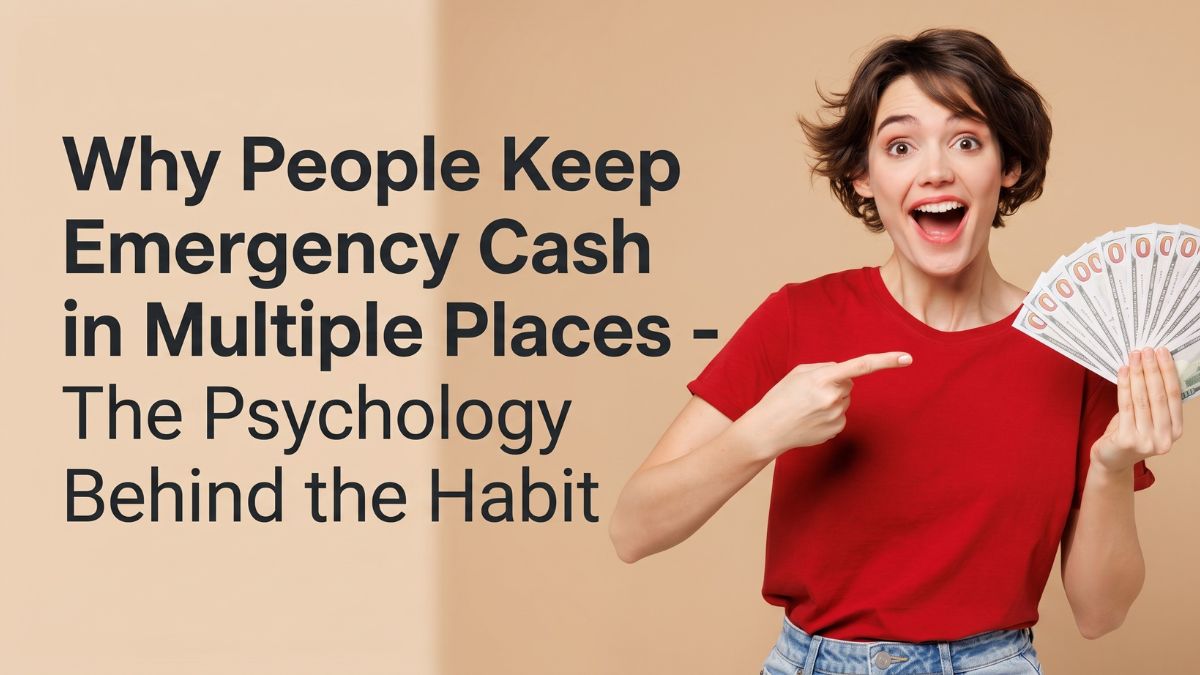
For some people, having emergency cash is not enough. They also want to know that money is available in more than one place – perhaps some in a wallet, some at home and a little in another secure location. From the outside, this can seem overly cautious. But behavioral economics offers a more nuanced explanation.
People regularly make financial decisions without knowing exactly what the future holds. Keeping extra money available can be a way to protect future spending from unexpected expenses or income disruptions. Economists often describe this as precautionary saving.
Keeping cash in multiple locations is not a proven personality test. Still, the habit can suggest a strong preference for preparedness, liquidity and having alternatives when circumstances change.
Uncertainty
One of the clearest ideas connected with this behavior is precautionary saving. The principle is simple: when the future feels uncertain, people may retain additional resources so an unexpected expense does not immediately disrupt their lives.
Research by economists Christopher Carroll and Andrew Samwick found evidence that households exposed to greater income uncertainty tend to hold more precautionary wealth. In practical terms, savings can act like a financial shock absorber.
Someone who keeps backup cash is essentially preparing an answer before a problem appears. They are not necessarily expecting something bad to happen. They are simply making sure an unexpected situation has less power over them.
Buffers
The buffer-stock model of saving, associated with economists including Carroll and Angus Deaton, provides another useful way to understand this mindset.
The model suggests that people may maintain a target amount of readily accessible wealth as protection against financial shocks. When their resources fall below that desired level, they may save more. Once the buffer feels sufficient, the urge to accumulate can weaken.
Multiple cash locations can fit into this broader preparedness strategy. Someone might keep $200 in a wallet and another $300 at home. The objective is not necessarily to increase total wealth. It is to maintain access to resources when one source becomes unavailable.
That distinction matters. The psychological value may come from accessibility and backup, rather than simply from having more money.
Redundancy
Keeping resources in different places creates financial redundancy. If one resource disappears, another remains available.
Think about how people use backups elsewhere. They might keep a spare house key, duplicate important documents or carry an extra phone charger. These habits reduce the consequences of losing one item.
Emergency cash can work in much the same way. If a wallet is lost, money stored elsewhere remains accessible. If digital payments become temporarily difficult, physical cash offers another payment option.
The underlying mindset is straightforward: depending entirely on one pathway can feel risky when alternatives are relatively easy to create.
Accounting
Behavioral economist Richard Thaler’s concept of mental accounting offers another explanation. People often divide money into psychological categories based on its purpose, source or intended use.
A person’s informal categories might look like this:
- Everyday spending money
- Travel emergency money
- Home emergency cash
- Money that should not be touched
Technically, a dollar is a dollar. Psychologically, however, people can assign different meanings to different amounts.
Putting emergency cash in a particular location can strengthen that mental boundary. The money becomes a resource reserved for a specific situation rather than cash that is available for everyday purchases.
Tangibility
Physical cash can also provide something that digital savings cannot: a tangible sense of resources.
A balance displayed on a banking app is abstract. Cash sitting securely in a known location is physically present. That difference can influence how available or reassuring the resource feels.
This does not mean physical cash is automatically safer or financially superior to money held in a bank account. Digital savings can offer important advantages, including security and potential interest earnings.
But psychologically, tangible resources can feel more concrete. Seeing or knowing where the cash is may reinforce the thought, “If something happens, I have another option.”
Planning
The habit can also reflect future-oriented thinking. People regularly imagine possible scenarios and adjust their behavior accordingly.
Someone might wonder:
- What if I lose my wallet?
- What if I need cash unexpectedly?
- What if something happens while traveling?
- What if electronic payments are temporarily unavailable?
This does not automatically indicate fear. It can simply represent contingency planning.
The person is mentally testing different futures and asking whether they would still have access to useful resources. In that sense, emergency cash becomes a small form of preparation for uncertainty.
Preparedness
An interesting distinction is whether someone focuses on probability or consequences.
A person may think, “This is unlikely to happen, but if it does, I would rather be prepared.” That is different from believing that something bad is almost certain.
This way of thinking resembles precautionary saving. Uncertainty can make people more willing to preserve resources today instead of maximizing current consumption.
The underlying calculation is somewhat similar to buying insurance: the event may never occur, but the backup has value because of what it could prevent.
Anxiety
It is important not to turn this behavior into a psychological diagnosis.
Keeping emergency cash in several places does not automatically mean someone is anxious, fearful or distrustful. There may be entirely practical explanations. Someone could have previously lost a wallet, travel frequently, live in an area where cash remains useful or simply prefer having a backup.
The behavior becomes more psychologically significant if a person feels unable to relax without several layers of backup. Even then, the habit alone cannot establish a mental health condition.
It may simply reveal a stronger preference for certainty, preparedness and personal control.
Safety
For many people, emergency cash functions as a kind of psychological safety net. Its value is not necessarily measured by how often it gets spent.
Someone might leave emergency money untouched for months or years and still feel better knowing it exists. The cash represents a buffer between the individual and an unpredictable future.
That is perhaps the most useful way to understand the habit. A person who keeps cash in several locations may not believe that something will go wrong. They may simply want to know that if it does, they have choices.
In a world where uncertainty is unavoidable, that feeling of having a backup can provide both practical flexibility and psychological reassurance.
FAQs
Why do people keep emergency cash?
It provides a backup for unexpected expenses or disruptions.
Is multiple cash storage a sign of anxiety?
No. It can simply reflect preparedness or practical planning.
What is precautionary saving?

It means saving to protect against uncertain future expenses.
What is mental accounting?
It is how people mentally divide money into different categories.
Why keep cash in several places?
It creates a backup if one source of money becomes unavailable.