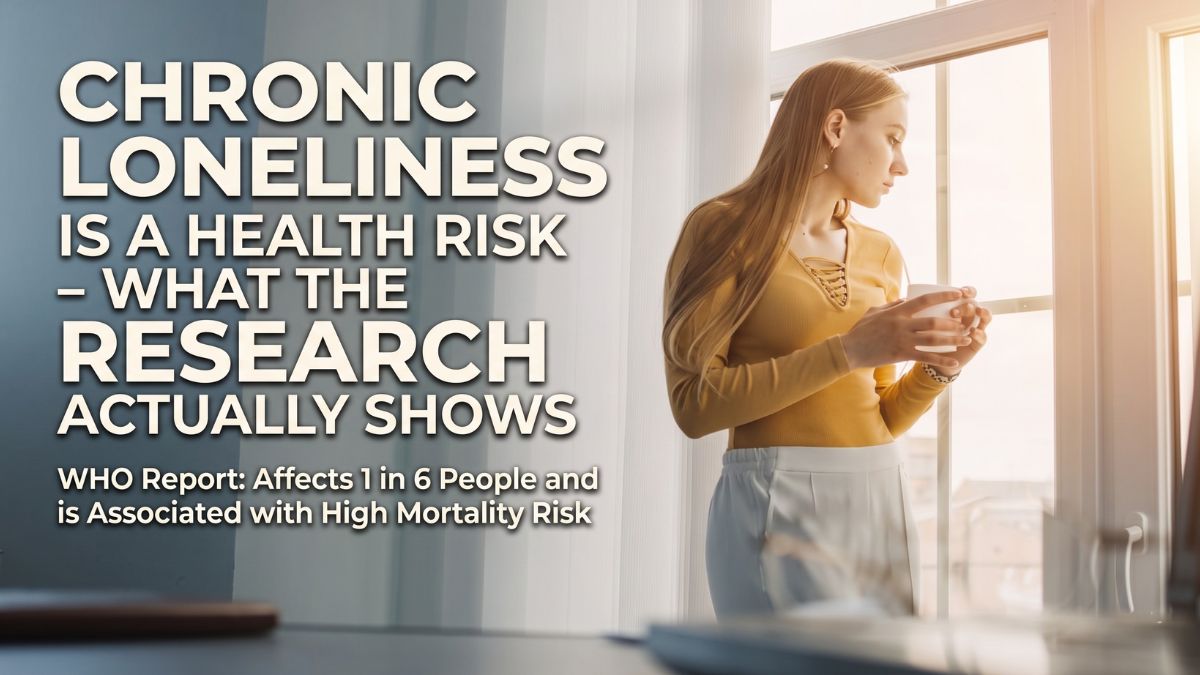
Nobody writes “loneliness” on a death certificate. It is more likely to appear indirectly through conditions such as cardiovascular disease, stroke, or other illnesses that develop over time.
That distinction is important when discussing the health effects of loneliness. Researchers are not saying that loneliness itself is usually recorded as a direct cause of death. Instead, a growing body of evidence suggests that persistent social disconnection is associated with a higher risk of serious illness and premature death.
The evidence has become substantial enough that major public health organizations now treat social connection as a health issue rather than simply a matter of emotional wellbeing.
Evidence
One of the most influential studies came from psychologist Julianne Holt-Lunstad and colleagues at Brigham Young University.
In a 2010 meta-analysis published in PLoS Medicine, researchers combined results from 148 studies involving 308,849 participants. The studies followed people for an average of about seven and a half years.
The researchers examined whether the quality and strength of people’s social relationships were associated with survival.
Their analysis found that people with stronger social relationships had about a 50 percent greater likelihood of survival during the follow-up period compared with those with weaker social connections.
The association remained after researchers considered factors such as age, sex, initial health status, and cause of death.
The finding attracted particular attention because the researchers compared the size of the association with several established mortality risk factors.
The effect was broadly comparable to the association observed for some established health risks, including smoking, and was larger than the associations reported for obesity and physical inactivity in the comparisons used by the researchers.
That does not mean loneliness is literally as dangerous as smoking in every circumstance. The comparison concerns effect sizes across observational research, not an experiment proving that one behavior causes the same number of deaths as another.
Loneliness
The distinction between different forms of social disconnection became clearer in a 2015 meta-analysis by Holt-Lunstad and colleagues, published in Perspectives on Psychological Science.
This analysis included 70 studies involving more than 3.4 million participants.
Researchers separated three concepts that are often treated as interchangeable: social isolation, loneliness, and living alone.
They found that social isolation was associated with a 29 percent higher likelihood of mortality, loneliness with a 26 percent higher likelihood, and living alone with a 32 percent higher likelihood.
These figures are associations, not guarantees about an individual’s health outcome.
Someone can live alone and have strong relationships. Another person can have a busy social schedule while feeling deeply lonely.
That distinction matters because loneliness is subjective. It describes the perceived gap between the relationships someone wants and the relationships they believe they have.
Social isolation is more objective. It concerns the number and frequency of social contacts and relationships.
The two can overlap, but they are not identical.
Limits
The research is significant, but it also has limitations.
The major studies are based largely on observational data. Researchers observe what happens to people over time and look for statistical relationships between social connection and health outcomes.
That approach can identify important patterns, but it cannot establish causation as confidently as a randomized controlled trial.
For example, poor health can make someone less socially active. A person experiencing chronic pain, mobility problems, depression, or another illness may withdraw from friends and community activities.
In that case, declining health may contribute to isolation rather than isolation being the original cause of the health problem.
Researchers can statistically adjust for many potential confounding factors, but adjustment cannot eliminate every possible source of bias.
That is why the most accurate description is that chronic loneliness and social isolation are associated with higher mortality risk.
Mechanisms
Researchers have proposed several explanations for why persistent social disconnection might affect physical health.
John Cacioppo, who conducted extensive research on the neuroscience of loneliness at the University of Chicago, described loneliness as an evolutionary signal that can encourage people to reconnect with others.
From this perspective, loneliness functions somewhat like hunger or thirst. It signals that an important need may not be receiving enough attention.
The problem may arise when that signal becomes persistent.
Research by Louise Hawkley and John Capitanio has examined how chronic loneliness can be associated with increased sensitivity to potential social threats.
A person who expects rejection may pay closer attention to ambiguous social signals and interpret uncertain interactions more negatively.
This can create a difficult feedback loop.
Loneliness may increase sensitivity to rejection. That sensitivity may make social interactions feel more threatening. Avoiding those interactions can then reduce opportunities for meaningful connection.
Over time, the original social problem can become harder to change.
Stress
The physical pathway is still being investigated, but researchers have examined links between loneliness and processes involving stress, inflammation, cardiovascular function, and sleep.
Persistent social threat perception may contribute to prolonged physiological stress responses.
Sleep can also become disrupted. Someone who feels socially unsafe or disconnected may experience more rumination, anxiety, or difficulty settling at night.
These effects are unlikely to explain every case of loneliness, and researchers continue to investigate the mechanisms involved.
The important point is that loneliness is not purely an emotional experience in the sense of having no possible connection to physical health.
The brain and body respond to social conditions, just as they respond to other forms of sustained stress.
Public
The growing evidence has also influenced public health policy.
In 2025, the World Health Organization’s Commission on Social Connection released a global report examining loneliness and social isolation as international health concerns.
The WHO estimated that about one in six people worldwide experience loneliness and reported an estimated 871,000 deaths annually associated with loneliness based on available evidence and modelling.
Those figures should not be interpreted as a literal count of death certificates listing loneliness. They are estimates derived from population research linking social disconnection with health outcomes.
The WHO’s work reflects a broader shift in public health thinking: social connection is increasingly being considered part of the conditions that influence health rather than simply a private matter of personality or happiness.
Age
The assumption that loneliness is mainly a problem of old age also does not fit the available evidence.
WHO reporting has highlighted substantial levels of loneliness among adolescents and young adults.
The London School of Hygiene and Tropical Medicine, summarizing the 2025 WHO report, noted that reported loneliness was particularly high among people aged 13 to 29, with estimates ranging from about 17 to 21 percent.
The burden also varies between countries and populations.
Reported rates have been higher in lower-income countries than in wealthier countries, suggesting that economic circumstances, community infrastructure, social inequality, and access to support can all influence social connection.
This is one reason researchers increasingly view loneliness as more than an individual psychological issue.
Intervention
Once loneliness is treated as a health-related risk factor, the obvious question is what can be done about it.
There is no single intervention that works for everyone.
The evidence reviewed by the WHO commission includes approaches such as psychological interventions, social skills programs, and community-based strategies.
Cognitive behavioral therapy can be relevant when loneliness is reinforced by negative expectations about social interactions. It may help people examine assumptions about rejection and develop different ways of interpreting social situations.
Social skills programs can be useful in some settings, particularly for young people who have difficulty forming or maintaining relationships.
There are also environmental solutions.
Community spaces, accessible public transportation, parks, libraries, local organizations, and neighborhoods designed for walking can create opportunities for people to encounter one another naturally.
These solutions may sound ordinary, but that is part of the point. Social connection does not always begin with a formal support group. Sometimes it begins with repeated, low-pressure contact with other people.
Connection
The strongest lesson from the research is not that loneliness should be feared.
It is that persistent social disconnection deserves to be taken seriously.
A person does not need hundreds of friends to be socially connected, and living alone does not automatically mean someone is lonely. What matters is whether a person’s relationships provide enough meaningful connection for their needs.
The comparison with smoking became prominent because it communicates that social connection can have measurable implications for health. But it should be understood as a comparison of research findings, not as a claim that loneliness is identical to tobacco exposure.
The evidence is strongest when viewed as a whole: long-term social isolation and loneliness are consistently associated with poorer health outcomes and higher mortality risk, while the precise causal pathways continue to be studied.
The practical implication is relatively simple. Social connection is not merely something that makes life more pleasant. For many people, it is part of the environment in which physical and psychological health are maintained. A conversation, a regular visit, a shared activity, or simply having people who notice when you are absent can be more consequential than it appears.
FAQs
Can loneliness affect physical health?
Yes. Chronic loneliness is associated with several poorer health outcomes.
Is loneliness as harmful as smoking?
Some studies found comparable effect sizes, but the risks are not identical.
Does living alone cause loneliness?

No. Living alone and feeling lonely are different experiences.
Why can loneliness affect health?
Possible pathways include stress, sleep disruption, and cardiovascular changes.
Can loneliness be treated?
Therapy, social programs, and stronger community connections may help.