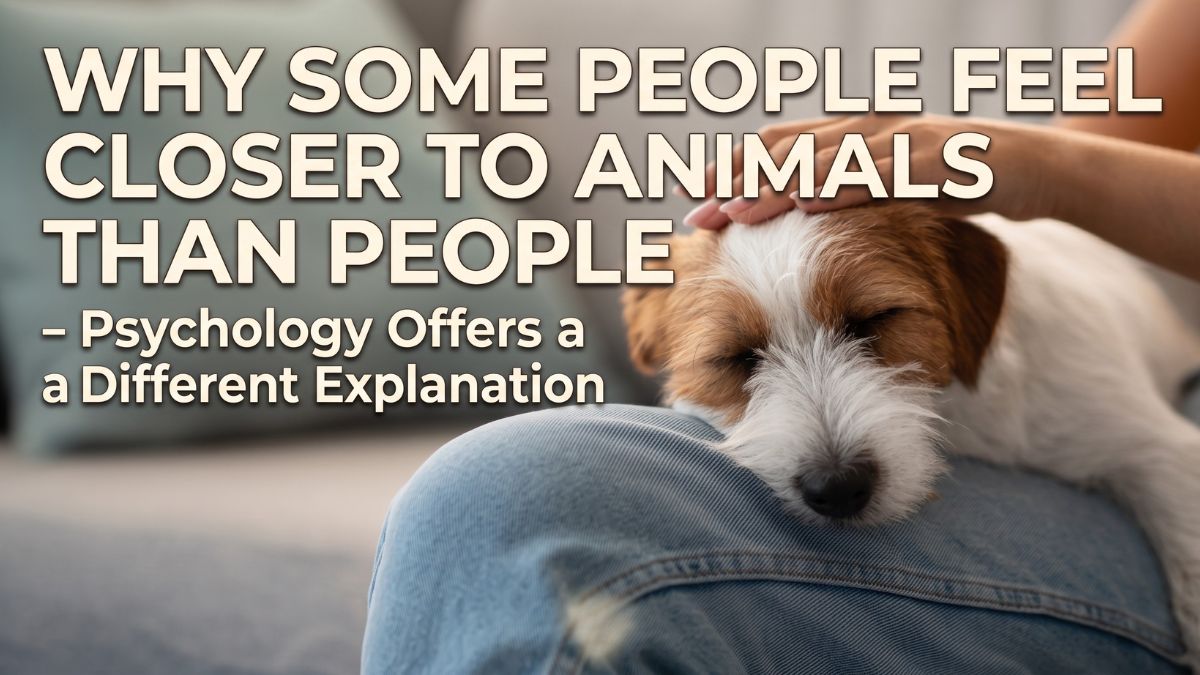
Some people say it almost apologetically: “Honestly, I feel closer to my dog than to most people.”
The animal might be a dog, cat, horse, or another companion. The relationship can feel unusually deep, reliable, and emotionally uncomplicated compared with friendships, romantic relationships, or family connections.
It is easy for others to interpret this as evidence that something has gone wrong socially. Perhaps the person cannot connect with people, so they have formed a substitute relationship with an animal.
Psychology offers a more complicated picture.
For some people, animals can provide a form of attachment that feels safer and more predictable than human relationships. This does not mean every strong bond with an animal reflects difficult past experiences. People can simply prefer animals, enjoy their companionship, or find human relationships more demanding.
But research involving attachment, trauma, and service animals suggests that animals can also become important sources of emotional security for people who find human closeness difficult.
Safety
Human relationships involve uncertainty.
Another person has changing moods, expectations, preferences, boundaries, and interpretations. Affection can change. Communication can be misunderstood. Relationships can end.
For someone who has experienced betrayal, rejection, instability, or interpersonal trauma, these uncertainties may carry more emotional weight.
An animal offers a different kind of relationship.
A dog does not expect a carefully constructed explanation for why you were quiet today. A cat does not evaluate your career, appearance, social status, or productivity. An animal’s responses are often more immediate and easier to interpret.
This does not make animals incapable of complexity. They have their own behaviors, needs, and temperaments.
The important difference is that the relationship is usually structured around a different form of communication.
For some people, that lower level of social ambiguity can make closeness easier.
Attachment
Attachment research provides one framework for understanding why these relationships can become so important.
People generally develop expectations about whether others will be available, responsive, and trustworthy. Those expectations can be influenced by early relationships, but they can also change through later experiences.
A person who expects human relationships to involve criticism or rejection may approach new relationships cautiously.
An animal can provide repeated experiences that are easier to interpret.
The person feeds the animal. The animal approaches them. They sit together. They go for walks. The animal depends on them, and the person learns that being needed does not necessarily result in criticism or abandonment.
These ordinary interactions can become meaningful precisely because they are repeated.
The relationship does not have to be perfect to provide a sense of security.
Veterans
Some of the clearest research on the therapeutic potential of animal relationships comes from work with military veterans experiencing post-traumatic stress disorder.
This is important because PTSD can involve heightened threat perception, avoidance, sleep difficulties, and changes in social functioning.
Research by Marguerite O’Haire and colleagues has examined the effects of service dogs on veterans with PTSD.
In one research program, veterans partnered with service dogs showed improvements in PTSD-related outcomes compared with veterans receiving usual care alone.
A 2024 clinical trial involving 245 participants also examined physiological measures of stress among veterans receiving service dogs. Researchers reported changes in the cortisol awakening response after three months.
Cortisol is involved in the body’s stress response, so biological measures can provide information that goes beyond a person’s self-reported mood.
However, these findings should not be interpreted as proof that service dogs cure PTSD or that an animal relationship can replace professional treatment.
The evidence is more specific: service dogs may provide meaningful support for some veterans, and researchers are continuing to investigate the mechanisms involved.
Connection
One particularly interesting possibility is that an animal relationship may sometimes support, rather than replace, human relationships.
Research involving veterans has examined whether relationships with service dogs can influence attachment security and social functioning.
The proposed pathway is relatively straightforward.
A person repeatedly experiences closeness with an animal without the relationship producing the interpersonal threat they have learned to anticipate.
The animal is nearby. Nothing bad happens.
The person depends on the animal. The relationship continues.
The animal depends on the person. That dependence becomes part of an ordinary routine rather than a source of punishment or rejection.
Over time, repeated experiences of predictable connection may provide a different reference point for relationships.
This does not mean an animal relationship automatically functions as exposure therapy. That would overstate the evidence.
It does suggest that safe attachment experiences can have value, particularly for people whose expectations about relationships have become strongly associated with threat.
Bridge
The idea that animals are merely substitutes for human relationships may therefore be too simplistic.
For some people, an animal can function as a bridge.
Consider someone who rarely speaks with strangers but begins talking to other dog owners during walks. A person who avoids social situations may become more comfortable with small interactions because their dog provides a natural reason to be there.
The animal can also create routines that bring a person into shared spaces.
Walking, visiting a park, attending a training class, or speaking with a veterinarian all involve forms of social contact.
These interactions do not necessarily become close friendships, but they can reduce complete social withdrawal.
In other circumstances, the effect may be more emotional than social. Feeling responsible for another living being can provide structure and purpose during periods when a person’s connection to other people is limited.
Boundaries
There is an important distinction between a relationship that provides safety and one that reinforces complete avoidance.
A strong bond with an animal is not automatically a problem.
The more useful question is whether the relationship allows the person’s life to remain flexible.
If someone loves spending time with their dog but also maintains friendships, family connections, work relationships, or other meaningful activities, there is little reason to view the animal bond as evidence of dysfunction.
The situation can be different when someone becomes unable to tolerate any human closeness and uses the animal relationship exclusively to avoid all interpersonal contact.
Even then, the animal should not be blamed.
The avoidance may be protecting the person from experiences they genuinely perceive as threatening.
Understanding that function can be more useful than telling them to “get out and meet people.”
Meaning
The strength of an animal bond also depends on what the relationship represents.
For one person, a dog may simply be a beloved companion.
For another, the relationship may represent the first experience of dependable attachment they can remember.
For someone recovering from trauma, the animal may provide routine, responsibility, companionship, and physical closeness without the same level of interpersonal uncertainty.
Those experiences can be significant without needing to turn the relationship into a psychological diagnosis.
It is also worth remembering that animals have individual personalities. Some are highly social, others are independent, and the quality of the relationship depends partly on the compatibility between animal and owner.
Support
If someone feels safer with animals than with people, the appropriate response is not automatically to treat the animal relationship as a problem.
It may be worth asking what the relationship provides.
Does it offer companionship?
Predictability?
A sense of responsibility?
Physical comfort?
A reason to leave the house?
A relationship without constant evaluation?
The answers can reveal what the person may need from other parts of life.
If human relationships consistently feel threatening, exhausting, or impossible, professional support can help someone explore those experiences without dismissing the bond they have with their animal.
The goal does not have to be replacing the animal with people.
A healthier outcome may be allowing the circle of safety to become larger.
Perspective
Having your deepest emotional bond with an animal does not, by itself, demonstrate an inability to connect with people.
Humans have always formed meaningful relationships with animals, and those relationships can provide companionship, responsibility, comfort, and security.
For some people, the bond may also be particularly important because human relationships feel less predictable or more threatening.
In those cases, the animal may represent more than a substitute for human connection. It can be a stable relationship in which closeness is experienced as safe and manageable.
Sometimes that is where connection begins.
The important question is not whether someone loves an animal “too much.” It is whether that relationship leaves room for the person’s world to grow or whether fear has made it smaller.
A strong bond with an animal can be the place where someone feels safest. And for some people, learning that closeness can be safe may eventually make other relationships feel possible too.
FAQs
Why do some people prefer animals to people?
Animals can offer predictable companionship and less complicated social cues.
Can pets help people with trauma?
Research suggests animals may provide meaningful support for some people.
Is a strong pet bond unhealthy?

Not necessarily. A close animal bond can be healthy and meaningful.
Can animals support human relationships?
For some people, animals may provide experiences that support social connection.
When can pet attachment become concerning?
It may matter when fear of people leads to severe and persistent isolation.