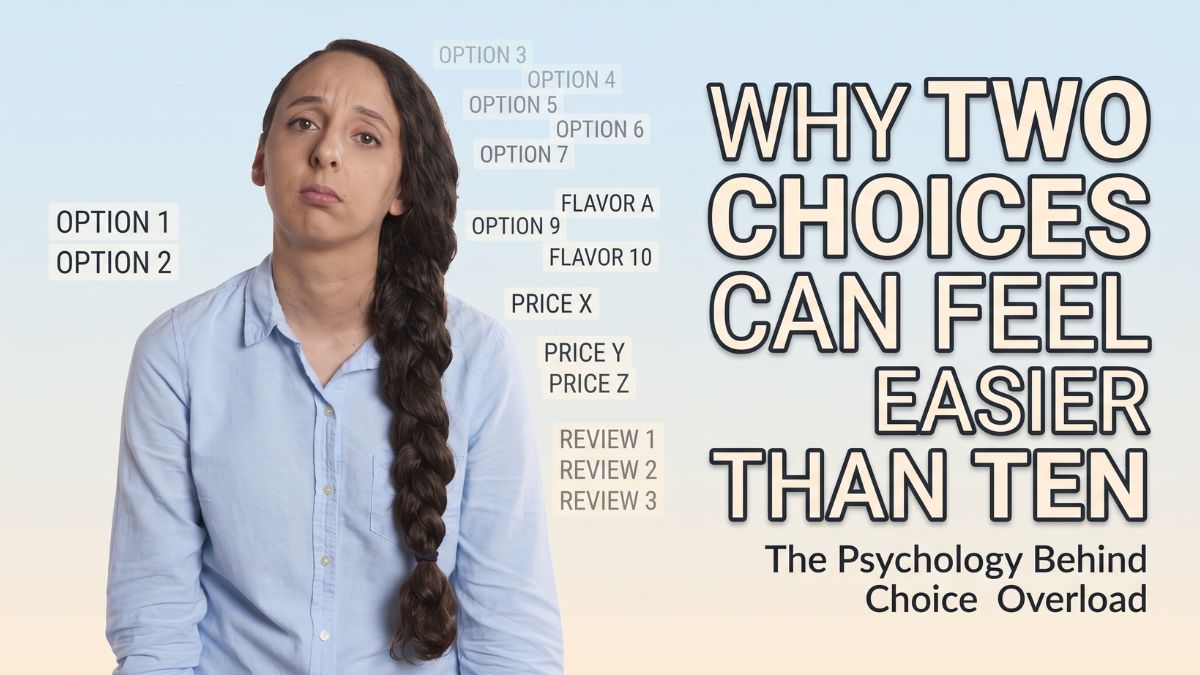
Imagine walking into a restaurant and being offered two desserts: chocolate cake or cheesecake. You can probably decide within seconds.
Now imagine being handed a menu with 10 desserts, each with different flavors, toppings, prices, ingredients, and reviews. Suddenly, choosing feels less like a simple preference and more like a small research project.
You start comparing options. You wonder whether another dessert might be better. You may even postpone the decision.
Psychology suggests this reaction can be an example of choice overload, a phenomenon in which having more options can sometimes make decisions harder rather than easier.
Research by psychologists Sheena Iyengar and Mark Lepper famously found that people were more likely to purchase a product when presented with a smaller assortment than a much larger one. In some conditions, people who chose from the smaller selection also reported greater satisfaction.
Later research has shown that choice overload is not inevitable. The effect depends on factors including the complexity of the options, the difficulty of the decision, how certain people are about their preferences, and what they are trying to accomplish.
Choices
Every additional option brings more information to process.
Suppose you are choosing between two phones. You might compare price, camera quality, battery life, and storage.
Now imagine choosing between 10 phones.
You have to determine which features matter, which differences are meaningful, and which products can be eliminated. The decision becomes less about choosing a preference and more about managing information.
This connects with the concept of cognitive load, which refers to the mental effort involved in processing information.
A larger selection is not automatically difficult. But as options become more complex and differences become harder to evaluate, the mental work involved can increase.
That is partly why two choices can feel so manageable. You do not need to identify the perfect option from an entire category. You only need to decide which of two alternatives better fits your needs.
Paradox
Psychologist Barry Schwartz popularized the phrase paradox of choice to describe the potential costs of having an abundance of options.
The idea is not that freedom is bad.
Having choices generally gives people control. The difficulty can arise when the number of choices becomes large enough to create additional work, uncertainty, or regret.
Consider buying cereal.
With two options, the question is straightforward: “Which one do I prefer?”
With 20 options, another question can appear: “What if one of these is better?”
That small change matters.
You are no longer simply comparing two products. You are potentially comparing your choice against every alternative you did not select.
Experiment
One of the best-known studies of choice overload came from Iyengar and Lepper.
At a gourmet food store, shoppers encountered either a large display of 24 jams or a smaller display of six.
The larger assortment attracted more attention. However, shoppers who encountered the smaller selection were more likely to make a purchase.
In some conditions, those who chose from the smaller assortment also reported greater satisfaction.
The experiment became influential because it challenged the assumption that a larger selection necessarily produces better outcomes.
More options can attract attention and create interest. But attention and decision-making are not the same thing.
A large assortment may make someone stop and look while simultaneously making the eventual choice more difficult.
Complexity
Later research has added important context to the original findings.
A major meta-analysis by Alexander Chernev, Ulf Böckenholt, and Joseph Goodman examined 99 observations involving 7,202 participants.
The researchers found that the effect of assortment size depended on several factors, including choice-set complexity, decision-task difficulty, preference uncertainty, and the person’s decision goal.
This means there is no simple rule stating that 10 options are too many.
For someone who knows exactly what they want, 10 choices may be easy.
A coffee enthusiast who understands different beans, roasting methods, and flavor profiles may enjoy comparing a dozen options. Someone who simply wants “a regular coffee” may prefer two straightforward choices.
The same number of options can therefore feel very different depending on the person and the decision.
Preferences
Knowing what you want can make a large selection much easier.
Suppose you know that you want vanilla ice cream.
If the choices are vanilla, chocolate, strawberry, and pistachio, you can quickly eliminate most of them.
But imagine you do not know what you want.
Now every flavor remains a possibility.
This is where preference uncertainty becomes important. When people have clear preferences, they can remove unsuitable options quickly. When their preferences are unclear, every option requires consideration.
That is one reason unfamiliar purchases can feel particularly tiring.
You are not only deciding what to buy. You are first trying to determine what you actually want.
Regret
More choices can also increase the possibility of anticipated regret.
Imagine buying one pair of shoes and then remembering another pair you considered.
You may start wondering whether the alternative was more comfortable.
The problem may not be that the shoes you bought are uncomfortable. The issue is that you continue imagining what might have happened if you had selected something else.
The same thing can happen with hotels, restaurants, smartphones, streaming programs, or even career decisions.
When alternatives remain visible, it can be harder to feel finished with a decision.
With two options, there is still a rejected alternative. But with 10 or 20, there are many more possibilities for imagining that another choice might have been better.
Delay
Another possible consequence is choice deferral, which means postponing the decision altogether.
The 2015 meta-analysis found that choice overload can be reflected in outcomes such as reduced satisfaction or confidence, greater regret, choice deferral, and switching behavior.
Streaming services provide an everyday example.
You might have hundreds of movies available, yet spend 30 minutes scrolling without choosing anything.
The abundance has created a new problem.
Instead of asking, “What should I watch?” you are now asking, “Which of these hundreds of options deserves my time?”
Two recommendations can sometimes be more useful than 200 possibilities.
Heuristics
People often manage complicated choices by using heuristics, or mental shortcuts.
Instead of carefully comparing every feature, someone might decide:
“I’ll choose the cheapest.”
“I’ll pick the highest-rated.”
“I’ll use the brand I already know.”
“I’ll choose the first acceptable option.”
These shortcuts reduce the amount of information that needs to be processed.
This connects with economist and psychologist Herbert Simon’s concept of bounded rationality. People have limited time, information, attention, and mental resources, so they often cannot evaluate every possible alternative perfectly.
Rather than searching indefinitely for the optimal choice, they may choose an option that meets their needs sufficiently well.
This approach is often described as satisficing.
For everyday decisions, choosing something that is good enough can be more practical than trying to find the theoretical best option.
Satisfaction
There is an important distinction between having freedom and feeling satisfied with a decision.
A large selection can initially feel empowering because it creates possibilities.
But once the number of possibilities becomes difficult to evaluate, the same freedom can become a source of uncertainty.
That does not mean fewer choices are always better.
Larger assortments can be valuable when people know what they want, when the alternatives represent meaningful differences, or when exploration is part of the experience.
The goal is not to remove choice.
It is to provide enough meaningful options without creating unnecessary comparison.
Balance
This helps explain why two choices can sometimes feel surprisingly comfortable.
“Do you want tea or coffee?”
The question creates a clear comparison.
You do not need to evaluate 15 drinks. You do not need to rank every possible flavor. You simply need to decide between two reasonable alternatives.
The difference is psychological as much as numerical.
Two choices can reduce cognitive demands, limit the number of alternatives you have to reject, and make the decision feel more manageable.
Of course, some people enjoy having many options, and more choice can be useful when preferences are clear. But when a decision is unfamiliar or complicated, a smaller selection can provide relief.
The broader lesson from choice-overload research is not that people should always be given fewer options. It is that choice has a cognitive cost. More possibilities can provide more freedom, but they can also create more comparison, uncertainty, and opportunities for regret.
Sometimes, two good choices are enough to let the brain stop searching and start deciding.
FAQs
What is choice overload?
Choice overload occurs when many options make decisions harder.
Why can fewer choices feel better?
Fewer options can reduce mental effort, uncertainty, and potential regret.
Are more choices always stressful?

No. The effect depends on complexity, preferences, and decision difficulty.
What is choice deferral?
Choice deferral means delaying or avoiding a decision.
What does satisficing mean?
Satisficing means choosing an option that is good enough.