
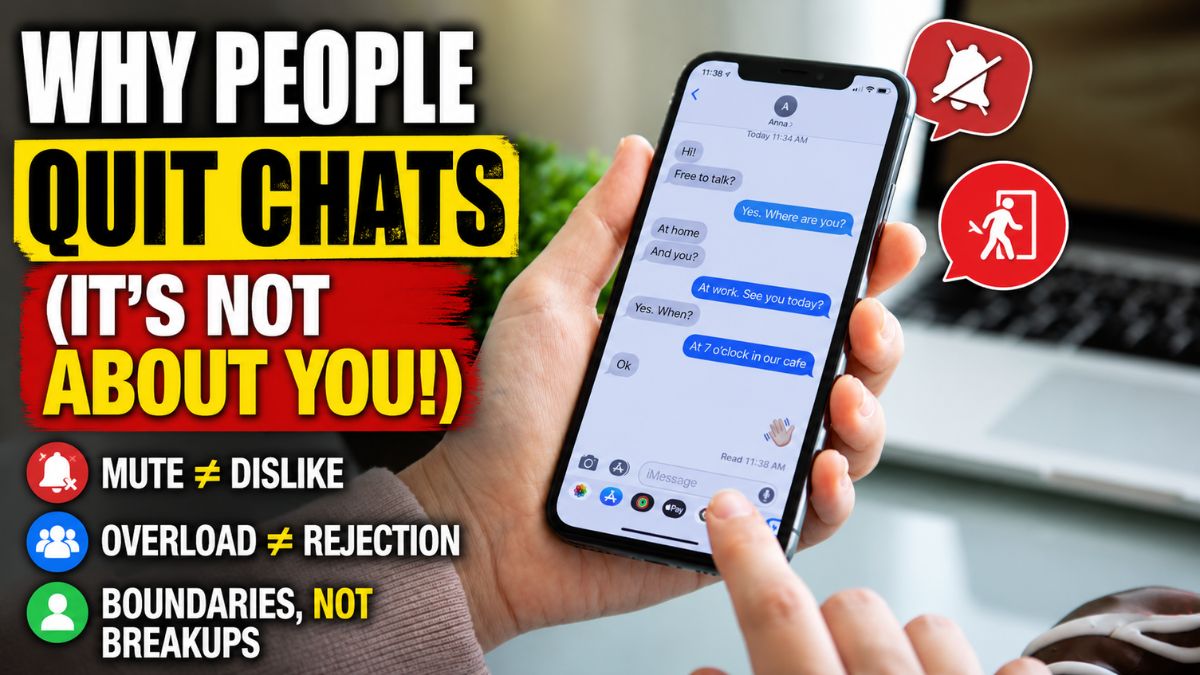
When someone quietly leaves a group chat, mutes several friends, or stops responding to a stream of messages, it is easy to interpret the behavior personally. It may look like anger, disinterest, or a desire to distance themselves from others. However, psychology suggests that digital withdrawal can have several explanations.
In an always-connected environment, messaging can become another source of cognitive and emotional demand. A person may mute a conversation because they feel overwhelmed by notifications, want fewer interruptions, or need more control over when they communicate. Research on social media fatigue has associated information overload, communication overload, social overload, and anxiety with decisions to reduce or stop using social platforms.
Quietly stepping away, therefore, does not necessarily mean someone is rejecting the people in the conversation. In some cases, it may simply reflect an attempt to manage the amount of social information reaching them.
Psychology
Group chats can make it easier to maintain relationships, organize plans, and stay connected across distances. At the same time, constant communication can create a sense that someone is expected to remain available.
Researchers Ae Ri Lee, Soo Min Son, and Kyung Kyu Kim examined social-networking fatigue through the transactional theory of stress and coping. Their work identified information overload, communication overload, and system-feature overload as factors that can contribute to fatigue.
Consider waking up to dozens of unread messages across several chats. None of the individual messages may be particularly stressful, yet the total volume creates several mental tasks: What needs a response? What did I miss? Is someone waiting for me? Muting notifications can reduce those immediate demands.
Boundaries
Muting a chat can be understood as a form of digital boundary-setting. A boundary does not necessarily mean ending a relationship. It can simply allow someone to decide when and how they want to participate.
The distinction is important. A person may not be saying, “I do not want these people in my life.” They may instead be communicating through their behavior, “I do not want every message to require my attention immediately.”
Modern messaging can make personal and social time difficult to separate. Communication overload can occur when people feel they are receiving more social input than they can comfortably manage.
Overload
Social overload describes the feeling that social demands have become excessive.
A 2022 meta-analysis covering 64 studies and more than 28,000 participants found that information overload, social overload, system-feature overload, and social-network anxiety were among important psychological factors associated with social-media fatigue. That fatigue was, in turn, associated with discontinuing social-media use.
This can help explain why some people gradually reduce their digital participation rather than openly announcing that they feel overwhelmed. They may simply begin muting notifications, checking messages less often, and leaving groups that no longer feel necessary.
Control
Perceived control is another useful way to understand the behavior. People generally prefer situations in which they feel capable of managing the demands placed on them. A constantly active group chat can create the opposite experience because information arrives regardless of whether someone is ready to process it.
Leaving the group can restore a sense of control. Muting can provide a similar benefit while keeping the person connected.
This may explain why some people choose to mute rather than leave. Muting reduces immediate stimulation without necessarily making the social separation visible. The person can still decide when to open the conversation.
Relationships
Muting a friend does not automatically indicate dislike. Relationship quality and communication frequency are not the same thing.
For example, someone may mute their closest friend during working hours because they need uninterrupted concentration. Another person may mute a family group because a high volume of messages makes it difficult to identify important information.
In these cases, the action says more about the person’s preferred communication environment than about how much they value the relationship.
Research on social media and loneliness also suggests that the relationship between digital communication and well-being is complex. Online platforms can help people maintain close connections, but the effects depend on how they are used and on the quality of the interactions.
Attention
Notifications compete for attention. Even when someone does not respond, seeing a message can create a brief mental interruption. They may wonder who sent it, what it concerns, and whether they should reply.
Over time, these interruptions can contribute to a feeling of constant digital activity.
Research on notification management has found that disabling notifications can reduce perceived distraction and improve productivity for some people. At the same time, people may experience concerns about being less responsive or less connected.
This creates a practical tension. Someone can value connection while still wanting fewer interruptions.
Coping
Quiet withdrawal can sometimes be related to avoidant coping, in which people reduce exposure to situations they perceive as stressful. However, not every instance of muting or leaving a chat represents unhealthy avoidance.
Context matters.
Muting conversations during work, sleep, study, or periods requiring concentration may simply be a way of managing attention. Repeatedly avoiding meaningful conversations whenever conflict occurs could suggest a different pattern.
The same digital behavior can therefore have different meanings depending on the circumstances surrounding it.
FOMO
There is also a possible contradiction between feeling overwhelmed by messages and worrying about missing something important.
This is where fear of missing out, commonly known as FOMO, can become relevant. Research on social-media fatigue has identified FOMO as one of the psychological factors associated with discontinuous social-media use.
Someone may therefore mute a conversation while continuing to check it manually. They want fewer constant interruptions but do not necessarily want to lose access to the group.
That behavior is different from deliberately cutting people out of their lives.
Context
A person who leaves a group chat without explanation may simply decide that the group is no longer useful. Perhaps an event has ended, the conversation has become repetitive, or they are managing too many other demands.
It is easy to interpret another person’s digital behavior as evidence of their personality or feelings. But situational factors can be equally important.
Someone who appears distant online may be tired, busy, distracted, or overwhelmed rather than uninterested in the relationship.
Meaning
People who quietly leave chats or mute friends may be doing something relatively ordinary: managing the amount of social information they receive.
For one person, the reason may be attention. For another, it may be emotional energy, work, privacy, or a preference for a quieter phone. The behavior should not automatically be interpreted as a statement about the relationship.
At the same time, persistent isolation, avoidance of meaningful relationships, or significant distress around communication can be worth examining.
But an occasional decision to step away from a busy chat does not necessarily mean someone is walking away from connection. In many cases, they may simply be trying to make digital communication easier to manage.
FAQs
Why do people mute group chats?
They may feel overwhelmed by notifications or social demands.
Does muting a friend mean dislike?
No. It can simply reflect a need for fewer interruptions.
Can chat overload cause stress?

Yes. Too much digital communication can increase mental strain.
Is leaving a group always rejection?
No. People may leave because the group no longer feels useful.
Can muting protect attention?
Yes. Fewer notifications can reduce interruptions and distraction.