
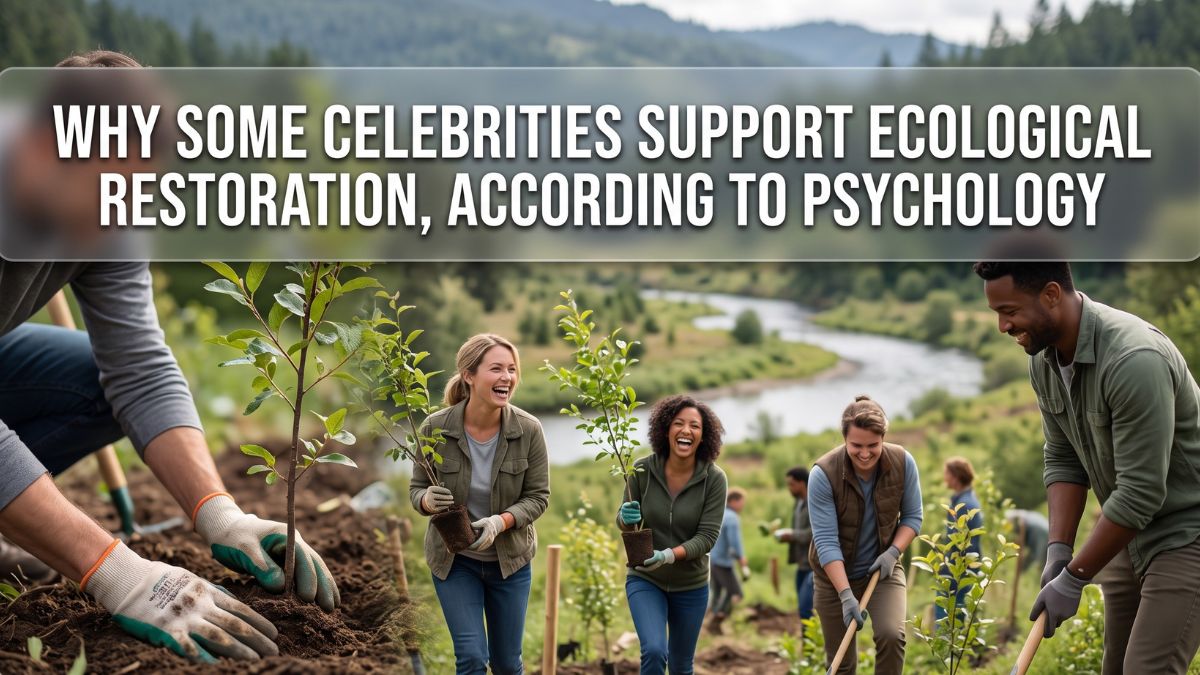
When celebrities publicly support reforestation, wildlife recovery, habitat protection or damaged ecosystem restoration, their involvement can be interpreted in several ways. It may reflect philanthropy, personal values, public advocacy or an effort to use their visibility for a cause.
Psychology suggests there can also be a deeper connection between environmental action and identity, purpose, social influence and responsibility. Ecological restoration is especially interesting because it focuses on repairing damage rather than simply protecting what remains.
That creates a clear psychological narrative: something has been harmed, and people can take part in helping it recover. For individuals whose public identities are constantly evolving, that sense of meaningful contribution may have particular appeal.
Identity
Environmental identity provides one useful explanation. Identity-based approaches to environmental behaviour suggest that people who see nature as an important part of who they are are more likely to engage in actions that support the environment.
This identity can involve feeling connected to nature or believing that protecting the natural world is part of one’s responsibilities.
For celebrities, environmental causes can become part of a broader public identity. A sustained association with conservation may gradually shape how audiences understand that person and how the celebrity understands their own role.
Leonardo DiCaprio offers a prominent example. His environmental work has included support for biodiversity, forests, oceans and ecosystem conservation. The United Nations has highlighted his involvement in conservation efforts.
In 2021, DiCaprio also announced a $43 million conservation initiative focused on restoring the Galápagos and other Pacific islands, including efforts involving Floreana Island and the reintroduction of locally extinct species.
Such long-term involvement can be viewed as more than a series of individual donations. It can become an important part of an environmental identity.
Influence
Social Identity Theory, developed by Henri Tajfel and John Turner, proposes that people partly understand themselves through their membership in social groups. Environmental researchers have used this framework to study participation in collective environmental behaviour.
Celebrities occupy an unusual position in this process because they can reach audiences far beyond the people directly involved in a particular environmental movement.
Their visibility can make environmental messages more noticeable and potentially more influential.
A 2022 field experiment examining celebrity-endorsed environmental messaging found that participants exposed to the celebrity-backed campaign used fewer single-use plastic items than participants in the control group. The study also suggested that information and celebrity endorsement can affect attitudes and behaviour in different ways.
This does not mean celebrity involvement automatically changes people’s habits. However, it indicates that the messenger can influence how an environmental message is received.
Purpose
Self-Determination Theory, associated with psychologists Edward Deci and Richard Ryan, provides another perspective.
The theory identifies autonomy, competence and relatedness as important psychological needs. Environmental work can potentially engage all three.
A person can choose to support a particular cause, develop a sense that their actions are making a difference and feel connected to a wider community or purpose.
Ecological restoration may be especially meaningful because it provides a clear goal. Restoring a wetland, replanting native vegetation or helping an endangered species recover creates a visible connection between effort and improvement.
For a celebrity accustomed to professional achievements being measured through awards, commercial success or public attention, environmental restoration can represent a different form of accomplishment.
The outcome is not necessarily a personal milestone. It is the recovery of something outside the individual.
Community
Environmental concerns can also connect with a broader sense of belonging.
Research on global identity and environmental behaviour suggests that people who identify strongly with humanity as a whole tend to show greater environmental concern and more pro-environmental behaviour. A systematic review of 30 studies found a generally positive relationship between global identity and environmental concern, with responsibility and obligation appearing among the factors that may help explain the connection.
This perspective can make ecological restoration feel larger than a single location.
A celebrity discussing a damaged forest, threatened species or recovering island can help audiences see an environmental problem as part of a shared world. The message can shift from “this ecosystem needs help” to “this is something that belongs to all of us.”
That sense of shared responsibility can support collective environmental action.
Authenticity
There is also an important qualification. Psychology cannot establish that every celebrity who supports ecological restoration is motivated by the same factors.
Personal environmental values may be important for one person, while philanthropy, professional relationships, public influence or reputation may matter more for another. Several motivations can also exist at the same time.
Perceived authenticity is particularly relevant. Research on celebrity environmental messaging has found that audiences can respond differently depending on whether a celebrity’s behaviour appears consistent with their environmental claims.
This means people may evaluate both the message and the messenger.
A public statement about conservation may attract attention, but audiences can also consider whether the person’s lifestyle and actions appear consistent with what they are advocating. Consistency can influence whether environmental communication is perceived as credible.
Restoration
Ecological restoration has a distinctive psychological message because it focuses on recovery.
Conservation often asks people to protect what still exists. Restoration adds another possibility: damaged ecosystems can sometimes be repaired, and human actions can contribute to that process.
That idea can encourage feelings of hope and agency. It also creates a narrative that is relatively easy to understand – damage, effort and recovery.
For celebrities, this can provide a way to connect personal values with a broader social purpose. Their visibility can help introduce environmental issues to audiences who might otherwise have little contact with them.
Still, psychology does not provide a single explanation for why a particular celebrity supports ecological restoration. The motivation may involve genuine environmental concern, personal identity, a desire to contribute, social responsibility, philanthropy or several of these factors together.
What psychology does show is that environmental causes can become closely connected with how people understand themselves, their communities and their sense of purpose. For some celebrities, restoring an ecosystem may therefore represent not only environmental work, but also a meaningful way to contribute to something larger than their individual careers.
FAQs
Why do celebrities support ecological restoration?
Motives can include environmental values, purpose, philanthropy and influence.
What is environmental identity?
It is seeing nature and environmental care as part of one’s identity.
Can celebrities influence environmental behaviour?
Research suggests celebrity messages can influence some environmental actions.
Why does restoration create a sense of purpose?
It connects personal action with visible efforts to repair damaged ecosystems.
Does celebrity activism always reflect genuine concern?
Not necessarily; motivations can differ and may involve several factors.