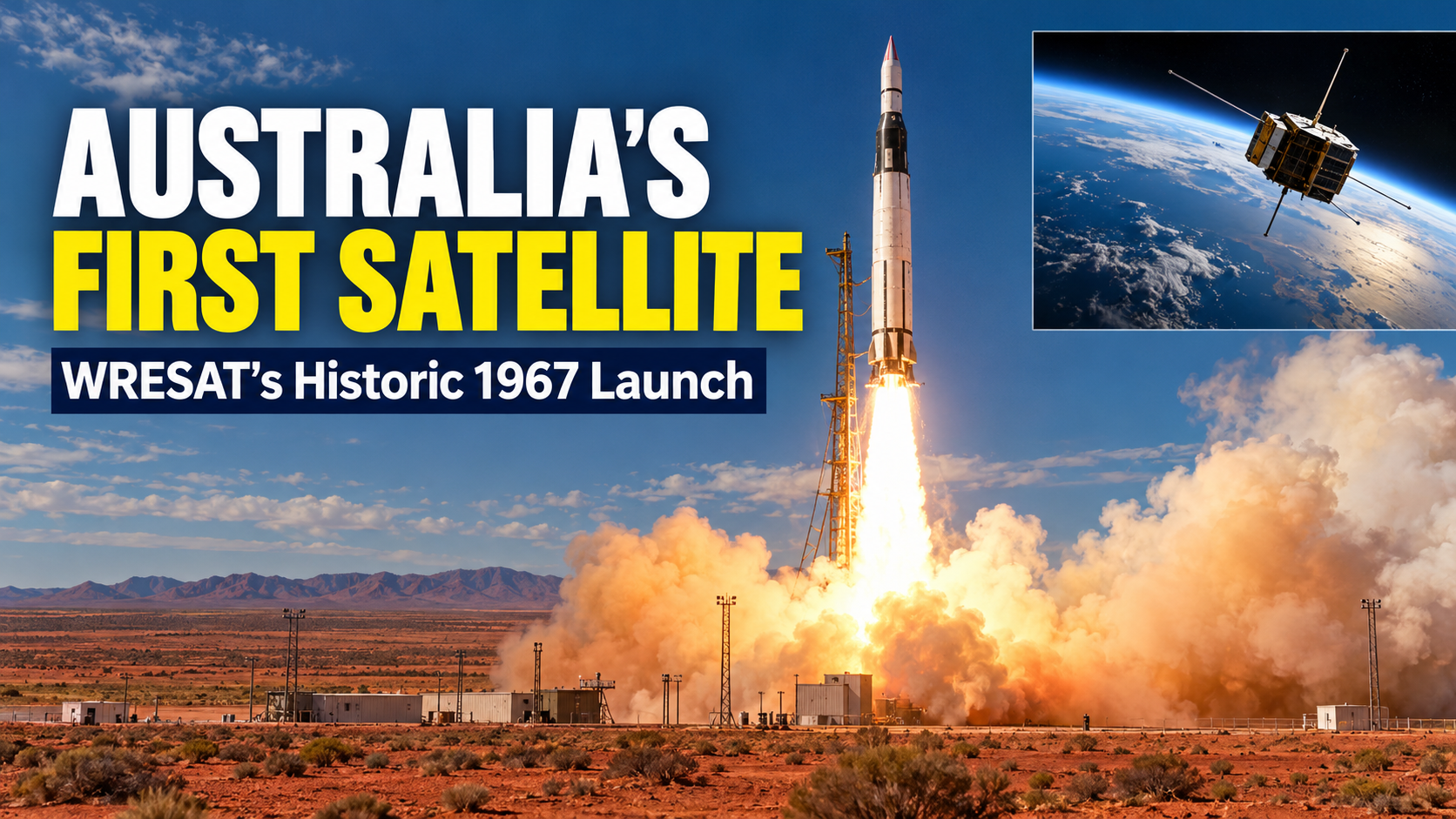
Australia made space exploration history on November 29, 1967, when it successfully launched its first satellite, WRESAT, from the Woomera Rocket Range in South Australia. What made this achievement extraordinary was that the mission used a modified American Redstone rocket that had become available through an earlier military research program.
At a time when space exploration was dominated by the United States and the Soviet Union, Australia’s successful satellite launch demonstrated that smaller nations could make meaningful contributions to space science.
The mission marked a major milestone in Australian scientific history and established the country’s early involvement in satellite technology.
What Was WRESAT, Australia’s First Satellite?
WRESAT, short for Weapons Research Establishment Satellite, was Australia’s first domestically developed satellite.
It was designed and constructed by Australian scientists and engineers associated with the Weapons Research Establishment and collaborating research organizations.
The satellite was developed primarily to conduct scientific experiments involving Earth’s upper atmosphere.
Unlike modern satellites equipped with advanced computers, cameras, and sophisticated communication systems, WRESAT was relatively simple.
The spacecraft weighed approximately 45 kilograms (99 pounds) and carried instruments designed to collect atmospheric measurements.
Despite its modest size, the satellite represented a remarkable achievement for Australia’s emerging space research community.
Its successful launch demonstrated the country’s ability to design, manufacture, and operate scientific equipment in space.
How a Surplus American Rocket Made the Mission Possible
One of the most fascinating aspects of the WRESAT mission was its launch vehicle.
Australia used a modified American Redstone rocket, originally developed as a ballistic missile and later adapted for space-related missions.
The rocket became available following the completion of a joint research program involving Australia and the United States.
Rather than allowing the available rocket hardware to go unused, Australian researchers recognized an opportunity to launch a domestically built satellite.
This decision significantly reduced the cost and complexity of developing a dedicated launch system.
The project demonstrated how existing technology could be repurposed for scientific exploration.
The Redstone rocket had already played an important role in American space history, including launching early Mercury spacecraft on suborbital missions.
For Australia, adapting the available rocket provided an opportunity to enter the space age without building an entirely new launch vehicle.
Why Woomera Was Chosen for Australia’s Historic Launch
The Woomera Rocket Range in South Australia played a central role in the WRESAT mission.
Established in the 1940s, Woomera became an important testing location for military rockets, missiles, and experimental aerospace technologies.
Its remote desert location provided substantial advantages for rocket launches.
The surrounding region had a relatively low population density, reducing risks associated with falling rocket components.
Woomera also offered extensive testing infrastructure and technical expertise developed through years of international defense research.
These facilities made it possible for Australian scientists and engineers to prepare and launch WRESAT within a relatively short development period.
On November 29, 1967, the modified Redstone rocket successfully carried WRESAT into orbit.
The launch established Australia as the third country to launch a satellite into orbit from its own territory using a launch vehicle, following the Soviet Union and the United States.
This distinction is separate from being the third country to build a satellite, as other nations had already developed spacecraft launched aboard foreign rockets.
What Scientific Experiments Did WRESAT Conduct?
WRESAT was primarily designed to study Earth’s upper atmosphere.
Its instruments collected information about atmospheric conditions at altitudes beyond the reach of conventional aircraft.
Scientists were particularly interested in understanding atmospheric composition and related environmental characteristics.
These measurements could contribute to research involving satellite operations, atmospheric physics, and the behavior of spacecraft in low Earth orbit.
Although the satellite’s operational lifetime was short, it successfully transmitted scientific information during its mission.
WRESAT remained in orbit for approximately six weeks before reentering Earth’s atmosphere in January 1968.
Its relatively brief lifetime did not diminish the mission’s historical significance.
The project proved that Australian scientists could develop and operate a satellite capable of conducting experiments in space.
How WRESAT Changed Australia’s Space History
WRESAT demonstrated that Australia possessed considerable scientific and engineering expertise during the early space age.
The mission involved cooperation among researchers, engineers, defense organizations, and international partners.
It also highlighted the importance of existing launch infrastructure and international technological collaboration.
However, the successful launch did not immediately lead to a continuous Australian satellite-launch program.
During the following decades, Australia’s involvement in space activities increasingly focused on ground stations, communications, research, and supporting international missions.
Australian facilities played important roles in NASA’s space exploration efforts, including tracking and communications during the Apollo program.
WRESAT nevertheless remained a powerful symbol of Australia’s early technological capabilities.
The mission showed that relatively small research teams could accomplish ambitious objectives when provided with appropriate resources and infrastructure.
Australia’s Modern Space Industry Builds on the WRESAT Legacy
More than half a century after WRESAT’s launch, Australia has renewed its focus on developing a domestic space industry.
The Australian Space Agency, established in 2018, supports the growth of the country’s civil space sector.
Modern Australian space initiatives include satellite manufacturing, Earth observation, communications technology, robotics, and launch services.
Private companies and research institutions are also exploring opportunities to develop new spacecraft and launch capabilities.
These activities reflect growing international demand for satellite-based services.
Earth observation satellites, for example, can support agriculture, disaster management, environmental monitoring, and climate research.
Although today’s space technologies are considerably more advanced than those available in 1967, WRESAT remains an important part of Australia’s scientific heritage.
Its success demonstrated the value of innovation, collaboration, and making effective use of available technology.
Why the WRESAT Mission Still Matters Today
The WRESAT story offers several important lessons for modern space exploration.
First, technological innovation does not always require entirely new systems.
By adapting an existing rocket, Australian engineers achieved an important scientific objective without developing a launch vehicle from scratch.
Second, international cooperation can create opportunities for countries seeking to establish space capabilities.
Finally, the mission demonstrated how scientific ambition can produce significant achievements even with limited resources.
As more nations and private companies enter the global space industry, WRESAT provides an early example of practical, resourceful space engineering.
Australia’s first satellite may have operated for only a short period, but its impact on the country’s scientific identity has lasted for decades.
The successful launch of WRESAT from Woomera on November 29, 1967, remains one of Australia’s most important achievements in aerospace history.
Using a modified surplus American rocket, Australian scientists placed a domestically developed satellite into orbit and demonstrated their ability to participate in the rapidly expanding space age.
Today, as Australia develops new space technologies and commercial opportunities, WRESAT serves as a reminder that groundbreaking achievements often begin with creative solutions and determined researchers.
Frequently Asked Questions (FAQs)
1. What was WRESAT?
WRESAT, or Weapons Research Establishment Satellite, was Australia’s first satellite. It was launched in 1967 to conduct scientific experiments involving Earth’s upper atmosphere.
2. When was WRESAT launched?
WRESAT was successfully launched on November 29, 1967, from the Woomera Rocket Range in South Australia.
3. Which rocket launched WRESAT?
WRESAT was launched using a modified American Redstone rocket that became available following an earlier research program.
4. How much did WRESAT weigh?
The satellite weighed approximately 45 kilograms, or 99 pounds.
5. How long did WRESAT remain in space?
WRESAT remained in orbit for approximately six weeks before reentering Earth’s atmosphere in January 1968.
6. Why was WRESAT important to Australia?
WRESAT demonstrated Australia’s ability to develop a scientific satellite and launch it into orbit from its own territory, establishing an important milestone in the country’s space history.
7. What is the significance of the Woomera Rocket Range?
Woomera served as a major rocket and missile testing facility and provided the infrastructure needed for Australia’s historic first satellite launch.