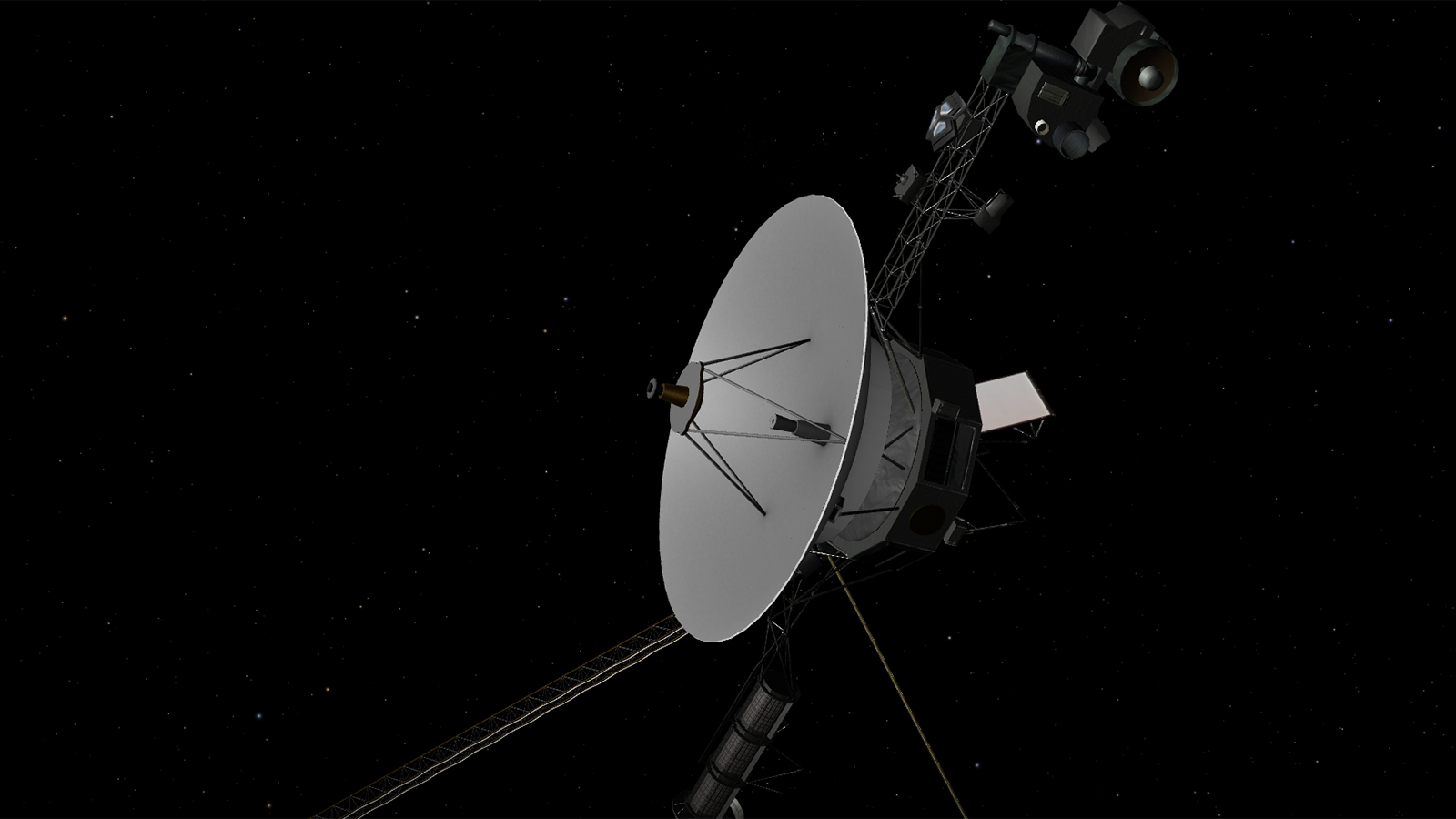
NASA’s Voyager 2 spacecraft has spent nearly five decades exploring the mysteries of our solar system and beyond. Now, as the legendary spacecraft travels through interstellar space, scientists face a growing challenge: keeping its scientific instruments operating with an increasingly limited power supply.
Launched in 1977, Voyager 2 has traveled billions of miles from Earth, becoming one of humanity’s most remarkable achievements in space exploration. However, its nuclear power source gradually weakens each year, losing approximately 4 watts of electrical power annually.
With only a small amount of electricity available for scientific operations, NASA engineers must make difficult decisions about which instruments can continue collecting valuable information about the space between stars.
Why Is NASA’s Voyager 2 Running Out of Power?
Unlike modern spacecraft that rely on solar panels, Voyager 2 operates using radioisotope thermoelectric generators (RTGs). These generators convert heat produced by the natural radioactive decay of plutonium-238 into electricity.
This technology has allowed Voyager 2 to operate far beyond the reach of practical solar power. However, radioactive decay and the gradual degradation of its power-conversion components mean that the spacecraft produces less electricity every year.
According to NASA, the Voyager spacecraft lose approximately 4 watts of electrical power annually.
Although this reduction might seem insignificant compared with the electricity consumed by everyday household appliances, every watt matters aboard a spacecraft operating billions of miles from Earth.
NASA engineers have already implemented several strategies to conserve energy, including shutting down nonessential systems and scientific instruments.
Why Nearly 10 Watts Matter for Voyager 2
For a spacecraft launched almost 50 years ago, even 10 watts represents a significant amount of electrical power.
Voyager 2’s scientific instruments operate under extremely strict energy limitations. Each instrument requires electricity to collect measurements, process information, and transmit scientific data back to Earth.
As the spacecraft’s power supply continues declining, NASA must carefully balance the energy requirements of its instruments against the electricity needed to keep essential spacecraft systems functioning.
The challenge is particularly difficult because Voyager 2 is operating in an environment that scientists have only recently begun exploring directly.
Losing even one instrument could reduce the amount of information researchers receive about interstellar space.
Consequently, NASA’s mission team continuously evaluates power consumption and identifies opportunities to extend the spacecraft’s scientific lifetime.
Which Scientific Instruments Are Still Operating?
Voyager 2 originally carried 10 scientific instruments designed to investigate planets, moons, magnetic fields, charged particles, and other features of the outer solar system.
Over the decades, NASA has gradually switched off instruments that were no longer essential to the spacecraft’s changing mission.
In October 2024, NASA turned off Voyager 2’s plasma science instrument to conserve electricity.
The spacecraft subsequently continued operating three scientific instruments:
1. Magnetometer: This instrument measures magnetic fields in interstellar space, helping researchers understand how magnetic environments change beyond the Sun’s influence.
2. Cosmic Ray Subsystem: It detects energetic particles traveling through space, providing information about cosmic radiation and its interaction with the surrounding environment.
3. Plasma Wave Subsystem: This instrument detects plasma waves, allowing scientists to investigate the density and characteristics of charged particles in interstellar space.
Together, these instruments provide valuable observations from a region that remains largely unexplored.
However, their continued operation depends on the spacecraft’s diminishing electrical power.
How Voyager 2 Changed Our Understanding of Space
Voyager 2 is one of the most successful robotic exploration missions in history.
Launched on August 20, 1977, it became the only spacecraft to visit all four giant planets of our solar system: Jupiter, Saturn, Uranus, and Neptune.
During these encounters, Voyager 2 revealed extraordinary details about planetary atmospheres, magnetic fields, rings, and moons.
Its 1986 flyby of Uranus provided humanity’s first close-up observations of the distant ice giant.
Three years later, Voyager 2 reached Neptune, discovering important details about its atmosphere, storms, and moon Triton.
In November 2018, NASA confirmed that Voyager 2 had entered interstellar space after crossing the heliopause, the boundary where the solar wind gives way to the interstellar environment.
This achievement made Voyager 2 the second human-made spacecraft to reach interstellar space, following Voyager 1.
Importantly, entering interstellar space does not mean Voyager 2 has completely left the solar system. The distant Oort Cloud, a vast region of icy objects gravitationally associated with the Sun, extends much farther.
Can NASA Keep Voyager 2 Operating Beyond 2030?
NASA engineers have developed creative techniques to extend the operational lives of both Voyager spacecraft.
These measures include adjusting onboard electrical systems, carefully managing heaters, and turning off instruments when necessary.
In 2023, NASA also began using a small reserve of power previously allocated to a voltage-regulation safety mechanism.
This decision allowed the mission team to delay shutting down additional scientific equipment.
Nevertheless, Voyager 2 cannot operate indefinitely.
Its electrical output will continue decreasing, and additional scientific instruments may eventually need to be switched off.
NASA has previously expressed hope that at least some scientific operations could continue into the 2030s, although the actual timeline depends on spacecraft health and available power.
Even after scientific operations end, Voyager 2 will continue traveling through space.
Why Voyager 2 Still Matters to Scientists
Voyager 2’s importance extends far beyond its historic planetary discoveries.
Most spacecraft study environments within the Sun’s protective magnetic bubble, known as the heliosphere.
Voyager 2, however, provides direct measurements from outside this region.
Its observations help researchers understand cosmic rays, interstellar magnetic fields, and the interaction between our solar system and the surrounding galaxy.
These findings also contribute to broader scientific questions about how stars interact with their galactic environments.
Because no newer spacecraft has reached Voyager 2’s location, its remaining scientific measurements are exceptionally valuable.
Every additional year of operation provides researchers with information that cannot easily be obtained elsewhere.
What Will Happen When Voyager 2 Finally Goes Silent?
Eventually, Voyager 2 will no longer generate enough electricity to maintain communication with Earth.
When that happens, the spacecraft will continue its journey through the Milky Way without receiving commands or transmitting scientific information.
However, it will carry an extraordinary reminder of its origins.
Voyager 2 contains a Golden Record featuring sounds, music, images, and greetings representing life on Earth.
Created as a message for any potential extraterrestrial civilization that might encounter the spacecraft, the record symbolizes humanity’s curiosity and desire to explore the universe.
Even when Voyager 2’s instruments stop functioning, its journey will continue for thousands, millions, and potentially billions of years.
NASA’s Voyager 2 mission demonstrates how extraordinary scientific achievements can emerge from technology developed nearly half a century ago. Although its declining power supply presents unavoidable challenges, the spacecraft continues contributing to our understanding of interstellar space.
With only a few scientific instruments remaining operational, every watt of electricity has become increasingly precious. Regardless of when its final transmission reaches Earth, Voyager 2 has already secured its place among humanity’s greatest space exploration achievements.