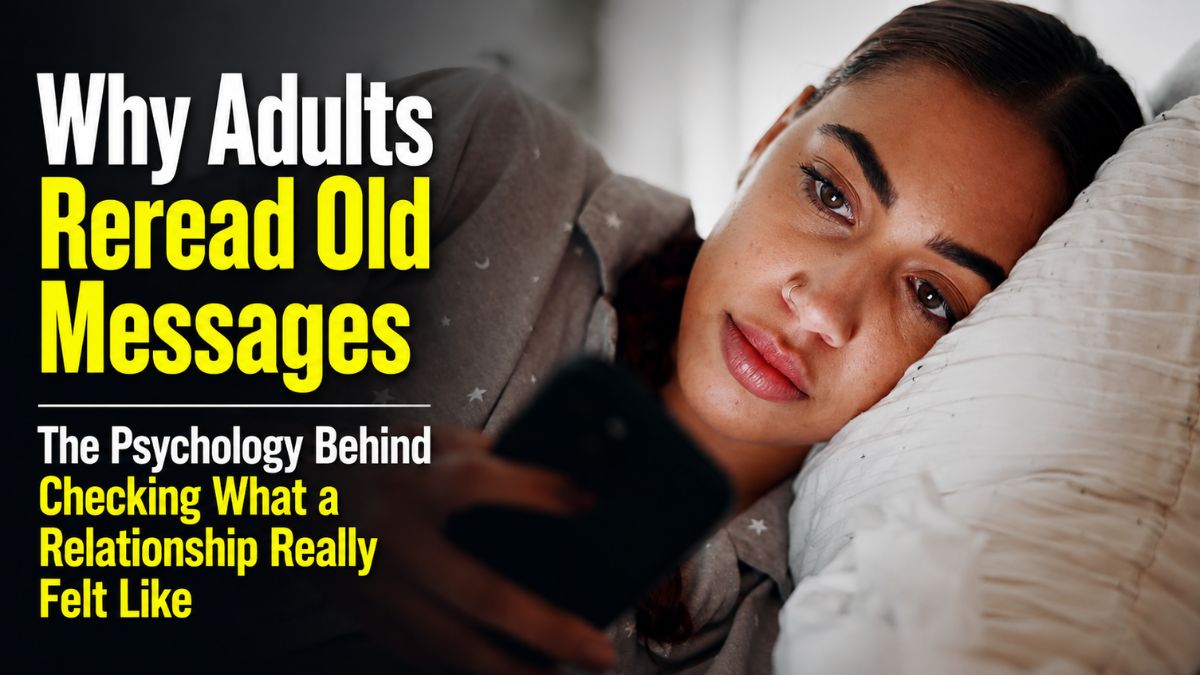
Old emails, text threads, birthday messages and other digital conversations can remain searchable for years. Unlike handwritten letters stored in a box, these records can be retrieved within seconds.
Sometimes people return to them simply because they feel nostalgic. At other times, the rereading appears more deliberate. They compare what they remember about a relationship with what was actually written, perhaps wondering whether the warmth they recall was present at the time or was strengthened by later memories.
Rereading old correspondence alone does not show that someone is stuck in the past. Research on constructive memory and digital remembering offers another possibility: people sometimes use external records to supplement, check or reconstruct autobiographical memories. The evidence does not establish that every person rereading an old message is evaluating past affection, but it makes that interpretation psychologically plausible.
Memory
A central finding in memory research is that episodic memory is constructive rather than a literal recording of an event.
In a 2007 review, psychologists Daniel Schacter and Donna Rose Addis described episodic memory as a constructive process that can produce errors and distortions while still functioning normally.
Remembering an experience involves bringing together details, meanings and impressions. The result can feel like playback, even though the memory has been reconstructed.
This matters when people remember the emotional character of a relationship. Someone who currently feels close to a parent may more easily recall warm experiences. Someone whose relationship has become strained may have easier access to difficult moments.
Neither person has to be deliberately changing the past. The emphasis of memory can shift naturally.
Digital correspondence provides something different. It is incomplete, but the words and dates that remain are relatively stable. That makes an old message potentially useful when someone wants to compare their current recollection with an external record.
Records
A 2025 think-aloud study led by Fabian Hutmacher examined how people reconstruct autobiographical memories using digital information.
The researchers asked 41 participants to reconstruct an important day and a random day from approximately one year earlier. Participants could consult resources available to them, including photographs, calendars, emails and instant messages.
Participants repeatedly moved between their own memories and external information. Some consulted records because they could not remember an event clearly. Others wanted additional details. Some already had a detailed recollection but wanted to check whether it was accurate.
The study did not examine old relationships or ask participants whether they were searching for evidence of affection. Therefore, it cannot establish that people reread old messages specifically to evaluate emotional warmth.
It does, however, demonstrate an underlying behavior that is relevant: people use digital records to reconstruct and verify autobiographical memories.
That provides a reasonable explanation for why someone might revisit an old conversation. They may not be trying to relive the past. They may be comparing a remembered relationship with a record created while that relationship was unfolding.
Audit
Consider someone opening an email thread from ten years ago.
Did a friend really check in during a difficult period? Was a parent affectionate in their messages? Did a friendship contain the ease and warmth that everyone remembers?
These questions differ somewhat from ordinary nostalgia.
Nostalgia can emphasize the emotional significance of the past without requiring precise factual reconstruction. Remembering a warm evening with an old friend is not the same as retrieving an untouched file from storage.
An old message can therefore act as a kind of reality check. It may confirm a remembered experience, complicate it or reveal details that memory has gradually changed.
The record cannot reproduce the entire relationship, but it can provide another perspective on what happened.
Evidence
Digital archives can provide evidence, but they are incomplete records of relationships.
Messages preserve words, dates and sometimes photographs. They usually do not preserve physical presence, facial expressions, voice, timing or the practical acts that may have communicated care.
Research by Amit Kumar and Nicholas Epley illustrates why this distinction matters. Across eight experiments involving small acts of kindness, people who performed those acts underestimated how positively recipients would respond. Recipients were influenced not only by the practical value of the action but also by the warmth they believed it communicated.
The study did not investigate archived messages, so its relevance is limited. Still, it illustrates an important point about communication: the emotional meaning of an interaction can extend beyond the literal content of the words.
A birthday message that appears brief years later may have felt meaningful when it arrived. A message that now seems routine may have been accompanied by context that the archive no longer contains.
The person rereading the message sees the surviving text. The person who originally received it experienced that text alongside everything else happening at the time.
Those are different records.
Hindsight
Knowledge of how a relationship ended can also influence how earlier events are interpreted.
Psychologist Mark Travers has discussed research involving 515 adults who evaluated a fictional relationship. Participants were told either that the relationship continued or that it ended. Those told about the breakup rated the relationship more negatively and considered the outcome more predictable.
The experiment concerned a fictional couple rather than participants’ own relationships, so it cannot directly establish how people remember their personal histories.
It does demonstrate a broader psychological principle: knowledge of an outcome can influence judgments about what came before it.
After a friendship ends, earlier interactions may therefore be interpreted differently. Warm moments can appear less meaningful when viewed through the lens of the ending, while warning signs may seem more obvious than they were at the time.
Rereading old messages can provide a way to test that retrospective interpretation.
Sometimes the record supports the current view. The affection may have been more limited than remembered. In other cases, the messages may show that genuine warmth existed even though the relationship later changed.
Attachment
Uncertainty about whether affection was mutual can also affect what people notice and remember.
Psychologist Hal Shorey has discussed connections between attachment patterns, current emotions and memory, including the possibility that a person’s present emotional state can make similarly toned memories easier to access.
That does not mean rereading old messages reveals someone’s attachment style. An isolated behavior cannot establish a person’s psychological history or relationship pattern.
The narrower point is more useful. Someone who has experienced uncertainty about whether affection was mutual may find an old written record appealing because it provides something relatively stable.
The message cannot prove the entire relationship. It can, however, offer a piece of evidence that is less dependent on how the person feels today.
Interpretation
Even when a message was originally received, its emotional meaning may not have been completely clear.
People interpret words through timing, punctuation, context and assumptions about the sender’s intentions. Those interpretations can change later as circumstances change.
Research discussed by psychologist Susan Krauss Whitbourne on hindsight bias in judgments of emotional expressions provides another relevant example. In five experiments involving computer-generated faces, participants later overestimated how quickly they had correctly identified negative emotions. The same pattern was not consistently found for happiness.
The research did not involve text messages or established relationships. It does, however, demonstrate that later knowledge can affect how people remember their earlier emotional judgments.
An old message can therefore go through several layers of interpretation. The recipient interpreted it when it arrived, remembered that interpretation over time and then interprets it again when rereading it years later.
The latest interpretation can feel definitive without necessarily being complete.
Meaning
Rereading old correspondence does not, by itself, indicate that someone is unable to move forward.
People may revisit old messages for nostalgia, practical information, curiosity or ordinary autobiographical remembering. Some may also be trying to resolve uncertainty about what a relationship meant.
Research supports several components of that possibility. Memory is constructive. People use external digital records to check and reconstruct memories. Knowledge of later outcomes can also influence how earlier experiences are evaluated.
What research does not establish is that adults who reread old messages share one psychological motive.
The same behavior can serve different purposes for different people. It can even serve different purposes for the same person at different times.
Archive
Digital archives also have significant limitations.
Messages survive unevenly. Accounts disappear, phones are replaced, platforms shut down and conversations may be deleted. Some relationships communicate primarily through writing, while others express affection through presence, actions and shared experiences.
A sparse archive therefore does not necessarily indicate a sparse relationship.
Likewise, a long message history does not automatically establish emotional closeness. The record is evidence, but it is not the entire relationship.
This is why rereading should not be treated as a simple forensic exercise in which every sentence proves or disproves affection.
Clarity
If an old record confirms the warmth someone remembers, that evidence can matter. A message written in the other person’s own words may restore confidence in an experience that later distance has made uncertain.
If the record appears colder than memory, the conclusion requires more caution. The archive may have preserved practical exchanges while leaving out tone, timing and everyday acts of care.
The more useful question may not be whether the archive contains the complete truth. It cannot. Instead, the question may be why this particular uncertainty needs to be checked now.
Sometimes rereading the past provides comfort. Sometimes it helps correct an inaccurate memory. Sometimes it complicates a story that had become too simple.
The important distinction is not how far someone scrolls. It is what the rereading does afterward. If it helps place an old relationship in a clearer context, the archive can be useful. If it repeatedly postpones attention to the present, the same habit may be serving a different purpose.
FAQs
Why do people reread old messages?
They may seek nostalgia, details, confirmation, or clarity about the past.
Does rereading mean someone is stuck?
No. Rereading can be a normal form of autobiographical remembering.
Can messages confirm memories?

Yes. Digital records can help people check and reconstruct memories.
Are old messages proof of affection?
No. They provide evidence but cannot capture an entire relationship.
Can hindsight change relationship memories?
Yes. Later outcomes can influence how earlier events are interpreted.