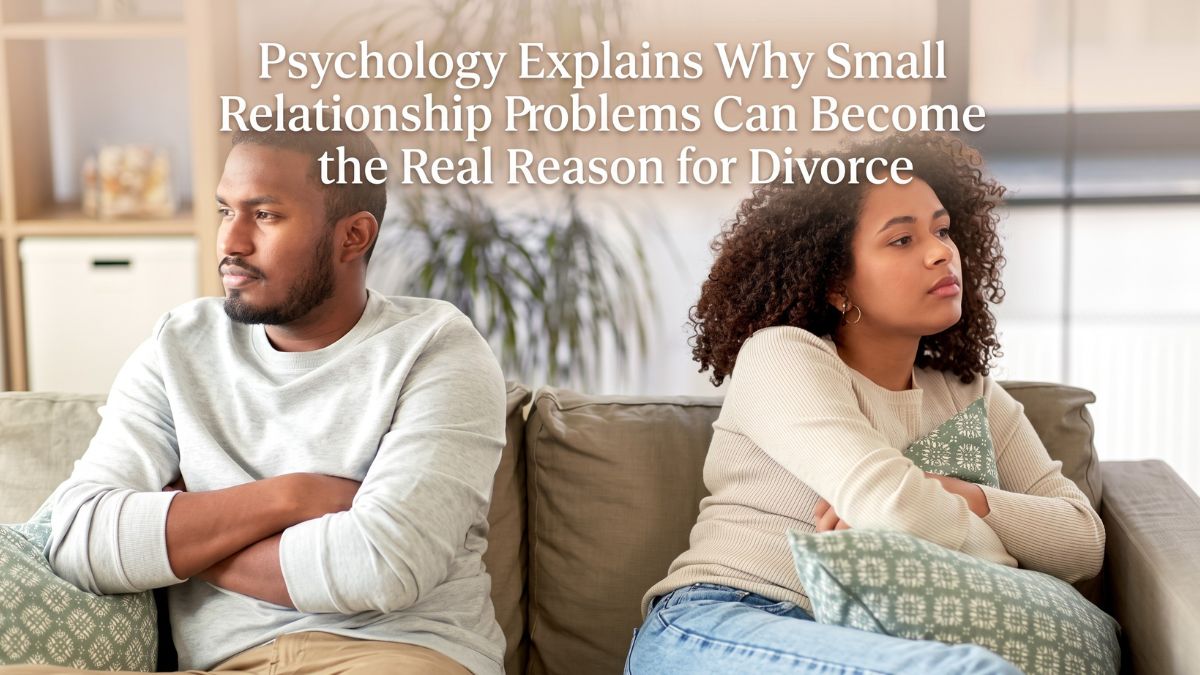
Divorce rarely comes down to one forgotten bill, one argument over dishes, or one disagreement about money. More often, these seemingly minor conflicts become the visible crack in a relationship that has already been under pressure for months or years. Unspoken resentment, unmet emotional needs, repeated misunderstandings, and unresolved arguments can gradually weaken a couple’s connection.
That is also where the question of forgiveness becomes interesting. Are younger generations genuinely less forgiving, or are they simply less willing to tolerate patterns that previous generations may have accepted?
According to Neha Cadabam, Senior Psychologist and Executive Director of Cadabam’s Hospitals, a minor disagreement is usually not the true cause of divorce. Instead, it can become the tipping point after prolonged emotional distress, communication problems, and unmet expectations.
When couples repeatedly fight about household chores, spending, routines, or responsibilities, the surface argument may hide a deeper feeling of being ignored or undervalued. Eventually, a small incident can feel like the final drop in an already overflowing glass.
Smitha Kashi, Consultant Art Therapist and Counsellor at Spandana Healthcare, similarly explains that a seemingly insignificant issue can expose relationship patterns that have remained unresolved. Arguments about finances or daily routines may actually represent deeper differences in emotional needs, expectations, communication styles, or ideas about marriage.
Modern Forgiveness
So, are younger people less forgiving?
Not necessarily. The bigger change may be in what they expect from a relationship.
Cadabam points out that younger generations increasingly view emotional fulfilment and psychological safety as essential parts of a healthy relationship rather than optional extras. Greater awareness of mental health has also made people more likely to identify unhealthy relationship dynamics earlier.
Kashi describes this as a shift in evaluation rather than simply a decline in patience. Younger adults often place greater importance on emotional compatibility, mutual respect, and personal wellbeing. They may forgive an honest mistake while being less prepared to repeatedly overlook behaviour that damages trust or emotional security.
That distinction matters. Forgiveness does not necessarily mean accepting the same hurt repeatedly. A person can forgive a mistake while still deciding that a recurring pattern is unacceptable.
Changing Expectations
Relationships have changed alongside society. Financial independence, particularly among women, has made it easier for some people to leave relationships that they consider unhealthy or emotionally damaging.
Social media has also complicated expectations. Couples are constantly exposed to carefully curated images of apparently perfect relationships. When everyday marriage inevitably looks messier, comparisons can make normal relationship difficulties feel like evidence that something is fundamentally wrong.
Dating apps and online interactions can create another psychological effect: the sense that alternatives are always available. If one relationship feels difficult, it may be easier to imagine finding someone more compatible elsewhere.
Research examining relationship evolution among millennials and Gen Z has also highlighted the importance these generations place on compatibility and self-expression, compared with some more traditional ideas of obligation.
Less Stigma
Perhaps one of the biggest changes is that separation and divorce are no longer viewed with the same level of social stigma in many communities.
Kashi notes that society has become more accepting of divorce, making separation a more realistic option for people who previously might have stayed because of social pressure alone.
Marriage is increasingly expected to provide emotional support, mutual growth, respect, and companionship. When those elements disappear, leaving may no longer be automatically viewed as failure.
But that does not mean younger people have stopped valuing commitment.
Cadabam cautions against interpreting increasing divorce as simply a decline in commitment. In some cases, it may instead reflect a greater willingness to acknowledge emotional distress and make difficult decisions rather than quietly endure an unhealthy relationship.
The Real Issue
The interesting question, then, may not be whether younger generations have become less forgiving. It may be whether they have become more selective about what deserves forgiveness.
A forgotten chore can be forgiven. A single disagreement about money can be resolved. But when the same problem keeps returning without accountability or meaningful change, the issue is no longer the forgotten chore or unpaid bill. It becomes a pattern.
Think of resentment like dust accumulating in a room. One speck is insignificant. But when nobody cleans it for years, the entire space eventually feels different.
Healthy relationships do not require couples to avoid every small conflict. They require them to notice what those conflicts are really saying. Sometimes the argument is about the dishes. Sometimes it is about feeling unseen.
For younger couples, the growing emphasis on emotional wellbeing may therefore represent less forgiveness, but it can also represent clearer boundaries. The challenge is finding the balance between knowing when to repair, when to forgive, and when a repeated pattern has become too damaging to continue.
FAQs
Can small issues cause divorce?
They can trigger divorce after deeper problems remain unresolved.
Are younger couples less forgiving?
Not always; many simply have different relationship expectations.
Why do small fights feel bigger?
They can reflect deeper problems with trust, respect, or communication.
Has divorce stigma decreased?
Yes, divorce is more socially accepted in many communities today.
Does forgiveness mean staying?
No, forgiveness does not require accepting repeated harmful behaviour.