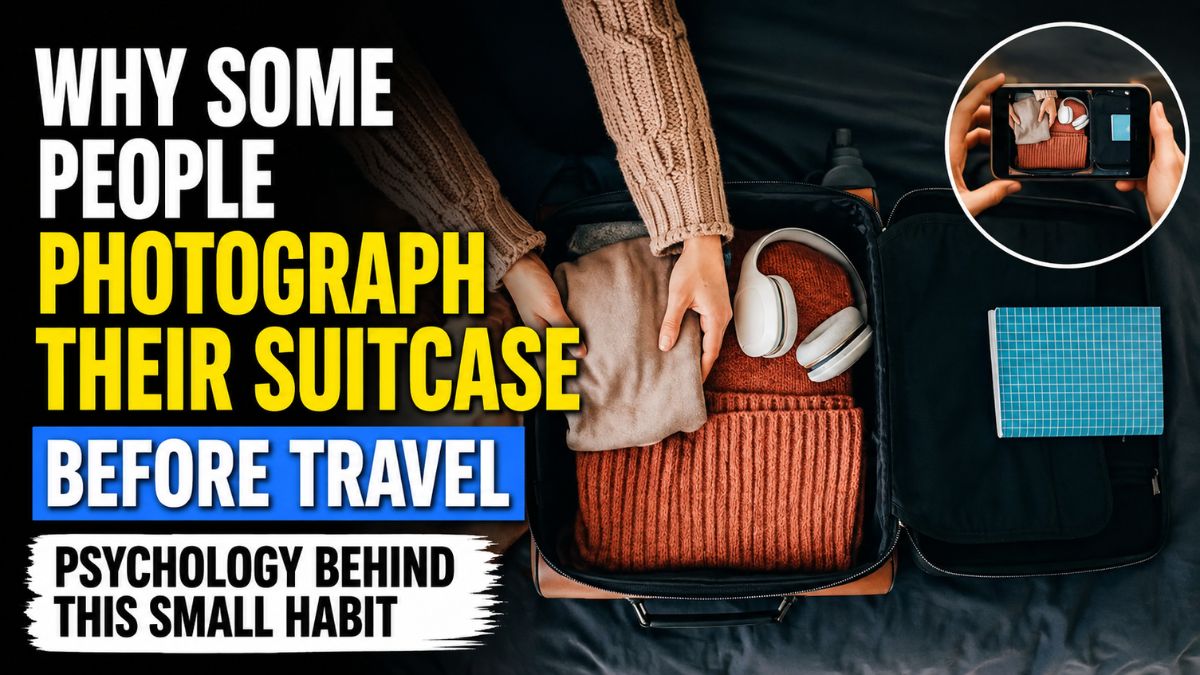
Before leaving for a trip, some travelers take one final photograph of their packed suitcase. The image might show neatly arranged clothes, travel documents or other items inside the luggage. Then the suitcase is closed, the phone goes into a pocket and the journey begins.
At first glance, this looks like an ordinary travel habit. But psychology offers another way to understand it. A photograph can act as an external memory cue, giving a person a record they can consult if uncertainty appears later.
Research on prospective memory, cognitive offloading and metacognition suggests that people regularly use external tools to reduce the demands placed on their memory. A suitcase photograph can therefore be more than a record of packed belongings. It can also provide a simple signal that says, “I checked this, and I have a record.”
Memory
Human memory is useful, but it is not a perfect storage system. People routinely rely on calendars, reminders, written notes and alarms to keep track of information they do not want to forget.
Psychologists describe some of these behaviors as cognitive offloading or intention offloading. Research by psychologists including Evan Risko and Sam Gilbert has examined how people use external tools and changes in their environment to reduce the mental demands associated with remembering.
A photograph can serve a similar function.
Imagine someone packing for an early-morning flight. They finish arranging the suitcase and take a photograph before closing it. Later, while traveling to the airport, they suddenly wonder, “Did I pack my passport?”
Instead of trying to reconstruct the scene from memory, they can consult the photograph.
The phone has become an external memory aid.
Cues
Another relevant concept is prospective memory, which involves remembering to perform an intended action in the future.
Travel creates plenty of prospective-memory demands. A person may need to remember to pack medication, charge electronic devices, bring identification, take travel documents and eventually collect their luggage.
A photograph does not necessarily remind the traveler to perform all these actions. Instead, it can preserve information about what has already happened.
For example, a person might photograph an open suitcase after packing. If uncertainty appears later, the photograph provides a retrieval cue showing what was inside at that moment.
This can make the memory easier to access than a vague mental image.
Offloading
Cognitive offloading is particularly relevant because external records reduce the amount of information a person has to retain internally.
A 2025 review in Nature Reviews Psychology examined how people use external representations to reduce demands on internal memory. Writing something down is a simple example. Once information has been recorded, the person does not have to rely entirely on their memory to retrieve it.
A luggage photograph works in much the same way.
Instead of remembering exactly where each item was placed, the traveler creates a visual record that can be inspected later. This can be useful when several similar objects are involved.
Someone might not clearly remember whether a charging cable was placed in the suitcase or left on a desk. A photograph could provide a much more direct answer.
Reassurance
There is also a connection with metacognition, which refers to how people think about and evaluate their own mental processes.
Memory accuracy and confidence in memory are not always the same thing. A person can remember something correctly while still feeling uncertain about whether the memory is reliable.
This distinction is relevant to checking behavior. Research on repeated checking has found that repeated checks can reduce people’s confidence in their memories, even when their actual memory accuracy changes much less.
A photograph offers a different approach. Rather than repeatedly reopening the suitcase, the traveler creates a stable record that can be reviewed if necessary.
That can make the reassurance more efficient.
Retrieval
External cues can also help people retrieve information when they need it.
Consider a traveler sitting at an airport who suddenly thinks, “Did I pack my travel adapter?” Knowing that a photograph exists may immediately reduce some uncertainty. If necessary, the traveler can open the image and inspect the suitcase.
The photograph therefore acts as a kind of backup for memory.
Interestingly, the traveler may never actually look at the image. Simply knowing that the record exists can make the original memory feel more secure.
This is one reason external memory tools have become so common in everyday life. People do not necessarily use them because their memory is poor. They use them because external records are convenient.
Control
Travel often involves circumstances that cannot be controlled. Flights can be delayed, traffic can change and weather can disrupt plans.
Packing is one part of the process where travelers have considerably more control.
Taking a photograph can become part of a broader preparation routine. The traveler packs, checks the contents, documents them and then leaves with a record available on their phone.
For someone traveling for an important meeting, this may be particularly useful. A photograph of clothing, documents, chargers and other essentials gives them something concrete to consult if doubt appears.
The photograph does not guarantee that nothing was forgotten. But it can make the preparation process feel more organized.
Planning
Psychologist Peter Gollwitzer’s research on implementation intentions provides another useful perspective.
Implementation intentions involve creating an “if-then” plan that connects a particular situation with a specific action. Research has found that this type of planning can improve people’s ability to remember future intentions.
A traveler might develop a simple routine: “When I finish packing, I will photograph the suitcase.”
Over time, the sequence can become automatic. Packing is followed by photographing, and the photograph itself can become a signal that the preparation stage has been completed.
This does not require the person to be unusually anxious or concerned. It can simply be an efficient routine developed through repetition.
Anxiety
Taking a photograph of luggage should not automatically be interpreted as a sign of anxiety or obsessive-compulsive disorder.
There are many practical reasons someone might photograph their suitcase. They may want a visual record of their belongings, remember how items were arranged or document valuable possessions.
The psychological meaning depends on the wider pattern.
If the photograph is simply a convenient backup, it can be understood as an ordinary example of cognitive offloading. If someone feels unable to leave without repeatedly photographing, opening and checking their luggage, the behavior may be serving a stronger reassurance function.
One habit alone cannot establish a psychological diagnosis.
Backup
Photographing a suitcase before a journey illustrates a broader feature of human memory: people often use their surroundings and technology to support what their minds have to remember.
The traveler takes something that normally exists as a mental representation – “what I packed” – and turns it into an external visual record.
That image can function as a memory cue, retrieval aid and source of reassurance. It does not necessarily mean the traveler is anxious or forgetful. In many cases, it may simply be a practical way of reducing mental effort before a trip.
The habit is a modern example of a very old strategy: when remembering something matters, people find ways to put part of the memory outside their own heads.
FAQs
Why do people photograph packed luggage?
The photo can provide an external record of what was packed.
Is photographing luggage a sign of anxiety?
Not necessarily. It can simply be a practical memory aid.
What is cognitive offloading?

It means using external tools to reduce demands on internal memory.
How can a luggage photo help memory?
It provides a visual cue that can help retrieve packing information later.
What is prospective memory?
It is the ability to remember and perform an intended future action.