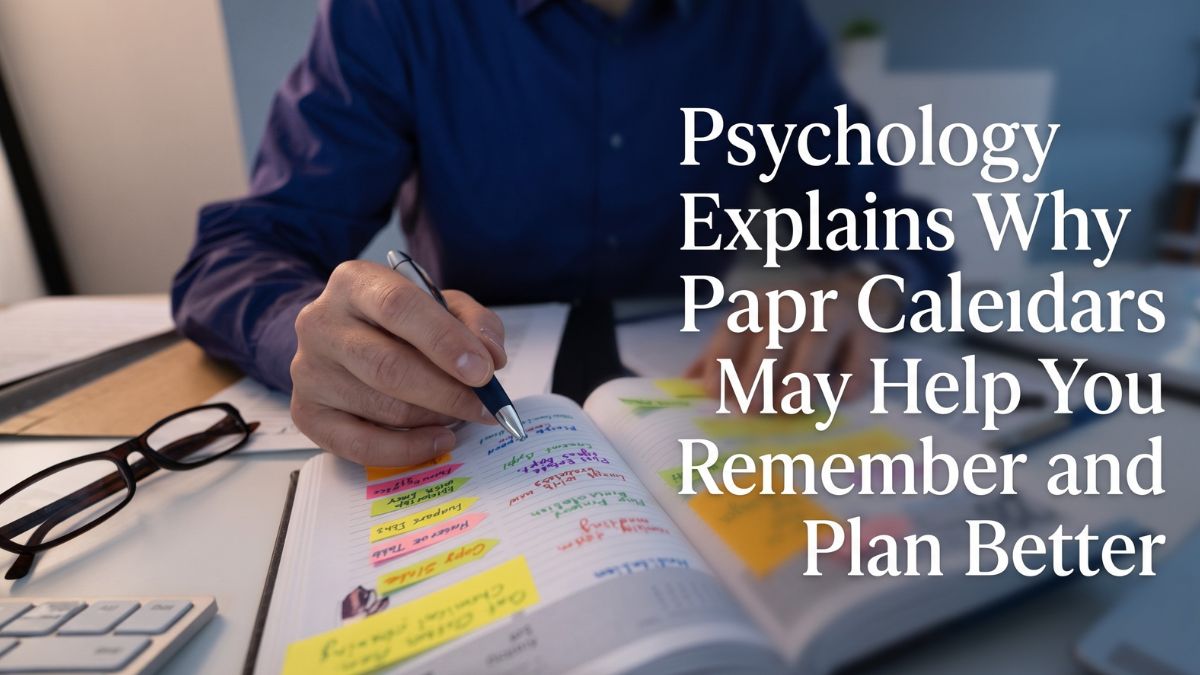
A paper calendar can seem out of place in a world where smartphones can schedule appointments, send reminders and update plans instantly. Yet some people still prefer writing their schedules by hand. Psychology research suggests that this habit may have less to do with being old-fashioned and more to do with how people process information.
A physical page can make an entire week visible at once, while handwriting can add spatial and tactile cues that may help information stick. Research also suggests that writing down goals can support commitment and follow-through. However, these findings do not mean that everyone who uses a paper calendar has a particular personality or superior memory.
Planning
Research by Yanliu Huang of Drexel University, Zhen Yang of California State University, Fullerton, and Vicki G. Morwitz of Columbia Business School examined how people use paper and mobile calendars.
Across three experiments, the researchers compared different calendar formats. In one experiment involving 129 undergraduate students, participants used either a paper or mobile calendar for two weeks. About 53% of paper-calendar users completed their plans on time, compared with 33% of mobile-calendar users.
The researchers suggested that paper can support a broader view of a schedule. A physical page allows several events to remain visible simultaneously, which may make relationships between tasks easier to notice.
For example, a Thursday meeting might look manageable on its own. But when a grocery trip, an assignment deadline and a family commitment are written nearby, the demands of the day become easier to assess.
Memory
Handwriting may also provide additional memory cues.
In a 2021 study, 48 adults copied a fictional two-month schedule into either a paper datebook, tablet or smartphone. Keita Umejima and Kuniyoshi L. Sakai of the University of Tokyo found that participants using paper completed the task in about 11 minutes, compared with approximately 14 minutes for tablet users and 16 minutes for smartphone users.
Paper users also performed better on some simpler memory tasks.
Brain scans taken about an hour later showed stronger activity in areas associated with memory, language and visual processing among the paper users. The researchers suggested that physical pages provide several types of information at once, including the location of writing, individual handwriting patterns and tactile sensations.
These details can act as additional retrieval cues when someone tries to remember information later.
Goals
Writing things down may also influence how people approach goals, although the evidence needs to be interpreted carefully.
Psychologist Gail Matthews at Dominican University of California studied goal-setting among 267 adults, with 149 participants completing a four-week study. Participants who wrote down their goals reported higher levels of achievement than those who only thought about their goals.
The written-goal group had an average achievement score of 6.08, compared with 4.28 among participants who did not write their goals. That difference should not be interpreted as proof that handwriting makes a person 42% more likely to succeed.
The study also found stronger results among people who combined written goals with weekly progress reports to a supportive friend. In addition, participants entered their goals through an online survey, so the research supports the value of putting goals into words rather than proving that pen and paper itself is responsible for the effect.
A paper calendar may nevertheless make plans more visible and easier to revisit, which can help turn an intention into something concrete.
Familiarity
Paper calendars can also make future events feel more familiar as they approach. A birthday, holiday or appointment may appear on the page repeatedly, creating a visual reminder long before the date arrives.
This idea can be connected to Robert Zajonc’s research on the mere-exposure effect. His studies found that repeated exposure to a neutral stimulus can increase familiarity and, in some circumstances, liking.
However, the connection should not be overstated. The classic experiments involved unfamiliar stimuli rather than calendar dates or upcoming personal events. They therefore cannot establish that people who use paper calendars experience stronger anticipation.
At most, repeated visual exposure provides one possible explanation for why regularly seeing an upcoming event might make it feel more familiar and mentally present.
Simplicity
There is also a practical reason some people may prefer paper. A paper calendar generally has a narrow purpose. It does not display messages, notifications, social media updates or other information competing for attention.
For people who already spend much of their day looking at screens, this separation can make planning feel more straightforward.
A physical calendar also remains visible without requiring a phone to be unlocked. That can make it easier to notice unfinished tasks or upcoming commitments during ordinary routines.
The appeal, therefore, may not be nostalgia. It can simply be a preference for a tool that offers fewer distractions and makes information physically present.
Technology
Digital calendars still offer important advantages. Smartphones can send reminders, synchronize appointments across devices, update changing schedules and make individual events easy to access.
The researchers studying paper and mobile calendars also found that digital tools can work effectively for specific appointments, particularly when reminders are useful. They suggested that mobile calendars may become more helpful for planning when users are encouraged to consider a wider view of their schedules.
That means paper and digital calendars do not necessarily have to compete. A person might use a smartphone for alerts and changing appointments while keeping a paper calendar for weekly planning, longer-term goals or information that needs to remain visible.
Choice
Using a paper calendar does not reveal a person’s personality, age or intelligence. Psychology cannot reliably determine someone’s character from a single planning habit.
What research can show is that the physical format of information may influence how people organize, remember and review it. Paper provides a combination of spatial arrangement, handwriting and tactile feedback that digital screens do not reproduce in exactly the same way.
For some people, that combination may make planning easier. For others, digital reminders and synchronization may be more useful. The best system is ultimately the one that helps a person notice commitments, remember important information and follow through on plans.
A paper calendar, then, is not necessarily a rejection of modern technology. It may simply be a different way of presenting information to the brain, one that some people find easier to see, process and remember.
FAQs
Can paper calendars improve memory?
They may provide spatial and tactile cues that support memory.
Why do people still use paper calendars?
Some prefer their visibility, simplicity and physical planning experience.
Is handwriting better for remembering plans?
Some research suggests handwriting can provide additional memory cues.
Are paper calendars better than phones?
Not always. Each format offers different planning and reminder benefits.
Does writing goals improve success?
Research suggests written goals may support achievement and follow-through.