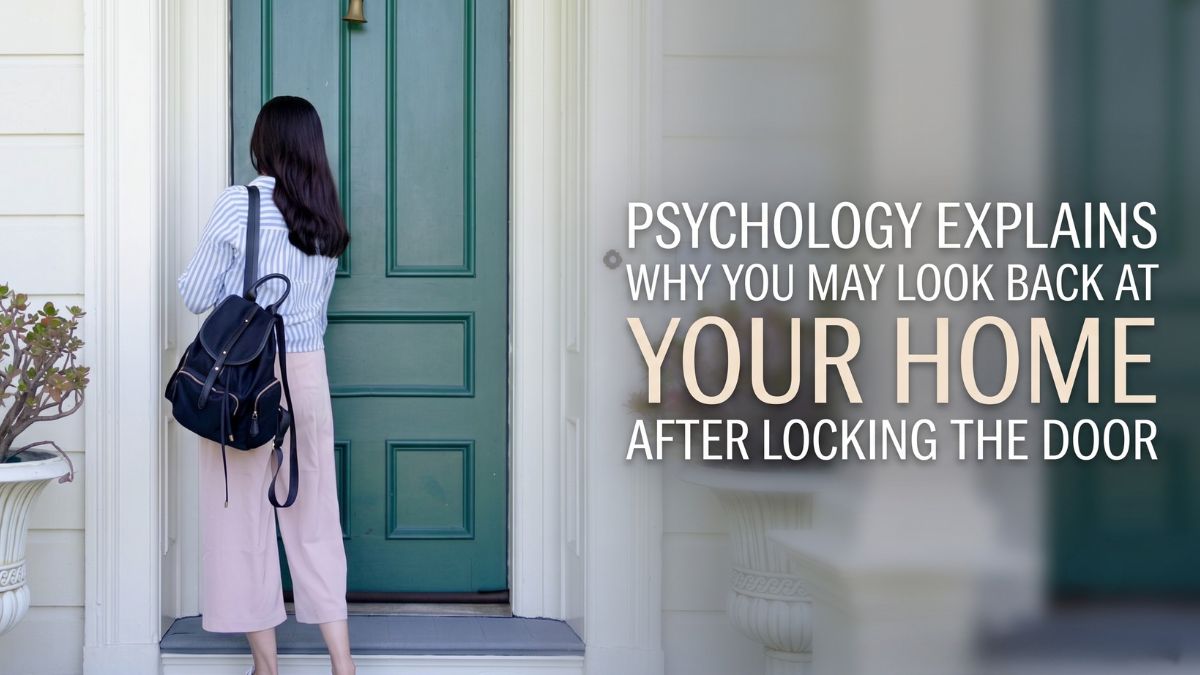
There is a small habit many people barely notice. The door closes, the lock clicks, and just before walking away, they turn around for one last look at their home.
It may be a glance at the doorway, windows or building before they continue toward the car, elevator or street. On the surface, it seems like an ordinary part of leaving. Psychology, however, provides several ways to understand why such a moment can sometimes feel meaningful.
Research on rituals, environmental psychology and transitions suggests that people often use familiar behaviors and environmental cues to move between different situations. A final look at home may, for some people, serve as a small transition marker between being at home and entering the next part of the day.
That does not mean everyone who looks back is anxious, unusually attached to their home or performing a specific psychological ritual. The meaning of the behavior depends on the person’s circumstances and the reason behind it.
Transitions
Leaving home involves more than physical movement. Inside the house, a person may have been relaxing, preparing for work, spending time with family or completing everyday tasks. Once they leave, they enter another environment with different expectations.
Research on role transitions has explored how people adjust when moving between social roles and contexts. Erving Goffman’s work on everyday interaction, for example, described how people adapt their behavior according to the setting they are in.
A final glance at the house may therefore function as a small psychological punctuation mark. The person has finished one context and is preparing to enter another.
Rituals
Psychologists have studied how rituals can affect emotional experiences and perceptions. Research by Nick Hobson and colleagues, among others, suggests that structured and repetitive behaviors can influence feelings even when the action itself has no direct practical effect on the desired outcome.
A ritual does not need to be elaborate. It might involve checking the door, touching a familiar object, following the same sequence before leaving or taking one last look around the house.
When a behavior is repeated in the same circumstances, it can become part of a person’s routine. Someone may not consciously think about completing a psychological transition. The action may simply feel like the natural end of the process of leaving.
Control
One reason rituals can feel useful is their predictability. Leaving home means entering a situation where the rest of the day cannot be completely controlled. A familiar departure sequence, however, remains predictable.
Shoes go on. The door closes. The lock is checked. The house is viewed one last time. Then the person leaves.
Research on rituals suggests that structured behavior can sometimes increase feelings of control and reduce anxiety. A final glance does not change what will happen outside, but it may provide a familiar structure at the point of departure.
That sense of order can be particularly noticeable when someone is preparing for an unfamiliar situation or an important day.
Home
A home is more than a physical building. Over time, it can become associated with familiarity, identity, safety and personal memories.
Environmental psychology has examined the relationship between people and meaningful places. Harold Proshansky and colleagues developed the concept of place identity to describe how physical environments can become connected with a person’s sense of self.
This provides one possible explanation for looking back. The person may not be focusing on the building itself. Instead, the glance may briefly reconnect them with a familiar environment before they move into another setting.
Someone leaving for work, for example, may experience the moment as a shift from home life to professional life.
Boundaries
Environmental cues can also help people distinguish one situation from another. A doorway is a particularly clear physical boundary. Crossing it changes the surroundings immediately.
Psychological research on event segmentation suggests that people organize continuous experiences into separate events. Gabriel Radvansky and colleagues have studied how movement between environments can influence the way people organize and remember activities.
In everyday terms, the brain does not necessarily process an entire day as one uninterrupted experience. It can divide the day into smaller episodes.
Leaving the house may therefore become one identifiable episode boundary. Looking back before walking away could reinforce that sense of moving from one episode to another.
Closure
Another possibility involves the feeling of completion. People often organize activities into sequences with recognizable beginnings and endings.
The departure routine has a clear structure. The person prepares to leave, secures the house and then walks away. A final glance may provide a visual endpoint to that sequence.
This idea can be considered alongside research related to the Zeigarnik effect, originally associated with psychologist Bluma Zeigarnik. While modern interpretations are more cautious than the popular claim that unfinished tasks are always remembered better, the broader study of unfinished and completed activities remains relevant to how people organize experiences.
For some individuals, the final look may simply make the departure feel complete.
Memories
The behavior may also become more noticeable during significant departures.
Someone leaving for a long vacation, moving to another city or beginning a new job may look back at their home with greater attention than they would on an ordinary morning. The image of the house can then become part of the memory of that particular departure.
Research on autobiographical memory has shown that places, objects and environmental details can become connected with personal memories. A final visual impression of home may therefore provide contextual information that becomes part of how the event is later remembered.
The person does not need to consciously tell themselves, “I should remember this.” The surroundings themselves can contribute to memory formation.
Meaning
The same behavior can have different explanations for different people. One person may look back because they feel emotionally connected to their home. Another may simply want to confirm that the door is secure. Someone else may have developed the habit through repetition.
Frequency and context also matter. A person who briefly looks back once before leaving is showing something quite different from someone who repeatedly returns to the door because they cannot feel certain it is locked.
For that reason, psychology cannot use this single behavior to determine someone’s personality or mental health.
Checking
It is important not to confuse an ordinary final glance with excessive checking.
Repeatedly locking a door, walking away, returning to check it again and experiencing persistent doubt can be part of a different behavioral pattern. Repetitive checking can occur in people experiencing obsessive-compulsive symptoms, particularly when the behavior is driven by distress or an inability to achieve certainty.
A brief look at the house after locking the door, by itself, is not evidence of obsessive-compulsive disorder or anxiety.
The difference lies partly in the person’s experience. If the behavior is quick and routine, it may simply be part of leaving. If it causes significant distress, takes considerable time or interferes with daily activities, it may warrant professional attention.
Transition
Looking back at home after locking the door may have several ordinary psychological explanations. It can mark a transition, provide a familiar routine, reinforce a sense of completion or briefly reconnect someone with a meaningful place.
The important point is that the behavior does not have one universal meaning. Psychology can offer possible mechanisms, but personal context determines what the gesture represents.
For some people, that final glance may simply be a practical check. For others, it may provide a quiet boundary between home and whatever comes next. A small pause at the doorway can sometimes help the mind recognize what the body has already done: leave one environment and begin another.
FAQs
Why do people look back at home?
It may be a routine, transition marker or simple security check.
Is looking back a sign of anxiety?
Not necessarily. The behavior alone does not indicate anxiety.
Can rituals help people feel in control?
Research suggests some rituals can increase perceived control.
Can places affect our memories?
Yes, familiar places can become connected with autobiographical memories.
When is checking a concern?
Repeated checking that causes distress or disruption may need attention.