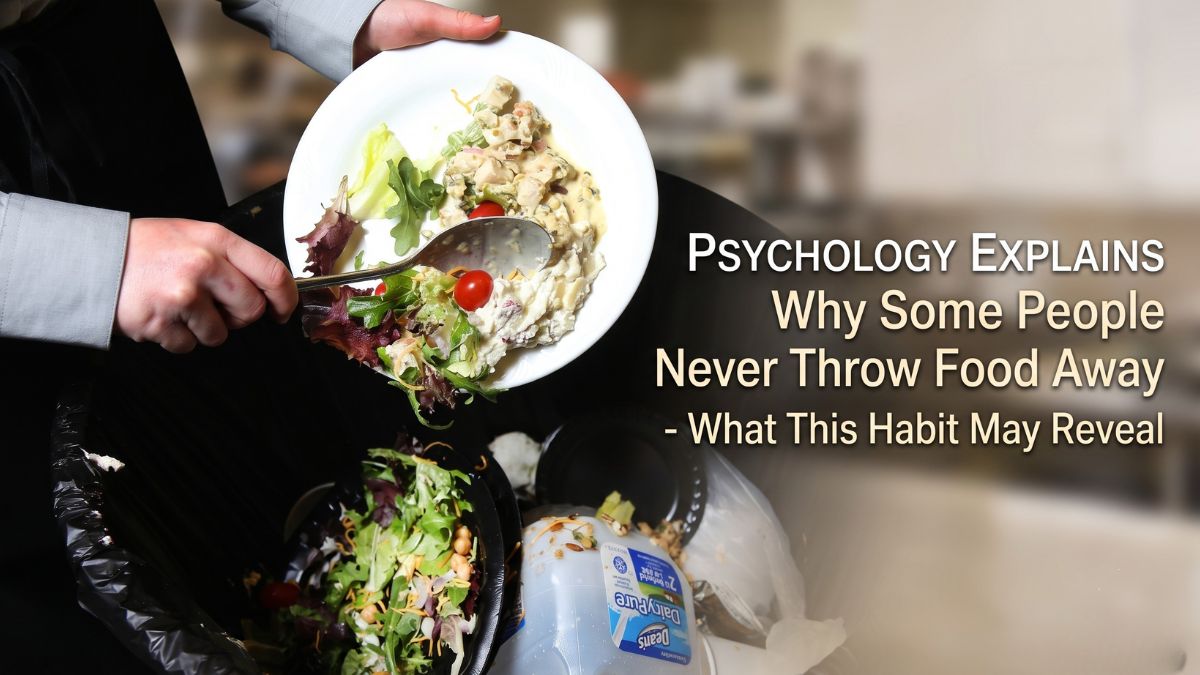
For some people, throwing away food can feel surprisingly difficult. A few leftovers may remain in the refrigerator for days, or an opened package may be kept because it might still be useful later. While saving food can be a practical way to reduce waste and control spending, the habit can also have emotional and psychological roots.
People do not always evaluate food only by whether they currently need it. Food can represent money, effort, security, family values and memories. Someone who grew up being taught that wasting food was unacceptable may carry that rule well into adulthood.
Several psychological concepts can help explain this behavior, including loss aversion, the endowment effect and social learning. None of these ideas can explain every person who avoids throwing food away, but together they show why a seemingly ordinary household decision can have a deeper background.
Security
The decision to keep food can sometimes be connected to a sense of security.
A person may look at leftover food and think about its future usefulness rather than its immediate value. Even without consciously worrying about scarcity, they may feel more comfortable knowing that something is available if it is needed later.
This response can be shaped by personal experience. Someone who has experienced financial difficulty or periods when food was limited may develop a stronger preference for preserving available resources.
That does not mean everyone who saves leftovers has experienced hardship. The important point is that people’s attitudes toward resources can be influenced by their personal history.
Memories
Food can carry emotional meaning beyond its nutritional value.
A particular dish may remind someone of childhood, a parent or grandparent, a family celebration or a familiar household routine. Even ordinary ingredients can become connected to memories.
This can make discarding food feel different from throwing away an object with no personal meaning.
The emotional response may be subtle. A person may not consciously think, “This reminds me of my childhood.” Instead, the food may simply feel too valuable to discard.
Ownership
The endowment effect offers another possible explanation.
In behavioral economics, the endowment effect refers to the tendency for people to place greater value on something once they own it. An item can seem more valuable simply because it has become part of what belongs to us.
Food can fit into this pattern.
A package sitting on a supermarket shelf may have one perceived value. Once it has been purchased, brought home and placed in the refrigerator, the person may feel differently about throwing it away.
The food is now part of the household’s resources. Discarding it can therefore feel like giving something up rather than simply removing an unwanted item.
Loss
Loss aversion is closely related but describes a different psychological process.
People often respond more strongly to losses than to equivalent gains. In practical terms, throwing away food may be experienced as losing money, effort or a resource that could potentially have been used later.
Imagine spending $20 on groceries and later throwing $5 worth away. The person may focus more on the money lost than on the convenience or benefit the food provided.
This can make disposal emotionally uncomfortable even when keeping the food no longer makes practical sense.
Loss aversion does not mean everyone will avoid wasting food. It is a general behavioral tendency, and its influence varies between people and situations.
Learning
Family behavior can also play an important role.
Children learn many everyday habits by watching the people around them. If parents regularly save leftovers, plan meals carefully and emphasize that food should never be wasted, children may internalize those behaviors.
Repeated messages such as “Don’t waste food” can become a lasting household rule.
As adults, people may continue following the rule even when their circumstances have changed. What began as a family practice can become an automatic response.
This is consistent with social learning theory, which emphasizes the role of observation and modeling in the development of behavior.
Scarcity
A history of scarcity can make resources feel especially important.
Someone who has experienced periods of financial uncertainty may be more reluctant to discard something that could potentially be useful. Keeping food can provide a sense that resources are being protected rather than lost.
However, this should not be interpreted as a diagnosis. Not everyone who avoids food waste has a scarcity mindset, and people can develop similar habits for entirely different reasons.
Some simply value thrift. Others dislike waste because of environmental concerns or family expectations.
Effort
Food can also represent effort.
A meal may involve planning, shopping, cooking, cleaning and spending money. Throwing it away can therefore feel like discarding more than the food itself.
Someone might think, “I spent an hour preparing this,” or “I paid for these ingredients.”
The psychological value of the food can become connected to the work that produced it.
This can also explain why people sometimes keep objects they rarely use. Their practical value may be low, but the effort, money or memories attached to them can make disposal difficult.
Habits
Not every food-saving behavior has a deep psychological explanation.
Some people simply have practical routines. They may save leftovers because they intend to eat them for lunch the next day. Others may plan meals around what is already available in the refrigerator.
In these cases, keeping food is simply sensible household management.
The distinction becomes more interesting when someone continues keeping food without a realistic plan to use it. Even then, there can be several possible explanations, including habit, emotional attachment, concern about waste or discomfort with losing resources.
A single behavior rarely provides enough information to determine the underlying cause.
Balance
Understanding these psychological factors can encourage a more balanced approach to food.
Avoiding unnecessary waste is generally useful. People can plan meals, check what they already have and store suitable leftovers safely. Buying realistic quantities can also reduce the amount of food that eventually needs to be discarded.
At the same time, saving food indefinitely is not necessarily practical. Food safety still matters, and keeping something does not prevent waste if it ultimately becomes unusable.
The goal is therefore not to preserve everything. It is to make thoughtful decisions about what can realistically be used.
Empathy
The psychology behind food habits can also encourage people to avoid judging others too quickly.
Someone who refuses to throw away food may appear overly frugal or stubborn from the outside. But their behavior could be shaped by childhood experiences, family traditions, financial history or a strong personal value against waste.
Another person may have completely different associations with the same food.
Understanding these differences does not mean every behavior needs to be justified. It simply provides context.
Lessons
The habit of keeping food can illustrate a broader principle in psychology: everyday decisions are often influenced by more than immediate usefulness.
People respond to ownership, memories, perceived losses, family routines and feelings of security. Food happens to bring many of these factors together because it has financial, practical, emotional and cultural value.
For some people, not throwing food away may reflect thrift. For others, it may be connected to learned family habits or discomfort with losing a resource. In some cases, concerns about scarcity or the value attached to ownership may also play a role.
The important point is that there is no single psychological explanation for the behavior. Saving food can be practical, emotional or habitual, and often several factors work together. Knowing those influences can make everyday behavior easier to interpret without turning a simple habit into a personality judgment.
FAQs
Why do some people never throw food away?
They may value resources, avoid waste, or feel uncomfortable with loss.
What is loss aversion?
It is the tendency to experience losses more strongly than equal gains.
What is the endowment effect?
It is valuing something more because you own it.
Can childhood affect food habits?
Yes. Family routines and lessons can shape attitudes toward food waste.
Does saving food always indicate scarcity fears?
No. It can also reflect thrift, habit, memories, or practical planning.