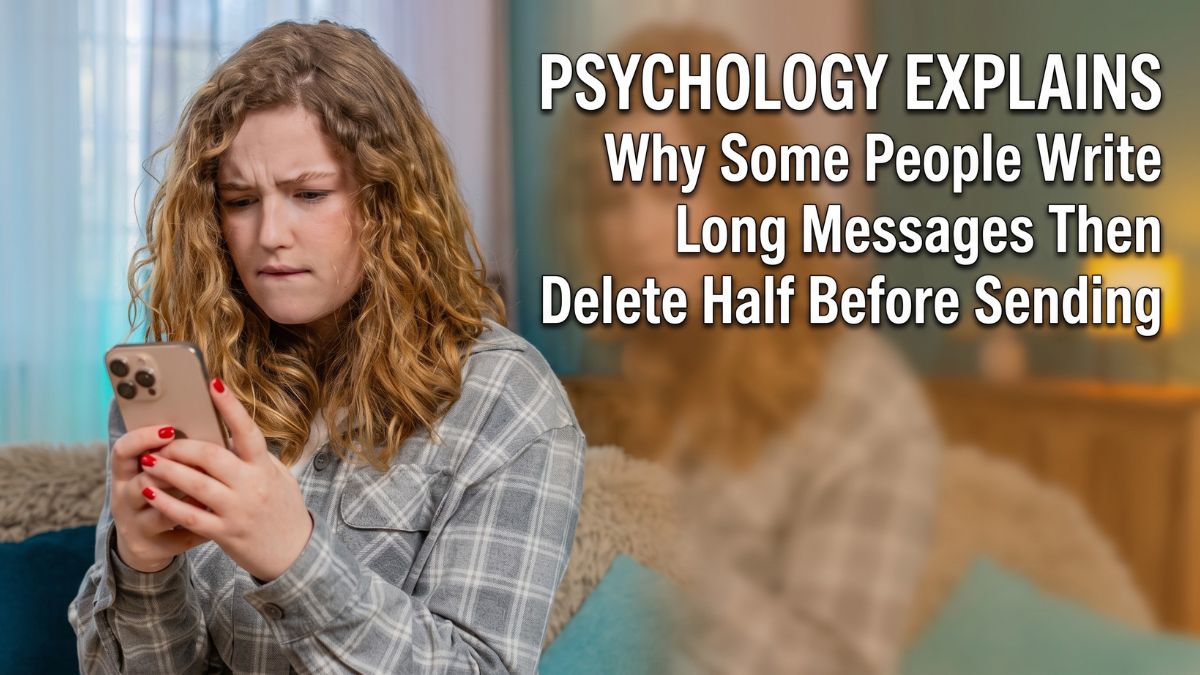
Have you ever written a message that seems to capture exactly what you want to say, only to reread it and start deleting? A paragraph becomes a sentence. An explanation disappears. A joke is removed because it might be misunderstood. Eventually, the message you send is much shorter than the one you originally wrote.
Sometimes this is simply good editing. But psychology offers another possible explanation. People often adjust communication based on how they expect others to perceive them. Research on self-presentation, impression management and social evaluation suggests that people may mentally simulate a recipient’s reaction before deciding what to reveal.
This does not mean that everyone who shortens messages is worried about judgment. But when someone repeatedly removes emotional, vulnerable or potentially awkward parts of a message, the editing process may reflect an attempt to manage anticipated social evaluation.
Impressions
Communication is not only about transferring information. It can also involve presenting a particular version of ourselves to other people.
Psychologist Erving Goffman’s work became influential in understanding self-presentation and the ways people manage the impressions they create during social interaction. Modern research continues to examine impression management as the process of influencing how others perceive us.
Written communication makes this process particularly visible.
A person might initially write:
“I was honestly disappointed that you didn’t tell me because I thought we were closer, and now I’m wondering whether I did something wrong.”
Then they pause.
They imagine the recipient reading it.
Will this sound needy?
Will they think I am angry?
Am I saying too much?
The final message might become:
“No worries, just let me know next time.”
The writer has not simply corrected grammar. They have considered the social consequences of revealing the original thought.
Editing
The delete button can therefore become part of self-presentation.
Research by Mark Leary and colleagues has examined individual differences in concern about the impressions people make on others. Factors such as public self-consciousness, approval motivation and fear of negative evaluation can influence how people manage self-presentation.
This helps explain why two people can respond very differently to the same situation.
One person may send a detailed explanation without much hesitation. Another may write several paragraphs, reread them, remove most of the content and send only a few sentences.
The second person does not necessarily have less to say. They may simply place more emphasis on how their words will be interpreted.
Judgment
Anticipated evaluation is particularly relevant to digital communication.
Before sending a message, people can imagine how the recipient might respond. They may expect annoyance, criticism, rejection or misunderstanding. Those expectations can influence what they ultimately communicate.
Research on self-presentational concerns suggests that people’s decisions about disclosure can depend partly on the impression they want to create and their expectations about how successful that effort will be.
This means the writer may be considering two questions at once:
“What do I want to say?”
and
“What will this make the other person think about me?”
The second question can significantly change the final message.
Emotion
The parts removed during editing may sometimes be the most emotionally revealing.
Someone might initially write:
“I was really excited to tell you this because I don’t usually share things like this with people.”
Then delete it.
Or:
“I know this probably sounds silly, but I was actually hurt when you didn’t respond.”
Delete.
Or:
“I’ve been thinking about this conversation all day.”
Delete.
The final message might simply say:
“Just wanted to clarify what I meant earlier.”
This can involve emotion regulation as well as impression management.
People sometimes modify emotional expressions when they anticipate social consequences. Research into emotional expression and suppression suggests that how people display emotions can influence how others perceive them, although the effects depend heavily on the situation.
Shortening a message can therefore control not only the amount of information being shared but also the amount of emotional exposure.
Tradeoff
There can be a practical benefit to editing.
A shorter message may be easier to understand and less overwhelming. Removing unnecessary explanations can make communication more direct.
But excessive editing can also remove important context.
Consider an apology. A person’s original message might explain what happened, acknowledge the other person’s feelings and take responsibility for their behavior.
After several rounds of editing, it becomes:
“Sorry about yesterday.”
The shorter version may feel safer to send. However, it also communicates considerably less.
This illustrates one potential tradeoff of impression management. Attempts to appear composed or avoid negative evaluation can sometimes change the message so much that its original meaning becomes less clear.
Audience
An interesting part of this behavior is that the recipient does not need to be physically present.
The writer can already have an imagined audience in mind.
They know the person well enough to anticipate how certain words might be received. The writing process can then become a negotiation between what the person wants to express and what they feel comfortable allowing the other person to see.
Digital communication may intensify this process because written messages leave a record. A text can be reread, analyzed and interpreted without the additional information available during face-to-face conversation, such as voice, facial expression and immediate clarification.
That permanence can encourage additional editing.
Disclosure
Self-disclosure creates another layer of psychological complexity.
Sharing personal information can help people develop relationships and build trust, but it also creates vulnerability. When someone reveals disappointment, affection, insecurity or excitement, they give another person information that can potentially be judged.
That creates a social calculation.
If I tell them everything, will they understand me better?
Or will they see me differently?
A person who regularly shortens messages may sometimes resolve that uncertainty by choosing a safer form of communication. They keep the practical information but remove details that reveal too much about their internal experience.
Insecurity
Careful editing should not automatically be interpreted as insecurity.
Some people simply prefer concise communication. Others may have learned through experience that long messages can create confusion. Someone communicating professionally may edit extensively because precision matters. A person writing in a second language may revise sentences to avoid ambiguity.
The pattern becomes more psychologically interesting when it appears mainly during emotionally sensitive conversations.
If someone comfortably sends long messages about ordinary topics but repeatedly removes vulnerable statements during conversations about relationships, conflict or personal feelings, concern about anticipated judgment becomes one possible explanation.
Even then, it would not be enough to establish someone’s psychological state from their texting habits alone.
Risk
For some people, pressing “send” can feel like a small social risk.
Once a message is delivered, the writer cannot completely control how it will be interpreted. That uncertainty may encourage repeated rereading and editing.
Words that seem too intense can be removed. Direct statements may become softer. Questions may disappear. Emotional explanations may be replaced with neutral language.
The goal may not be to deceive anyone. Instead, the writer may be trying to reduce the possibility of embarrassment, rejection or misunderstanding while still communicating the essential point.
Silence
The words removed from a message can sometimes be psychologically interesting, although they cannot provide a definite explanation on their own.
Someone who repeatedly deletes emotional explanations may be trying to appear unaffected.
Someone who removes enthusiastic language may be trying not to appear overly invested.
Someone who deletes several questions may be trying not to seem demanding.
Someone who changes a detailed complaint into “It’s fine” may be avoiding the discomfort of a more direct conversation.
These interpretations are possibilities, not conclusions. The same editing behavior can have completely different causes for different people.
Still, the pattern demonstrates a broader principle of communication: people do not only consider what they want to express. They also consider what expressing it might mean socially.
Context
Writing a long message and then shortening it can therefore serve several purposes.
It may improve clarity. It may remove unnecessary information. It may help someone organize their thoughts before deciding what matters.
In other situations, however, it may reflect an attempt to manage anticipated judgment. The writer has an emotional reaction, imagines how the recipient might respond and then modifies the message accordingly.
The final version may be calmer and easier to receive, but it may also contain less of the writer’s original experience.
Psychology does not suggest that every person who edits their messages is afraid of judgment. Research on self-presentation, impression management, self-consciousness and emotion regulation simply provides a framework for understanding why anticipated social evaluation can influence communication.
So when someone repeatedly writes everything they want to say and then deletes half before sending, the important question may not be why they had so much to write. It may be what they believed the other person might think if they left it all in.
FAQs
Why do people shorten long messages?
They may want clearer wording or fewer socially risky details.
Can editing reflect fear of judgment?
Sometimes, especially when emotional details are repeatedly removed.
Is deleting messages a sign of insecurity?
No. Editing can simply reflect a preference for concise communication.
What is impression management?
It is the process of influencing how others perceive you.
Why are emotional details often deleted?
They can make people feel more socially exposed or vulnerable.