
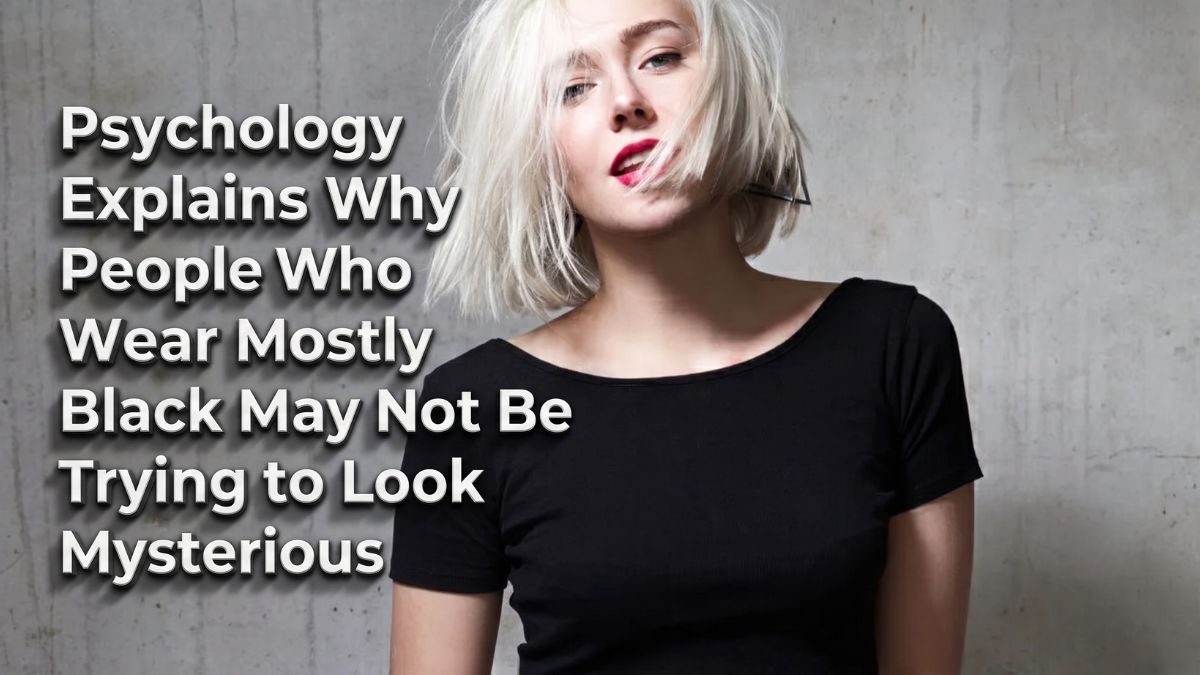
If most of your wardrobe is black, people may assume you are trying to look serious, stylish, mysterious, or intimidating. But psychology offers a less dramatic explanation. For some people, wearing the same color repeatedly is simply a way to reduce decisions, avoid unnecessary attention, and make getting dressed easier.
That does not mean everyone who wears black has the same personality. Clothing choices can reflect practicality, culture, profession, personal taste, and circumstances. Still, several psychological findings help explain why a simple, consistent wardrobe can become appealing over time.
Mystery
The idea that black clothing automatically signals mystery or intimidation is popular, but research suggests that observers can indeed perceive people dressed in black differently.
Psychologist Aldert Vrij conducted two experiments in the 1990s in which participants evaluated people in crime-related scenarios. The clothing color was changed while other aspects of the scenarios remained consistent. Participants tended to rate people wearing black as more aggressive than those wearing lighter clothing.
Research on uniforms has produced similar findings. One study involving 737 citizens asked participants to evaluate four police uniform color combinations. The all-black uniform received the least favorable ratings on six of seven measures, while a light blue shirt with navy trousers received the strongest overall ratings.
These findings suggest that black can influence how other people perceive someone. But perception is not the same as intention. A person can choose black for convenience without trying to appear intimidating.
Decisions
One practical reason people settle on a limited wardrobe is that it removes repeated decisions.
Michael Lewis reported on Barack Obama’s clothing habits in a 2012 profile and noted that the former president generally wore grey or blue suits. Obama explained that he wanted to reduce the number of decisions he had to make because he already had many other decisions competing for his attention.
The principle is straightforward. Choosing an outfit takes some mental effort, even when the decision seems insignificant. For someone with a demanding schedule, reducing small choices can make mornings simpler.
A wardrobe built around a few reliable colors works in much the same way as a routine. Once you know what works, you do not need to reconsider it every day.
Attention
Another psychological concept helps explain why some people prefer understated clothing: the spotlight effect.
In a series of studies published in 2000, Thomas Gilovich and colleagues examined how much people overestimate the extent to which others notice their appearance and behavior. In one experiment, students wore an embarrassing T-shirt into a room of strangers and estimated how many people would remember what was printed on it.
Participants generally overestimated how many people would notice the shirt. Their estimates suggested that almost half of the people in the room would identify it, while the actual figure was closer to one quarter.
The finding illustrates a broader tendency. People often pay more attention to themselves than others are paying to them.
That can change the way someone thinks about clothing. If you realize that most strangers are not carefully evaluating your outfit, dressing to manage everyone’s impression of you may seem less important.
Hiding
There is another possibility worth considering. A preference for understated clothing can sometimes be about avoiding attention rather than simply reducing decisions.
Those are not necessarily the same thing.
Someone might think, “I do not want my clothes to be the focus.” That can be a practical preference. But someone else might feel uncomfortable being noticed at all and use inconspicuous clothing as a way to feel less exposed.
Psychology cannot determine which explanation applies simply by looking at someone’s clothes. The useful question is how the person feels about being noticed.
If wearing neutral colors feels comfortable and convenient, there may be little to examine. If wearing something brighter produces a strong feeling of vulnerability or anxiety, that reaction may reveal more about the person’s relationship with attention.
Uniform
A limited color palette can also turn a wardrobe into a personal uniform.
Instead of choosing a completely different outfit every morning, someone might keep several versions of the same basic combination. Black trousers, black shirts, and different textures can provide variety without requiring a new decision about color.
This approach can also make shopping and laundry easier. Once someone knows which clothes they actually wear, buying multiples of those items may be more practical than continually experimenting with new styles.
Texture, fabric, and fit can provide variation without introducing a large number of colors. Heavy cotton, linen, knitwear, and different silhouettes can make similar-colored clothing look noticeably different.
Balance
A simple wardrobe does not have to mean an entirely black wardrobe.
Keeping a few alternatives can be useful for situations where a different appearance is appropriate. Formal events, celebrations, professional occasions, or simply a desire for variety can all provide reasons to step outside a regular uniform.
There is also a practical issue with wearing the same clothes repeatedly. Dark garments can fade, and frequently washed clothing eventually loses its original shape and finish. Replacing worn items before they become visibly tired can matter more than continually adding new pieces.
Cognition
Clothing may also influence how people feel while wearing it. This idea is often discussed under the term “enclothed cognition,” which proposes that clothing can affect psychological processes as well as how other people perceive us.
Some of the early research in this area, including famous experiments involving lab coats, has faced replication concerns. It would therefore be too strong to claim that wearing a particular color automatically changes someone’s thinking or personality.
A more cautious interpretation is useful. Clothing can become associated with routines, roles, and expectations. If someone has spent years wearing simple clothes that require little thought, putting them on may become part of a familiar routine that helps them move quickly into the day.
So, if someone wears black more than any other color, the explanation may be much simpler than mystery or intimidation. They may like the color, find it easy to coordinate, prefer not to attract attention, or simply have decided that choosing clothes is not where they want to spend much mental energy.
In that sense, a mostly black wardrobe may say less about wanting to be noticed and more about deciding what deserves attention. For some people, clothing is part of their identity. For others, it is simply something that needs to work without demanding much thought. Both approaches are perfectly compatible with ordinary differences in personality and preference.
FAQs
Does wearing black mean someone is intimidating?
No. Black can affect perception, but clothing does not reveal intent.
Why do people prefer simple wardrobes?
Simple wardrobes can reduce daily decisions and make dressing easier.
What is the spotlight effect?

It is the tendency to overestimate how much others notice us.
Can clothes affect how people feel?
Clothing may influence feelings through routines, roles, and associations.
Is wearing mostly black a personality trait?
Not necessarily. It can reflect taste, convenience, or personal preference.