
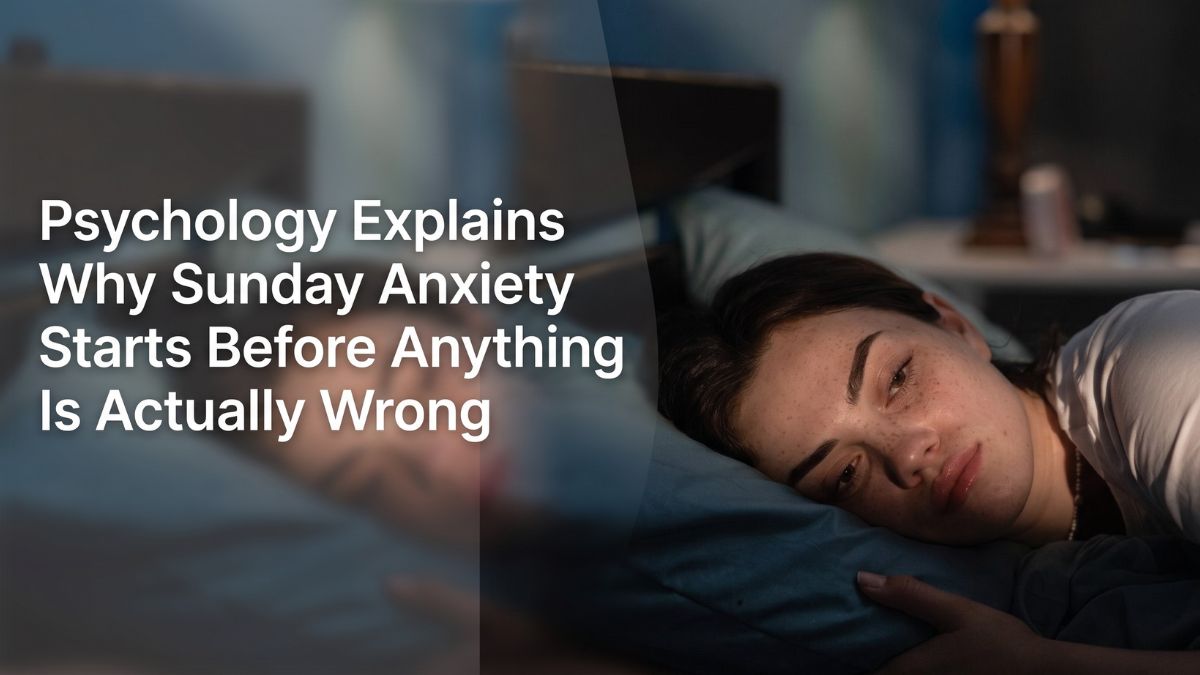
Sunday evening can feel strangely uncomfortable for some people. Nothing has necessarily gone wrong, yet the thought of Monday can bring tension, restlessness, racing thoughts or a sense that the weekend is already over.
This experience is often described as the “Sunday scaries.” Psychology offers several possible explanations, including anticipatory anxiety, intolerance of uncertainty, learned associations, work-related rumination and difficulty mentally switching off from work.
The important point is that the anxiety does not necessarily mean something bad is happening at that moment. The mind can respond to an expected future situation before it arrives.
Uncertainty
Anticipatory anxiety occurs when someone experiences worry or physical tension about a future event rather than an immediate threat.
Imagine sitting at home on Sunday evening. There is no urgent email, unexpected deadline or difficult conversation happening. Yet thoughts about Monday begin to appear: “Tomorrow is going to be difficult” or “I have so much to deal with.”
The threat is not present in the room. It exists in the person’s prediction of what may happen.
Research into intolerance of uncertainty, a concept extensively studied by psychologist Michel Dugas and colleagues, suggests that difficulty dealing with uncertain future outcomes can contribute to worry and anxiety. When the future feels unpredictable, the mind may try to reduce that uncertainty by repeatedly imagining possible problems.
That can make Monday feel psychologically present before it has actually arrived.
Conditioning
Sunday anxiety can also develop through learning.
If Sunday evenings repeatedly occur before stressful Mondays, the brain can begin connecting ordinary Sunday cues with the approaching workweek. Checking the calendar, preparing clothes, eating dinner, watching the clock or noticing that the weekend is ending can become reminders of what comes next.
This resembles classical conditioning, a learning process associated with psychologist Ivan Pavlov. A neutral stimulus can acquire emotional significance when it is repeatedly paired with an important event.
For example, if stressful Monday mornings consistently follow Sunday evenings, the Sunday evening period itself may eventually become associated with tension.
This helps explain why anxiety can appear even when nothing particularly stressful has happened yet. The cue has acquired meaning through repetition.
Detachment
Another explanation involves psychological detachment from work.
Psychologist Sabine Sonnentag’s research on recovery from work has examined how people mentally disconnect from their jobs during non-work hours. Psychological detachment means being able to stop thinking about work and temporarily disengage from work-related demands.
Sonnentag’s stressor-detachment model suggests that stressful work demands can interfere with this recovery process. When people remain mentally connected to work during their leisure time, they may have less opportunity to recover.
Sunday can make this particularly noticeable.
Someone may spend much of Saturday focused on personal activities and successfully avoid thinking about work. By Sunday evening, however, Monday becomes more immediate. The person starts reviewing tasks, anticipating meetings and thinking about unfinished work.
The weekend has not technically ended, but the workweek has returned mentally.
Research involving full-time employees has also found associations between work-related social stressors, poorer psychological detachment on Sunday evening and poorer sleep that night.
Rumination
Repetitive thinking can make the pattern stronger.
A person might replay a difficult conversation from Friday, predict how a Monday meeting will unfold, or repeatedly calculate how much work needs to be completed.
This can feel productive because the mind appears to be preparing for a problem. But repeatedly thinking about a stressful situation does not necessarily make it easier to manage.
Research by Sonnentag and colleagues has examined how failing to detach from negative work events during leisure time can contribute to negative rumination and subsequent negative affect.
The process can become circular. Thinking about Monday increases anxiety, anxiety makes Monday seem more threatening, and that perception encourages further thinking.
The person is trying to prepare for the future, but the preparation itself may keep the nervous system engaged with the source of stress.
Contrast
The difference between weekend life and weekday responsibilities may also contribute to Sunday anxiety.
Weekends often provide greater control over time. A person can decide when to wake up, what to do, where to go and when to respond to other people’s demands. Returning to work usually means accepting a more structured schedule and external responsibilities.
Research on weekend recovery suggests that recovery experiences and activities can help replenish psychological resources before people return to work.
The transition can therefore feel significant even when someone does not dislike their job.
A person may enjoy their work and still experience anxiety about returning to a schedule with less autonomy. The discomfort can come from the change in control rather than from the job itself.
Patterns
Sunday anxiety does not automatically indicate that someone hates their job or has an anxiety disorder.
For some people, occasional worry may simply reflect ordinary anticipatory stress. For others, a recurring pattern may point toward issues such as excessive workload, poor work-life boundaries, burnout or a consistently stressful working environment.
The frequency and impact are more informative than the existence of Sunday anxiety alone.
If the feeling regularly interferes with sleep, relationships, daily functioning or the ability to enjoy most of the weekend, speaking with a qualified mental-health professional may be appropriate.
Future
The unusual feature of Sunday anxiety is that the feared situation has not happened yet.
A person can be physically present on Sunday evening while mentally rehearsing Monday morning. Psychology suggests that this can happen when anticipation, uncertainty, learned associations, work-related thoughts and repetitive thinking interact.
The mind is designed to anticipate future demands. Sometimes that ability is useful. But when anticipation begins too early and repeatedly turns ordinary Sunday cues into signals of danger, the end of the weekend can become stressful in its own right.
So if anxiety appears every Sunday evening even when nothing is objectively wrong, the feeling may be less about what is happening now and more about what the brain has learned to expect next.
FAQs
Why do I feel anxious on Sunday?
Your mind may be anticipating Monday and its expected demands.
Is Sunday anxiety normal?
Occasional worry can be normal, but persistent distress deserves attention.
Can Sunday anxiety be learned?
Yes, repeated stressful Mondays can make Sunday a learned anxiety cue.
Does Sunday anxiety mean I hate my job?
No, it can also reflect uncertainty, workload or reduced autonomy.
Can work rumination cause Sunday anxiety?
Yes, repetitive work thoughts can interfere with recovery and increase strain.