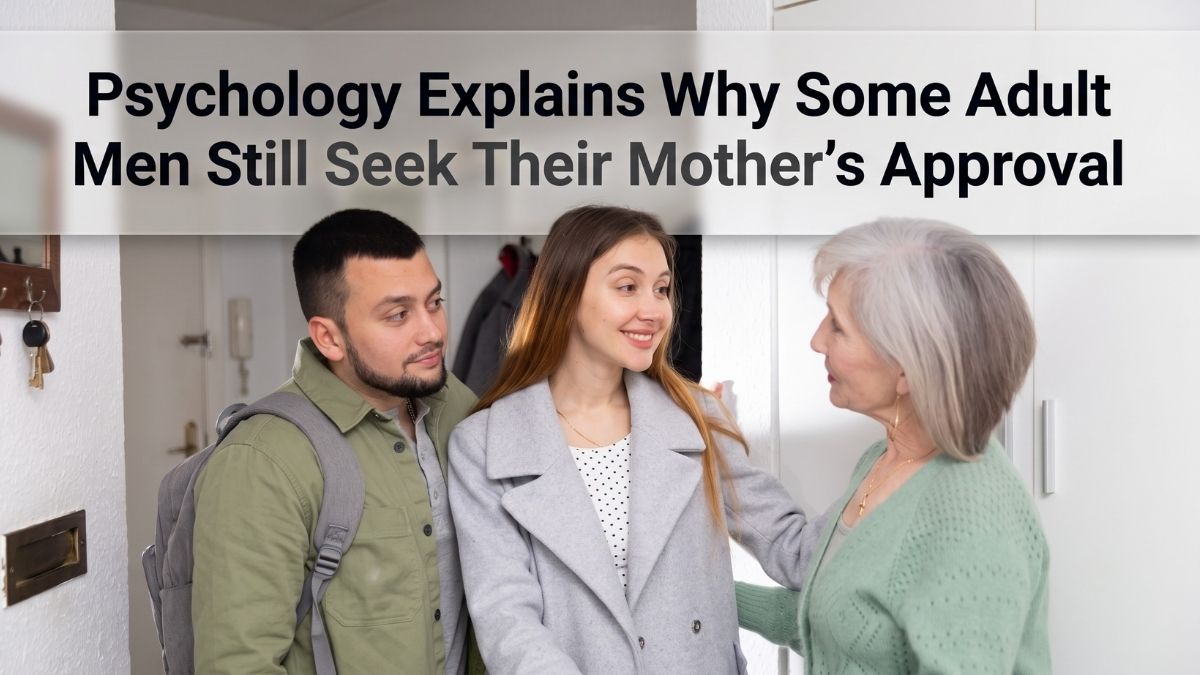
A man who calls his mother before making every major decision, worries about whether she approves of his career or relationships, or feels guilty whenever he disagrees with her may casually be called a “mama’s boy.” Psychology, however, offers a more nuanced explanation than simply describing him as overly dependent on his mother.
The behavior can involve attachment, emotional dependency, differentiation of self, autonomy and the internalization of parental approval. A close relationship between an adult son and his mother is not inherently unhealthy. The concern arises when the relationship makes it difficult for the adult to make independent decisions, tolerate disagreement or develop a stable sense of self that does not depend heavily on maternal approval.
Attachment
Attachment theory, developed by psychologist John Bowlby and expanded through the work of Mary Ainsworth, proposes that early relationships with caregivers help shape expectations about relationships and emotional security.
This does not mean childhood attachment mechanically determines adult behavior. Instead, attachment experiences can become part of the psychological framework through which people understand closeness, reassurance and separation.
For example, an adult man who immediately calls his mother whenever he feels uncertain may have learned that seeking reassurance from a trusted attachment figure is an effective way of regulating distress.
Research examining attachment, autonomy and intimacy in psychotherapy has described healthy adulthood as involving a balance between maintaining meaningful attachment and developing sufficient autonomy.
The issue, therefore, is not whether he loves his mother. It is whether he can remain emotionally connected without needing her approval to feel secure about himself.
Differentiation
One of the useful theories for understanding this pattern comes from psychiatrist Murray Bowen’s Family Systems Theory.
Bowen’s concept of differentiation of self refers to the ability to maintain a clear sense of personal identity while remaining emotionally connected to one’s family.
A highly differentiated adult can think, “My mother disagrees with my decision, but I can still respect her and make my own choice.”
Someone with lower differentiation may experience disagreement as emotionally threatening. They might change their decision simply to restore harmony or become highly anxious when their mother expresses disappointment.
A 2022 scoping review covering 295 primary studies found substantial evidence connecting differentiation of self with psychological health and relationship quality. The researchers also noted that more longitudinal and causal research is needed.
This distinction is important because emotional closeness and personal independence do not have to be opposites. An adult can maintain a strong family bond while developing an independent identity.
Approval
Another relevant concept is contingent self-worth. If a child repeatedly learns that approval, praise or affection comes when they behave in ways their parent values, they may become highly sensitive to parental reactions.
Consider an adult son who wants to move to another city. His mother says, “I do not think you are making the right decision.” Instead of considering the practical arguments and deciding for himself, he immediately feels guilty and begins questioning whether he is a bad son.
The problem is no longer simply disagreement. His mother’s opinion has become connected to his sense of being a good or acceptable person.
This can create a pattern in which external validation substitutes for internal confidence. The individual may know what he wants but still feel unable to act until someone important confirms that the decision is acceptable.
Overparenting
Research on overparenting, sometimes called helicopter parenting, provides another relevant perspective.
A 2012 study by Chris Segrin and colleagues examined 538 parent-young adult child dyads and found that overparenting was associated with poorer parent-child communication and lower family satisfaction. It was also associated with greater entitlement among young adult children.
Overparenting does not simply mean being loving or involved. It involves excessive involvement that may not be appropriate for the adult child’s developmental stage.
For example, a mother who continues arranging her adult son’s appointments, solving ordinary problems, managing conflicts and making decisions for him may unintentionally reduce opportunities for independent problem-solving.
The adult child can consequently become accustomed to asking, “What should I do?” instead of developing the habit of asking, “What do I think I should do?”
Fusion
Bowen’s theory also discusses emotional fusion, where family members become excessively emotionally intertwined. In such relationships, another person’s emotions can feel like one’s own responsibility.
An adult son may therefore believe that choosing a partner his mother dislikes means hurting her, moving away means abandoning her or disagreeing with her means disrespecting her.
Research on differentiation among Indian youth similarly describes healthier differentiation as the ability to balance autonomy and connectedness, while lower differentiation can involve emotional reactivity and discomfort in interpersonal situations.
Cultural expectations around family closeness can also differ substantially. A close mother-son relationship should not automatically be interpreted as psychological dependence.
In some families, frequent communication and involvement are normal expressions of affection. The more useful question is whether the adult remains capable of making decisions and maintaining boundaries when opinions differ.
Autonomy
A psychologically healthy adult relationship with a mother can involve frequent calls, affection, advice and emotional closeness. The important distinction is whether the adult has meaningful choice.
A son can listen to his mother’s advice without automatically following it. He can disagree without becoming overwhelmed by guilt. He can make mistakes without immediately seeking reassurance.
Recent scholarship comparing attachment and Bowen’s differentiation perspectives similarly emphasizes the importance of balancing connection and autonomy in parent-child relationships.
This means that the phrase “mama’s boy” can obscure more than it explains. The same behavior can have different psychological meanings depending on the person’s family history, personality, cultural environment and level of independence.
The psychological question is therefore not whether a man loves his mother too much. It is whether he can remain connected to her while still being psychologically his own person. That distinction provides a more useful way to understand adult mother-son relationships, particularly when approval, guilt or dependence begins to interfere with autonomy and a stable sense of self.
FAQs
Why do some adult men seek maternal approval?
Attachment, family dynamics and contingent self-worth may contribute.
Is being close to your mother unhealthy?
No, closeness is not unhealthy when autonomy and boundaries remain intact.
What is differentiation of self?
It means maintaining identity while staying emotionally connected to family.
Can overparenting affect adult independence?
Yes, excessive involvement can limit opportunities for independent decisions.
What does healthy attachment look like?
It balances emotional connection with personal autonomy and boundaries.