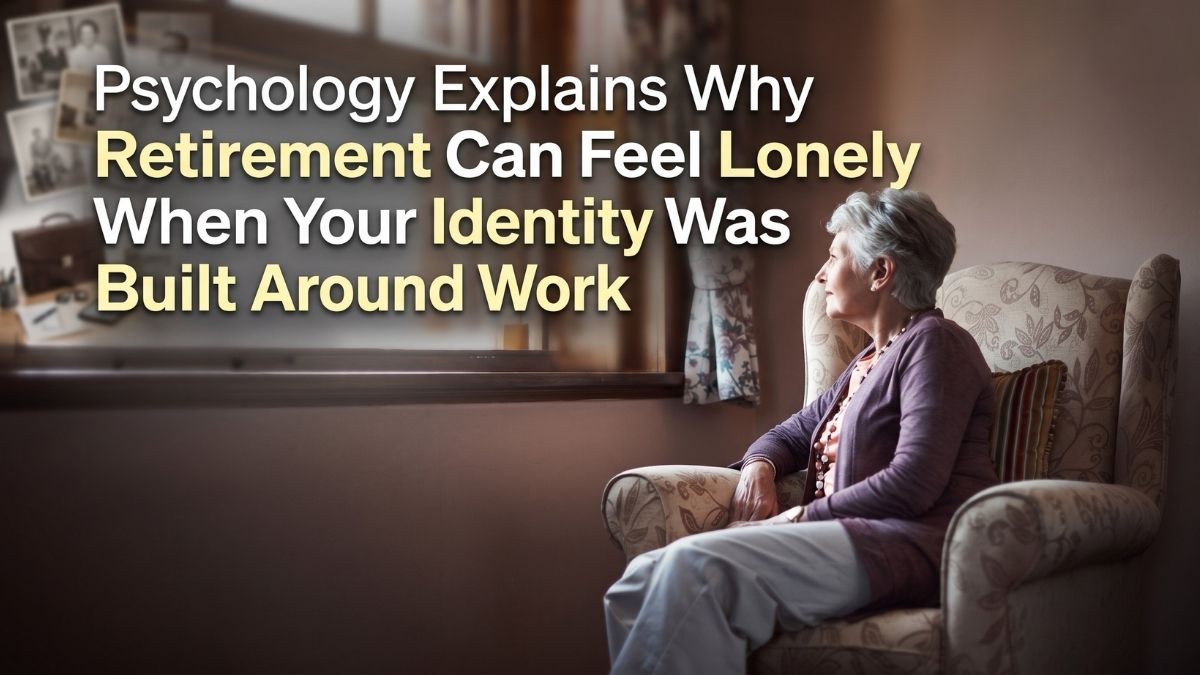
Someone retires on a Friday. By the following Wednesday, the garage has been reorganised twice, the inbox has gone quiet, and the phone sits on the table with nothing to say. The silence does not feel like peace. It feels like a power cut.
That person is not lazy. They are not necessarily unprepared either. The pension may be sorted and the mortgage may have been paid off years ago. Something subtler has happened. Four decades of being useful built a self that runs on demand, and that demand has suddenly disappeared.
Rest, under those conditions, does not always feel like freedom. It can feel like being taken off the roster.
Erasure
Psychologists have a straightforward term for part of this experience: role loss. Role theory suggests that people carry several roles at once, with each one contributing to their sense of identity. When an important role disappears, people can experience what researchers describe as rolelessness.
Work provides much more than a salary. It creates structure, regular contact with other people, responsibilities and countless small reminders that a person’s skills and judgment matter.
Research on self-complexity by Patricia Linville suggested that people whose identities contain several distinct parts may be better able to absorb setbacks affecting one part of their lives. Later attempts to replicate aspects of the original findings have produced mixed results, so the idea should not be treated as a universal rule. Still, the broader concept offers a useful way to think about retirement. If work has become the main source of identity, losing it can leave a surprisingly large gap.
Loneliness
Retirement itself does not automatically cause loneliness. Research presents a more complicated picture.
A 2025 analysis using data from the English Longitudinal Study of Ageing followed 3,758 adults over 50 and found no short-term or long-term association between retirement and loneliness. In that study, people who had recently retired were actually somewhat less socially isolated than those who remained employed.
Other research has found different results. A comparison involving Australia, China and the United States found that retirees were lonelier than non-retirees in Australia and the United States, but not in China.
That difference matters. It suggests that retirement does not operate in isolation. Culture, family relationships, financial circumstances, health and opportunities for social participation can all influence what happens after someone leaves work.
So retirement is better understood as a possible transition point rather than a guaranteed path to loneliness.
Identity
It is tempting to assume that people who care deeply about their careers will struggle most after retirement. Research does not provide such a simple answer.
A study of 394 retirees between the ages of 45 and 93 examined work centrality, or how important employment was to a person’s identity. Work centrality did not predict how well participants adjusted to retirement or how active they became afterward.
Instead, factors including psychological health, income, marital status and the circumstances surrounding retirement explained more of the differences.
This changes the question. The issue may not be whether someone loved their job too much. It may be what the job was providing beyond the work itself.
A career can quietly supply a social network, routine, purpose, status and regular commitments. When those disappear together, the transition can be more difficult even for someone who was ready to stop working.
Groups
Social participation appears to be especially important.
A meta-analysis covering 139 samples and 78,632 people found that social participation was the strongest predictor among several factors associated with a positive retirement experience. Physical health, marital relationships, finances and the circumstances of leaving work also mattered.
Research from the University of Queensland offers another useful perspective. Researchers followed retirees and examined their memberships in social groups, including clubs, teams, congregations and other organisations.
They found that each group membership lost after retirement was associated with approximately a 10 percent decline in quality of life six years later.
The same research also reported a striking association with mortality. Among people who belonged to two groups before retirement, those who retained both had a reported 2 percent risk of death over the following six years. The figure was 5 percent for those who lost one group and 12 percent for those who lost both.
These findings are observational and should not be interpreted as proof that losing a group directly causes death. But they reinforce a broader point: social connections can be an important part of healthy ageing.
Structure
One practical lesson is to build parts of life outside work before retirement arrives.
Joining a club, volunteering, taking part in a regular sporting activity or developing a longstanding hobby can create connections that do not disappear when employment ends. Starting these activities before retirement may also make the transition less abrupt.
Regular commitments can be particularly useful. A weekly rehearsal, community project, walking group or standing game creates a reason to leave the house and gives other people a reason to expect you.
That distinction matters. “I will keep busy” is a plan. “People are expecting me at 10 on Tuesday” is a commitment.
Retirement does not necessarily require someone to discover a grand new purpose. Often, the more practical goal is to replace some of the structure and social contact that work previously supplied.
Preparation
There is also value in preparing psychologically, not just financially.
A retirement plan that covers savings, healthcare and housing can protect financial security, but it does not automatically replace colleagues, routines or a sense of contribution. Those areas deserve attention too.
This does not mean maintaining a packed schedule simply to avoid having free time. Rest can be valuable, and learning to enjoy unstructured time is itself part of adjusting to retirement.
The aim is balance. A person needs enough freedom to enjoy retirement while retaining enough connection and structure to feel involved in everyday life.
Adjustment
The first year may be particularly important, although evidence is limited. A small study of 75 psychiatric outpatients in Zagreb found loneliness scores peaking around 12 months after retirement. Because the sample was narrow and clinically specific, its findings cannot be generalised to all retirees.
Still, the broader lesson is useful. Retirement adjustment may unfold gradually rather than immediately. Someone can feel fine during the first few weeks and struggle months later, once the novelty has disappeared and the absence of routine becomes more noticeable.
Feeling lonely after retirement, therefore, does not necessarily mean someone failed to prepare or made the wrong decision. It can be part of adapting to a major change in daily roles.
Retirement removes a job, but it does not have to remove a person’s sense of belonging, usefulness or identity. The strongest protection may come from having several sources of connection and meaning rather than relying on employment to provide them all. Sometimes the most important preparation for the last working day is simply making sure there are still places to go, people to see and commitments that continue after the office door closes.
FAQs
Can retirement cause loneliness?
Retirement can contribute, but it does not automatically cause loneliness.
Why can retirement affect identity?
Work often provides roles, routines, relationships and a sense of purpose.
What helps with retirement loneliness?
Regular social activities and meaningful commitments can help.
Does loving your job predict poor retirement adjustment?
Research suggests work centrality alone does not predict adjustment.
Why are social groups important after retirement?
They can provide routine, connection, support and a sense of belonging.