
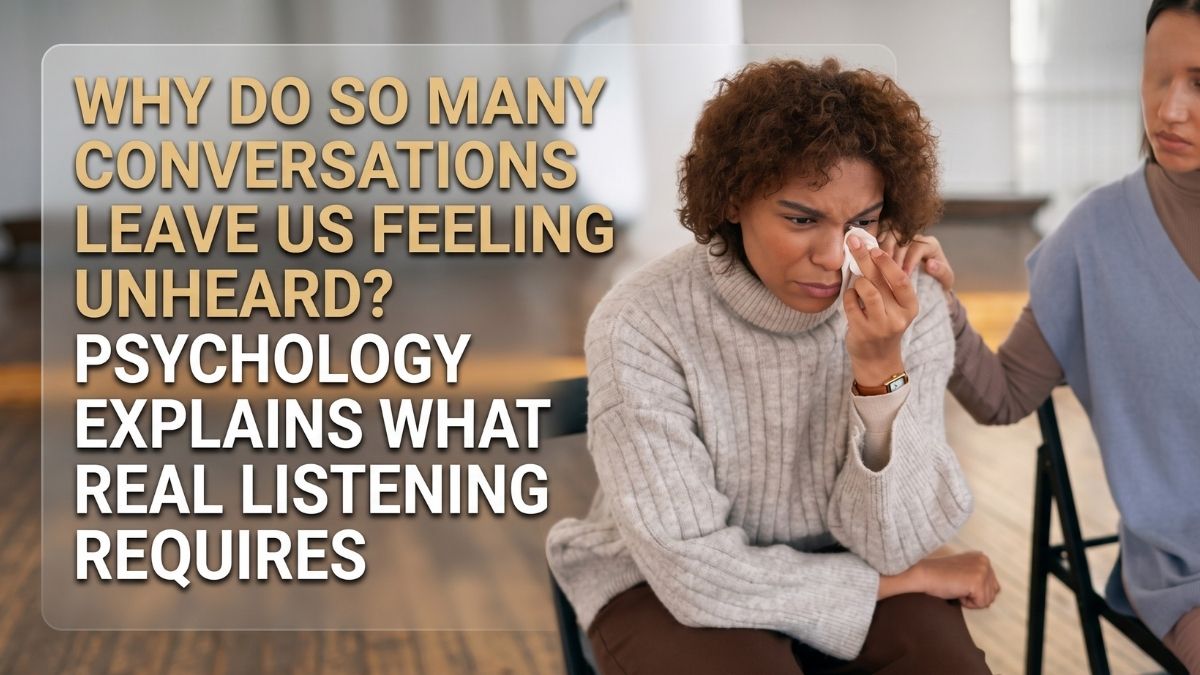
A person can have friends, family members, colleagues and hundreds of online connections and still feel emotionally alone. Being surrounded by people does not necessarily mean feeling understood.
Knowing requires more than simply hearing someone’s words. It involves attention, patience and an effort to see a situation from another person’s perspective. The US Surgeon General’s advisory on social connection and loneliness has highlighted the importance of meaningful social connection for health and well-being. Research has also suggested that high-quality listening can reduce loneliness after people discuss painful experiences.
So why can genuine understanding feel difficult to find?
Listening
Many everyday conversations may look like dialogues but function more like two separate monologues.
Someone describes a difficult day, and the listener may already be preparing a response before the story has finished. They might be thinking about a similar experience, searching for advice or deciding what reassuring comment to make.
A response such as “It happened to me too” can be intended as empathy. But it can also shift attention away from the person who was speaking.
Dr Sugami Ramesh, Senior Clinical Psychologist at Apollo Hospital, Bannerghatta Road, Bangalore, explained, “Most people don’t listen to understand; they listen to respond.”
She added, “The vast majority of interpersonal interactions are not authentic dialogues; they are merely overlapping monologues.”
The difference may seem subtle, but it changes the experience of a conversation. One person is trying to communicate an experience while the other is already preparing what to say next.
Fixing
Another obstacle is the instinct to solve problems immediately.
When someone says, “I am exhausted,” the statement does not necessarily contain a request for advice. They may simply want another person to recognise what they are experiencing.
Advice can be useful when someone asks for it. But offering solutions too quickly can sometimes make a person feel that their emotions have been treated as a problem to be corrected.
Dr Ramesh explained, “When people share their struggles, they are rarely looking for a technical solution, they are looking for an emotional witness.”
That distinction is important. Feeling understood does not always depend on receiving a solution. Sometimes it comes from knowing that another person has noticed the emotion behind the words and is willing to stay with it.
Attention
Phones and digital distractions are often blamed for poor conversations, and they can certainly make sustained attention more difficult. But they are not the only explanation.
People also enter conversations carrying stress, fatigue, work pressures and personal concerns. Even without a phone nearby, someone’s attention may be divided between the conversation and everything else occupying their mind.
This makes attention central to meaningful listening. Two people can be sitting across from each other and exchanging words while neither is fully present.
The quality of a conversation depends partly on whether the listener is actually processing what the other person is saying rather than simply waiting for an opportunity to speak.
Silence
Good listening can sometimes look less active than expected.
It may involve allowing someone to finish without interruption. It may mean asking a simple follow-up question such as, “What happened after that?” It can also involve leaving a brief pause instead of immediately filling the silence.
Silence can feel uncomfortable because people often assume that every pause needs an answer. But a short pause can give someone space to gather their thoughts or continue explaining something difficult.
Listening does not require constant verbal responses. Attention itself can communicate that the conversation matters.
Mirroring
Dr Ramesh suggested “reflective mirroring” as one way to improve listening. Instead of immediately offering a solution, the listener reflects the emotion or situation they believe they have heard.
For example, if someone says they have been overwhelmed at work, a listener might respond by acknowledging that the situation sounds exhausting rather than immediately suggesting how to manage their workload.
This does not mean pretending to know exactly how another person feels. Instead, it creates an opportunity for the speaker to clarify whether the listener has understood correctly.
A response such as “It sounds like you have been carrying a lot lately” leaves room for the other person to say more.
Connection
The importance of being heard becomes clearer when viewed alongside the broader issue of loneliness.
Social connection is not simply about the number of people in someone’s life. A large network can coexist with a lack of emotional closeness. Someone can regularly communicate with others and still feel that their experiences are not being recognised.
This is why the quality of interactions matters. A conversation in which someone feels listened to may provide a different experience from one in which they feel interrupted, dismissed or quickly given advice.
Meaningful listening cannot remove every source of loneliness, but it can contribute to a stronger sense of connection.
Practice
Becoming a better listener does not necessarily require complicated techniques. It can begin with small changes in how conversations are approached.
Let the other person finish their thought. Ask questions that encourage them to explain rather than questions that quickly lead to advice. Resist the urge to compare their experience with your own unless that comparison genuinely helps. Most importantly, notice whether you are listening to understand or simply waiting for your turn to speak.
Being truly understood can feel rare partly because listening requires something that modern conversations often lack: sustained attention. When people slow down, allow space and respond to the experience behind the words, a conversation can become more than an exchange of statements. It can become a place where another person feels recognised rather than merely heard.
FAQs
Why do people feel unheard?
Listeners may focus on responding rather than understanding.
What is reflective mirroring?
It means reflecting the emotion or situation you heard.
Does listening reduce loneliness?

High-quality listening may help reduce feelings of loneliness.
Why can advice feel unhelpful?
Advice can miss the emotional need behind someone’s words.
How can you listen better?
Stay present, avoid interrupting and ask thoughtful follow-up questions.