
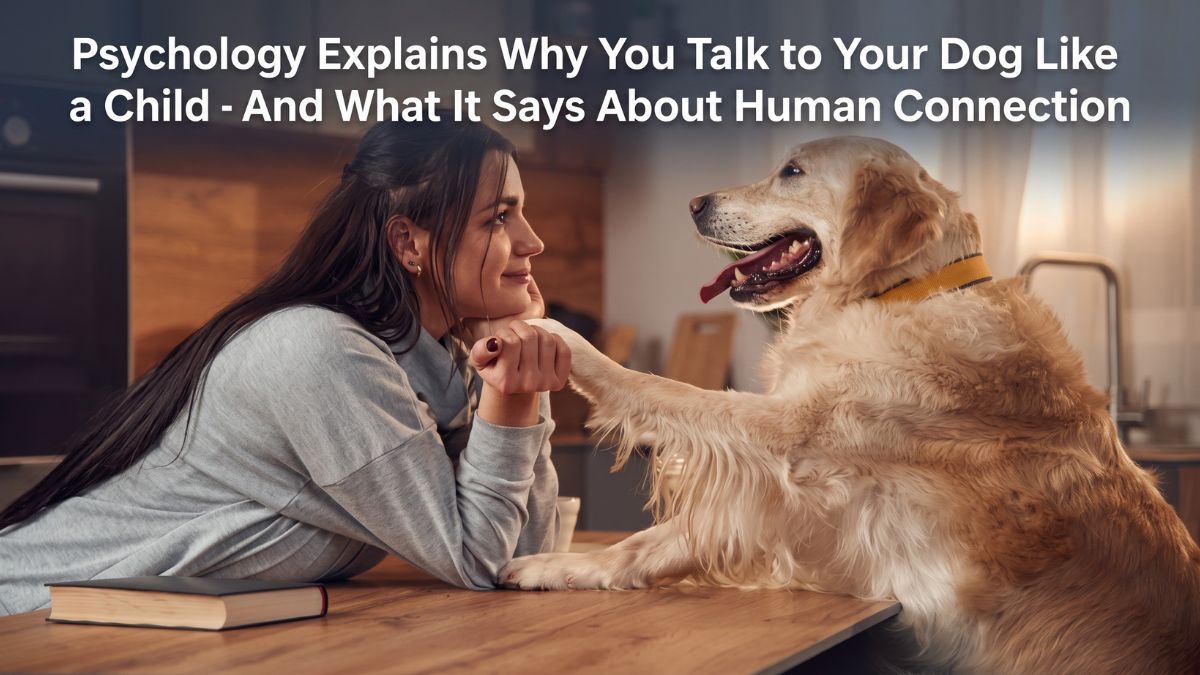
Talking to a dog in a high-pitched voice, stretching out words and using phrases such as “who’s a good boy?” is common among pet owners. From the outside, it can look a little childish. But psychology research suggests there is more happening than simple imitation of the way people speak to babies.
Humans naturally adjust the way they communicate depending on who is listening. When the listener cannot respond using language, we may change our pitch, pace and emotional tone to make the interaction easier and more engaging.
Dogs, in turn, appear capable of detecting some of these changes. So why does your voice change when you speak to your dog?
Speech Changes
Research has found that people use different speech patterns when addressing infants, animals and other adults.
In a 2002 study led by Denis Burnham, researchers recorded 12 mothers speaking to a baby, a family pet and another adult. They examined factors including pitch, emotional warmth and vowel hyperarticulation.
Pitch increased when the women spoke to both babies and pets, while emotional warmth also increased. However, vowel hyperarticulation was primarily associated with speech directed at the baby.
Vowel hyperarticulation means making vowel sounds more distinct from one another. It can help infants identify and eventually learn different sounds in language.
The difference is revealing. People may instinctively make their speech more expressive when communicating with a dog, but they do not necessarily simplify pronunciation in the same way they do when speaking to a child who is learning language.
A later experiment involving adults, dogs, parrots and infants found that vowel clarity increased across those groups, with infant-directed speech showing the greatest degree of hyperarticulation. The findings suggest that humans adjust speech according to what they believe their listener can understand.
Human Instincts
Psychology has a term for attributing human characteristics, intentions or emotions to animals: anthropomorphism.
Research by Nicholas Epley and colleagues proposed that anthropomorphism can be influenced by several factors. These include how easily human explanations come to mind, how motivated people are to understand and predict another being’s behavior, and the desire for social connection.
The social element is sometimes interpreted too simply as evidence that people who talk extensively to their pets must be lonely. That conclusion misses the broader picture.
People may talk to animals because they want to understand their behavior, establish routines or strengthen a social bond. If you are trying to persuade a dog to leave the sofa, for example, predicting what might motivate it is useful regardless of whether you feel lonely.
In that sense, talking to a pet can reflect an ordinary human tendency to build a mental model of another creature.
Slower Pace
The way people speak to dogs also appears to change in terms of speed.
A research team based in Geneva compared human speech directed toward other people with speech directed toward dogs across several languages. The study involved 27 people speaking to humans and 22 speaking to dogs, along with recordings of vocalizations from 30 dogs.
Humans generally spoke at around four syllables per second when addressing other people. When speaking to dogs, their rate dropped to approximately three syllables per second.
That slower pace is interesting because dog vocalizations tend to occur at an even slower rhythm.
Researchers also examined brain activity using EEG recordings. Human neural responses to speech tend to follow relatively fast rhythms, while dogs appear to process vocal information through slower neural patterns.
Slowing down may therefore help align human speech with the way dogs process auditory information. It is not something most owners consciously plan. The adjustment appears to happen naturally during interaction.
Words Matter
Tone alone may not be enough to capture a dog’s attention.
A 2018 study from researchers at the University of York examined how dogs responded to different combinations of voice and language. Dogs heard people using a dog-directed style with a higher, warmer tone and dog-related language. They also heard people speaking in a more ordinary adult-directed manner.
The dogs showed greater attention toward the speaker using the dog-directed combination and later spent more time near that person.
Researchers then separated the elements. Some speech used dog-related words but an ordinary adult tone, while other speech used a warm, exaggerated tone but adult-oriented content.
The dogs did not show the same preference when the elements were separated.
That suggests both delivery and content may matter. A warm voice can help attract attention, but the words themselves may also provide meaningful information.
However, the evidence is not completely consistent. An earlier study found that puppies responded to dog-directed speech while adult dogs did not show the same response when the speech was played through speakers.
Differences in age, setting and whether the speaker was physically present could help explain the contrasting results.
Practical Changes
So what does this mean for everyday conversations with your dog?
There is no need to abandon the expressive voice altogether. Instead, using clear, familiar words may make communication more useful.
Words such as “dinner,” “outside,” “wait,” “bed” and “walk” can become meaningful because dogs repeatedly encounter them in specific situations.
Slowing down can also help. Speaking at a measured pace gives a dog more opportunity to process the sounds and associate them with familiar actions.
Keeping instructions relatively short is another practical approach. Dogs may respond more effectively to a clear cue than to a long sentence containing several competing signals.
Context matters, too. A dog can learn that certain words predict particular events, but body language, facial expressions, gestures and the surrounding situation also contribute to communication.
Natural Connection
Talking to a dog like a child is not necessarily a sign of immaturity. It may instead reflect a broader feature of human communication: we adapt our voices when interacting with beings whose responses are different from our own.
People do this with infants, animals and even individuals who speak another language. We slow down, change our tone and look for signs that the other person or animal has understood.
Dogs cannot answer in words, but they can respond through movement, attention, facial expressions and behavior. That feedback gives humans enough information to keep adjusting the way they communicate.
Your dog may not understand every sentence you say, but it can learn that certain sounds, tones and patterns predict what happens next. That makes the familiar sing-song voice more than a quirky habit. It is part of a larger human tendency to adapt communication when trying to connect with another mind.
FAQs
Why do people talk to dogs like babies?
Humans naturally adjust speech to engage nonverbal listeners.
Do dogs respond to high-pitched voices?
Some studies suggest dogs attend more to expressive speech.
Should you speak slowly to your dog?
A slower pace may help dogs process spoken cues.
Do dogs understand human words?
Dogs can learn associations between sounds, words and outcomes.
Is talking to dogs immature?
No, it can reflect normal human communication behavior.