
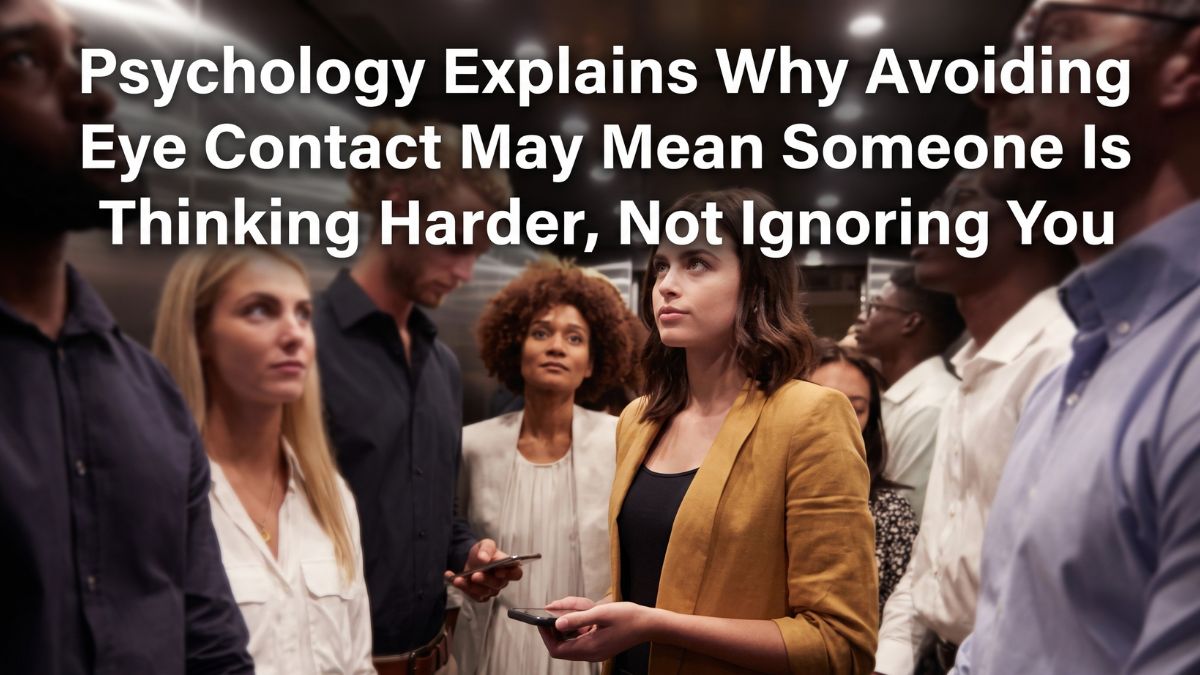
Looking away during a conversation is often interpreted as a sign of discomfort, dishonesty or disinterest. In workplaces, interviews and everyday conversations, people may assume that someone who avoids eye contact is not paying attention or is trying to hide something.
Psychological research offers a more nuanced explanation. When a question becomes difficult, looking away can reduce the amount of visual information the brain has to process, leaving more mental capacity for finding words, remembering information or organizing a response.
In other words, the person staring at the ceiling may not have left the conversation at all. They may be concentrating on what they want to say.
Mental Load
A human face contains a remarkable amount of information. During a conversation, the brain processes eye movements, facial expressions, mouth movements and other subtle changes while also listening to the words being spoken.
That creates competing demands for attention.
Research by Arthur Glenberg and colleagues, published in 1998, examined gaze aversion across five experiments. The researchers found that people were more likely to look away when questions became harder. They also found that gaze aversion was associated with better performance on some tasks.
The researchers proposed that looking away may temporarily disengage people from external visual information, allowing internally focused thinking to operate more efficiently.
This helps explain a behavior that can otherwise seem strange. Someone may look away precisely because they are trying harder to answer you.
Hard Questions
The relationship between gaze and thinking has also appeared in later research.
Researchers Shogo Kajimura and Michio Nomura examined whether direct eye contact could interfere with word retrieval. Participants were asked to generate verbs for nouns while watching videos of faces displaying either direct or averted gaze.
Direct gaze slowed word retrieval when both retrieval and selection demands were high.
The experiment was relatively narrow. It involved video recordings rather than a live conversation, so it should not be treated as a complete explanation of everyday eye contact.
Still, it supports the broader idea that looking directly at another person’s face can sometimes compete with demanding cognitive tasks.
When the brain is searching for a precise word or constructing a complicated answer, reducing visual input may be useful.
Childhood Patterns
Gaze aversion also changes as children develop.
Young children do not show the same consistent pattern of looking away during difficult questions as older children and adults. Research by Gwyneth Doherty-Sneddon and Fiona Phelps examined 36 eight-year-olds using questions with different levels and types of difficulty.
The children looked away more often when questions were harder. The pattern appeared both during face-to-face interaction and through a live video connection.
The researchers interpreted increased gaze aversion as an indication that children were allocating attention toward solving a problem.
Later research found similar relationships between gaze aversion and thinking in autistic children and children with Williams syndrome.
That matters because eye contact is sometimes treated as a universal measure of attention or social engagement. The evidence suggests it is not that simple.
Cultural Rules
Eye contact also carries different meanings across cultures.
Researchers from Japan and Finland studied how participants responded to faces displaying direct or averted gaze. Their physiological responses were broadly similar, but their social judgments differed.
Japanese participants tended to rate faces with direct eye contact as angrier and less approachable than Finnish participants did.
The researchers suggested that cultural display rules could help explain the difference.
This does not mean that everyone from one culture interprets eye contact in exactly the same way. It does show why assumptions about a single “correct” amount of eye contact can be misleading.
A behavior that seems confident in one social environment may appear aggressive, uncomfortable or overly intense in another.
Deception Myths
The idea that liars avoid eye contact remains widespread, but research does not provide strong support for using gaze aversion as a reliable lie detector.
In a survey of 99 British police officers, 73% said they believed liars look away. That belief was considerably more common than several other proposed behavioral cues.
Researchers later tested the idea with 338 passengers at an international airport. Some participants were telling the truth about their trip while others were lying.
Gaze aversion did not distinguish the two groups.
Interestingly, the researchers observed more deliberate eye contact among some people who were lying. They suggested that this could reflect an attempt to appear credible.
That finding does not mean looking directly into someone’s eyes proves they are lying either. It simply illustrates the weakness of treating one behavior as a dependable indicator of deception.
Better Conversations
The research has a practical implication: give people time to think.
If someone looks toward the wall, floor or ceiling after receiving a difficult question, interrupting the silence may make it harder for them to formulate an answer.
This can be particularly relevant during interviews, meetings and serious conversations. A short pause may be part of the thinking process rather than evidence that someone is disengaged.
People can also make the process easier by explaining what they are doing. Saying, “Give me a second to think about that,” can prevent a normal thinking pause from being mistaken for avoidance.
Changing the physical setting may help as well. Conversations that involve walking, driving or doing another simple activity naturally reduce the pressure of constant face-to-face attention.
Eye Contact
Eye contact remains an important part of communication, but more is not necessarily better.
Research by Frances Chen and colleagues found that increased eye contact was associated with less attitude change among listeners who already disagreed with a speaker. Participants instructed to focus on a speaker’s mouth showed greater shifts in their views than those instructed to maintain eye contact.
The study was conducted under laboratory conditions, so its findings should not be directly applied to every workplace or social interaction. Nevertheless, it challenges the popular idea that sustained eye contact is always the most persuasive communication strategy.
Eye contact can signal attention, connection and engagement, but maintaining it also requires mental resources. Looking away can sometimes be a way of temporarily reducing that load so a person can concentrate on what they are trying to communicate.
So the next time someone looks away while answering a difficult question, it may be worth resisting the immediate assumption that they are bored, evasive or uninterested. They may simply be using their visual attention differently. Communication is not measured by eye contact alone, and a person’s ability to stay engaged cannot always be seen in where they choose to look.
FAQs
Why do people look away when thinking?
Looking away can reduce visual distractions during difficult thinking.
Does avoiding eye contact mean disinterest?
No, it can indicate concentration, discomfort or personal preference.
Does eye contact prove someone is lying?
No, eye contact is not a reliable lie detector.
Does culture affect eye contact?
Yes, cultures can have different expectations about eye contact.
Can eye contact affect thinking?
Yes, direct gaze can sometimes compete with demanding mental tasks.