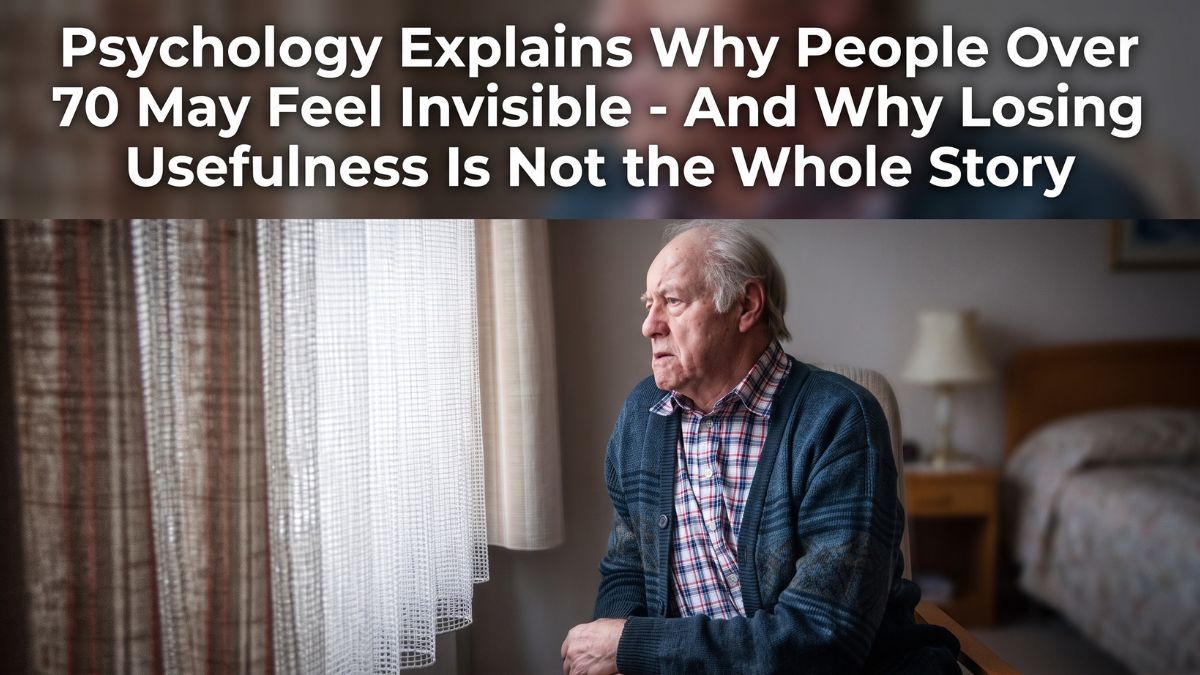
Feeling invisible after 70 can be deeply unsettling. An older person may notice that others speak to a companion instead of them, interrupt them, or use an overly simplistic tone when addressing them. Over time, these experiences can influence how they see themselves.
But psychology suggests there is an important distinction between feeling invisible and believing that personal value has disappeared. An older adult may accurately recognize age-based changes in how others treat them while still making an inaccurate conclusion about their own worth.
Invisibility
The feeling of being overlooked is not necessarily a distorted perception. Ageism can influence everyday interactions, often in ways that people do not consciously recognize.
In 2021, the World Health Organization and other United Nations bodies published the first global report on ageism, drawing partly on research involving 83,034 people across 57 countries. The report found that approximately one in two people held moderately or highly ageist attitudes toward older adults.
That broader social environment matters. If older people regularly encounter assumptions that they are less capable, less independent or less relevant, being ignored can become a repeated experience rather than an isolated misunderstanding.
Someone who feels overlooked may therefore be responding to genuine social behavior. The important question is what meaning they attach to that experience.
Elderspeak
One example of age-related bias is known as elderspeak. It refers to communication patterns sometimes used when speaking to older adults, including exaggeratedly slow speech, simplified vocabulary, unusually loud voices or overly familiar terms.
Research has found that older adults can perceive these communication styles as patronizing and disrespectful. Although much of the research has focused on healthcare and care settings, similar communication patterns can occur in everyday environments.
The problem is partly that such behavior can appear helpful on the surface. A person may believe they are being considerate when they are actually making assumptions about another adult’s ability to understand or respond.
For an older person, repeated experiences like these can gradually affect their sense of social identity.
Self-Worth
This is where psychology adds an important distinction.
Feeling ignored does not necessarily mean that a person’s usefulness has ended. The social response may be real, but the conclusion that personal value has disappeared is a separate judgment.
Research by psychologist Becca Levy and colleagues at Yale followed 660 people aged 50 and older for more than two decades. Participants with more positive views of their own aging had a median lifespan 7.5 years longer than those with more negative views.
The researchers identified several possible explanations, including what they described as will to live. However, the findings were correlational and came from one cohort. They do not prove that simply changing one’s attitude will add years to an individual’s life.
Still, the study illustrates an important psychological point. Beliefs about aging can be connected with health and well-being rather than functioning merely as positive or negative thoughts.
Usefulness
Many people build part of their identity around being needed.
Work can provide a clear role. So can raising children, managing a household, supporting relatives or contributing to a community. These responsibilities create regular evidence that one’s skills and decisions matter.
Retirement or other major life changes can remove those signals very quickly.
The resulting adjustment can be difficult because the person has not necessarily become less capable. Instead, the environment may have stopped asking them to use the abilities they previously relied upon every day.
This distinction matters at any age, but it can become especially significant later in life when employment, physical independence or family responsibilities change.
Usefulness can therefore be an unstable foundation for self-worth. Other people may stop needing a particular service without that meaning the person providing it has become less valuable.
Identity
A healthier psychological approach is to separate usefulness from identity.
Being needed can provide satisfaction and purpose, but it is only one part of a person’s identity. Knowledge, relationships, interests, memories, judgment, humor and personal values can remain meaningful even when someone’s daily responsibilities change.
For older adults, maintaining meaningful social roles may also help counter the effects of isolation and age-related stereotyping. These roles do not have to resemble employment. Teaching someone a skill, helping with a community activity or sharing specialized knowledge can all provide opportunities for genuine participation.
The goal is not to keep older people permanently busy simply so they feel useful. It is to recognize them as complete individuals whose value does not depend entirely on what they can provide to others.
Connection
Small changes in everyday communication can also make a difference.
Speaking directly to an older person rather than automatically addressing their companion is a simple starting point. Asking about their experiences, opinions and knowledge can also reinforce their role as an individual rather than treating them as a passive recipient of care.
Specific questions can be particularly useful. Asking someone about their professional experience, neighborhood history or interests communicates that their knowledge is worth hearing.
At the same time, older adults who frequently feel invisible may benefit from examining two separate ideas: how other people are treating them and what that treatment says about their own worth.
The first may require social change. The second may require a change in self-perception.
Psychology does not suggest that older adults should simply ignore ageism or convince themselves that poor treatment is imaginary. A more balanced view recognizes that age-based discrimination can be real while also rejecting the idea that reduced social attention means a person has become irrelevant.
Growing older can change the roles through which people contribute, but it does not erase their identity. The challenge is to avoid allowing other people’s assumptions to become the measure of one’s own value. A person may no longer be needed in the same ways they once were, but that is different from no longer mattering.
FAQs
Why do some older people feel invisible?
Ageism, isolation and changing social roles can contribute.
What is elderspeak?
It is a patronizing communication style sometimes used with older adults.
Can ageism affect mental health?
Yes, repeated ageism can affect well-being and self-perception.
Does usefulness determine self-worth?
No, usefulness is only one part of personal identity and value.
How can older adults maintain purpose?
Meaningful relationships, interests and community roles can help.