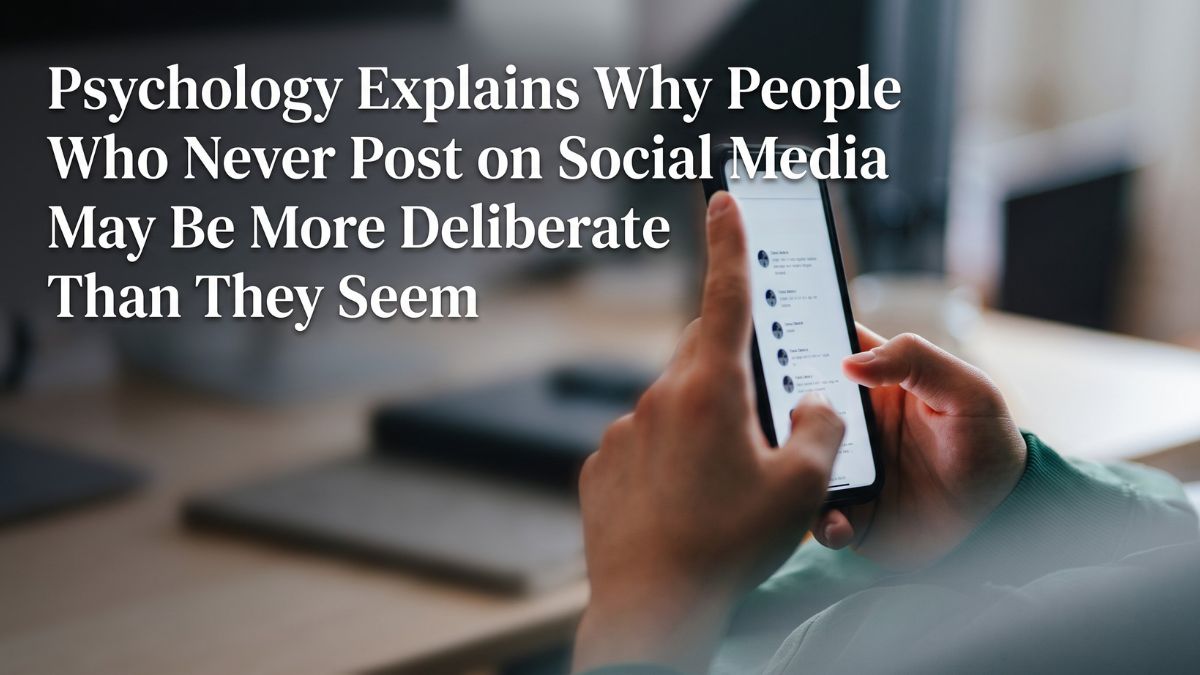
A person can spend hours on social media without posting a single update, leaving a comment or reacting publicly. From the outside, that behavior can look passive. But psychology and research on online communities suggest that people who mostly observe may have their own reasons for staying quiet.
Some users simply find what they need by reading. Others may prefer privacy, want to understand a community before participating or decide that adding another comment would not be useful. In many cases, browsing without contributing is not necessarily a sign of disengagement.
Majority
The idea that most online users are silent observers is not new.
Jakob Nielsen popularized the concept of “participation inequality” in 2006. His frequently cited 90-9-1 rule suggested that roughly 90% of people in many online communities primarily observe, 9% contribute occasionally and 1% account for most contributions.
Nielsen presented the ratio as a rule of thumb rather than a universal law, and participation patterns vary considerably between platforms and communities. Still, the broader pattern has appeared repeatedly: a relatively small group of highly active users can generate a large share of the content consumed by everyone else.
Research from Pew Research Center illustrates the same imbalance on Twitter. In a study involving 2,791 American adults whose Twitter activity was examined, the most prolific 10% of users produced 80% of all tweets. The median user among the remaining 90% posted only twice a month and had 19 followers.
The result is easy to overlook while scrolling. A feed can feel like a representation of everyone’s opinions when it is actually shaped heavily by a relatively small number of highly active accounts.
Motivation
Why do so many people choose to remain quiet?
Research suggests there is no single explanation.
Blair Nonnecke and Jenny Preece interviewed online community members who mainly observed rather than contributed. Their research identified numerous reasons for lurking, including simply finding reading sufficient and wanting to understand how a community worked before participating.
Later research by Preece and colleagues similarly found that some people remained silent because they did not need to post, while others believed that saying nothing was the more appropriate or useful choice.
That distinction matters. Not contributing does not necessarily mean someone has nothing to say.
A person may read a discussion carefully and decide that another comment would add little. Another may be interested in learning rather than presenting an opinion. Someone else may value the information without feeling any need to become publicly visible.
Privacy
Social media makes an unusual demand on users: it can place very different parts of their social lives in one audience.
Researchers Alice Marwick and danah boyd described this phenomenon as “context collapse.” Online, a single post can potentially be seen by family members, colleagues, friends, acquaintances and strangers.
Offline, people naturally adjust what they say according to who is present. The way someone speaks with a close friend is usually different from how they speak with an employer.
Social media can blur those boundaries.
For people who value privacy, remaining an observer may therefore be a deliberate way to maintain control over what others know about them. They can access information and participate indirectly without creating a permanent public record of their opinions.
Intimacy
There is also a difference between being seen and being known.
Psychologists Harry Reis and Phillip Shaver’s interpersonal process model of intimacy describes closeness as involving self-disclosure followed by a response that communicates understanding, acceptance or care.
Simply revealing something does not automatically create intimacy. The response matters too.
This helps explain why posting to a large audience may not necessarily create the sense of connection that people expect. A person can receive hundreds of views without feeling genuinely understood.
A private conversation with one trusted person can provide a very different experience. The audience is smaller, but the interaction can be more meaningful.
Social media visibility and interpersonal closeness are therefore not interchangeable.
Effects
The idea that passive social media use is automatically harmful is also more complicated than it is sometimes presented.
Research by Patti Valkenburg and colleagues examining 40 survey studies found that the evidence did not consistently support a simple distinction in which active use was beneficial and passive use was harmful.
Other reviews have also produced conflicting findings. Individual differences appear to matter, meaning the same online behavior can affect different people in different ways.
A three-week study involving 353 adolescents, for example, found support for the passive-use hypothesis for about 20% of participants, while the pattern was not supported for the remaining 80%.
The study involved adolescents and represents only one piece of evidence, so it should not be generalized to everyone. Still, it highlights an important point: the psychological effect of browsing may depend partly on what a person experiences while doing it.
For some, scrolling can encourage comparison or envy. For others, it can provide information, entertainment or a sense of connection.
Envy
How someone feels after using social media may be more informative than whether they posted or remained silent.
A person who repeatedly compares their life with carefully presented versions of other people’s lives may experience dissatisfaction or envy. Someone else may scroll through the same platform and simply learn something new or stay informed about friends.
This is why time spent online does not tell the whole story.
Two people can spend the same amount of time on the same platform and have completely different experiences. One may leave feeling discouraged, while the other leaves curious or entertained.
The useful question is therefore not simply, “How much social media do you use?” It may also be, “What does using it do to you?”
Connection
People who rarely post do not necessarily need to become more active.
If browsing feels useful and does not consistently interfere with well-being, there may be little reason to treat quiet participation as a problem.
For someone who does feel disconnected, however, a private conversation may be more valuable than increasing public engagement. Sending an interesting article to one friend, joining a small group or maintaining a regular conversation can create a different kind of connection than collecting likes or comments.
Social media engagement is also not a reliable measure of affection. A person can care about what someone shares without ever clicking a reaction button.
The silent user may not be disengaged at all. They may simply have decided that observing is enough, that privacy matters, or that meaningful connection is better built in smaller spaces. Psychology suggests that being visible online and being genuinely known are different experiences, and confusing the two can make social media seem more socially rewarding than it actually is.
FAQs
Why do people browse without posting?
Many find reading useful or prefer to stay private.
Are social media lurkers passive?
Not necessarily. Research suggests observation can be deliberate.
What is participation inequality?
It describes how a small group creates most online contributions.
Can passive social media use be harmful?
It depends on the person and how social media affects them.
Does posting create genuine connection?
Not always. Private interactions can create deeper connection.