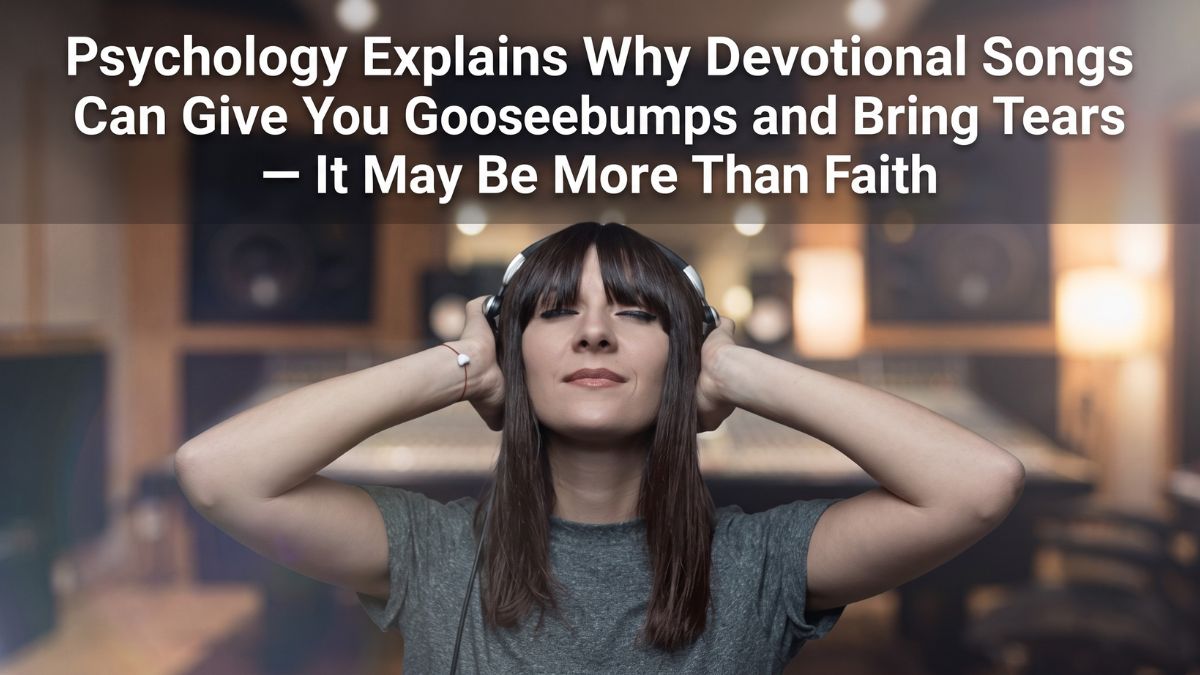
A familiar devotional song can sometimes trigger a surprisingly strong emotional response. A bhajan, hymn, chant or spiritual song may bring tears to the eyes, create goosebumps or produce a sudden sense of calm.
For some people, the reaction is closely connected to faith. For others, the music may bring back childhood memories, family traditions, places of worship or difficult periods when the song provided comfort.
Psychology suggests that these reactions can involve several processes at once. Music can interact with memory, identity, expectation and emotions such as awe. As a result, tears or goosebumps do not necessarily indicate sadness. They can also accompany pleasure, gratitude, relief or a feeling of connection.
Memory
One reason devotional music can feel unusually powerful is its connection with autobiographical memory.
Music is a strong cue for personal memories, particularly when a particular song has been heard repeatedly during emotionally significant periods. Research has found that music can bring autobiographical memories to mind vividly and sometimes with considerable detail.
A familiar devotional song may therefore remind someone of a grandparent singing it, childhood visits to a place of worship, family gatherings or a period when the music provided emotional comfort.
In these situations, the melody is only the starting point. The emotional response may come from the network of experiences and relationships associated with the song.
Identity
Devotional music can also connect with a person’s sense of identity.
Social identity theory, associated with psychologists Henri Tajfel and John Turner, proposes that people derive part of their self-concept from groups and identities that are important to them.
For someone whose spiritual or religious practice is an important part of their identity, devotional music may carry meanings that other forms of music do not.
Research by Renate Ysseldyk and colleagues has examined how music associated with religious identity can interact with memory, self-esteem and mood. Their research involving 267 participants found that responses to religious and nonreligious music could depend partly on the listener’s identity.
This does not establish that devotional songs universally produce stronger emotional reactions. Instead, it illustrates how music can interact with personal identity.
When someone hears a devotional song, they may therefore be responding not only to its melody and lyrics but also to memories, beliefs, relationships and experiences that form part of their identity.
Awe
Goosebumps and tears may also be connected with awe.
Psychologists such as Dacher Keltner have studied awe as an emotion associated with experiences that feel vast or greater than the individual. Awe can sometimes produce what researchers describe as a reduced sense of the self.
Research by Jesse Preston and Faith Shin found that recalling spiritual experiences increased feelings of awe and a sense of the “small self.” Their five studies involved 1,064 participants and included both religious and nonreligious individuals.
This provides one possible explanation for why devotional music can make someone feel humbled, grateful or connected to something larger than themselves.
A powerful chorus may temporarily shift attention away from everyday concerns. During that moment, personal worries can feel less prominent, while feelings of gratitude, wonder or connection become more noticeable.
Expectation
Music can also create emotions through expectation.
Listeners continually anticipate what might happen next in a piece of music. Familiar songs make these predictions particularly strong because the brain already knows the melody, rhythm and structure.
Research in music psychology has identified several mechanisms that can contribute to emotional responses, including musical expectancy, autobiographical memory, emotional contagion, rhythmic entrainment and learned associations.
This may help explain why the opening notes of a familiar devotional song can sometimes trigger an immediate reaction.
If someone has heard a song hundreds of times, they may already anticipate a particular musical phrase or chorus. When that expected moment arrives, the combination of anticipation and emotional significance can intensify the experience.
Tears
Tears do not always mean sadness.
Research by Kazuma Mori and Makoto Iwanaga examining music-induced chills and tears found that tears could occur alongside pleasure and physiological calming. Their findings also suggested that tears and chills are not identical emotional responses.
Another study involving 961 adults found different emotional forms of music-related crying, including positive crying associated with awe as well as crying connected with sadness or distress. Awe-related crying appeared more frequently with religious or classical music and music perceived as complex and beautiful.
This helps explain why someone can cry during a devotional song while simultaneously feeling peaceful.
Consider someone hearing a song associated with a deceased parent. The experience might bring together grief, affection, gratitude and a sense of connection. The tears would not necessarily represent one emotion. They could reflect several emotions occurring together.
Response
There is no single personality type that becomes emotional when listening to devotional music.
Personal familiarity, musical preference, emotional state, memories, identity and the meaning attached to a particular song can all influence the response.
This is particularly relevant to music-evoked autobiographical memories. A song can act as a powerful reminder of an earlier period because it was repeatedly present during meaningful experiences.
As a result, two people can hear the same devotional song and respond very differently. One person may feel peaceful, another nostalgic, another deeply moved and someone else may experience little emotional reaction at all.
The response is therefore highly personal.
When a devotional song produces goosebumps or tears, psychology suggests that faith may be only one part of the explanation. Memory, identity, musical expectation, awe and emotional associations can work together to create an unusually powerful experience. For some listeners, the music may become a bridge between the present moment and the people, places, beliefs and experiences that have shaped their lives. That is why a familiar song can sometimes feel less like something being heard and more like something being remembered and experienced all over again.
FAQs
Why do devotional songs cause goosebumps?
Music, memory, expectation and awe can trigger goosebumps.
Why can devotional music make people cry?
Tears can reflect awe, gratitude, memories, sadness or emotional release.
Can music trigger old memories?
Yes, familiar music can strongly evoke autobiographical memories.
Is emotional crying always sadness?
No, tears can also accompany pleasure, awe and gratitude.
Does devotional music affect everyone similarly?
No, responses depend on personal meaning, memories and preferences.