
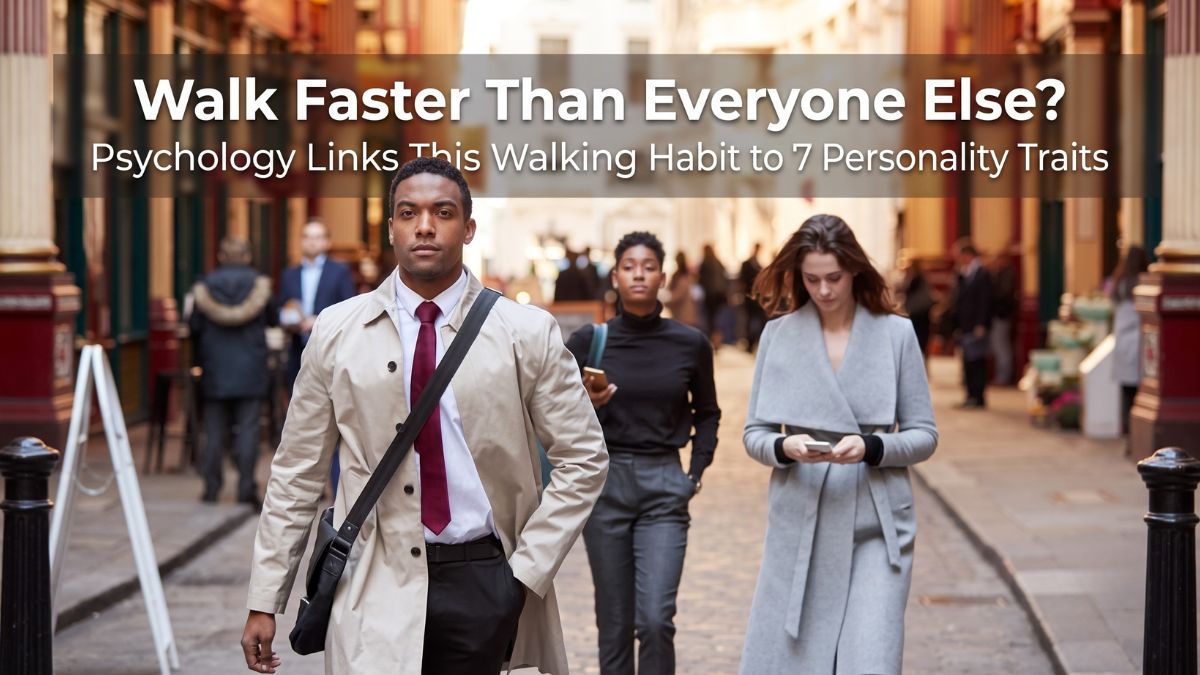
People often fall into two broad groups when it comes to walking speed: those who move quickly and those who prefer a slower, more relaxed pace. In busy streets, railway stations or office corridors, the difference can be obvious.
Walking speed is influenced by many practical factors, including age, fitness, health, environment and whether someone is in a hurry. But research has also explored whether movement patterns are associated with personality and behaviour.
Some studies have found links between faster walking and traits such as extraversion, conscientiousness and emotional stability. These findings do not mean that walking speed can accurately determine someone’s personality. Instead, they suggest that the way people move may sometimes reflect broader patterns in behaviour.
Conscientious
Fast walkers may sometimes display characteristics associated with conscientiousness, a personality trait linked with organisation, reliability, self-discipline and goal-directed behaviour.
People who are highly conscientious often place importance on planning and completing tasks efficiently. A purposeful walking pace may fit into that broader behavioural pattern.
Research examining personality and walking speed has reported associations between faster movement and goal-oriented characteristics. However, walking quickly on its own cannot establish whether someone is conscientious.
A person could simply be trying to catch a train.
Extraverted
Extraversion is generally associated with sociability, energy and a tendency to seek stimulation from the environment.
Some research has linked extraversion with greater physical activity and more energetic movement patterns. A faster walking pace may sometimes appear alongside this higher level of physical engagement.
That does not mean every fast walker is outgoing. Someone can walk quickly while being quiet or socially reserved. Personality traits exist on a spectrum, and behaviour can change depending on the situation.
Stable
Another possible association involves neuroticism and emotional stability.
Neuroticism describes a tendency toward greater emotional reactivity, worry and sensitivity to stress. Lower levels are generally associated with greater emotional stability and resilience.
Some research has found relationships between walking speed and measures of emotional or psychological health. Faster walking can sometimes occur alongside characteristics associated with greater confidence or emotional stability.
Still, this relationship should not be interpreted as a psychological test. A person’s walking pace can be affected by dozens of factors unrelated to their emotional state.
Open
Openness to experience is associated with curiosity, imagination, creativity and interest in new experiences.
The connection between openness and walking speed is less direct than some other personality associations. People who seek stimulation or novelty may sometimes display more active movement patterns, but walking quickly does not necessarily indicate curiosity or adventurousness.
Someone walking quickly through an unfamiliar city, for example, could simply be trying to reach a particular destination.
Agreeable
Agreeableness is associated with warmth, cooperation, compassion and consideration for other people.
Walking speed can sometimes reveal this trait indirectly because people adjust their behaviour to accommodate others. A person who normally walks quickly may slow down when walking with someone who moves more slowly.
Conversely, a fast pace may sometimes be maintained when people are walking together because both individuals are comfortable with it.
This illustrates why context matters. The same person’s walking speed can change depending on who they are with.
Assertive
Fast movement can also appear alongside behavioural assertiveness.
Assertiveness involves expressing yourself confidently, taking initiative and acting with a degree of purpose. People who are more assertive may sometimes move through environments with a clear sense of direction.
A fast walking pace can therefore be interpreted as one possible behavioural signal of confidence or urgency.
But again, the signal is not definitive. Someone who walks quickly may simply have developed the habit over many years.
Ambitious
Ambition involves a desire to achieve goals, make progress or improve one’s circumstances.
A person who values efficiency may prefer to move quickly because they dislike wasting time. In that sense, walking speed can become part of a broader pattern of goal-directed behaviour.
This does not mean that slower walkers lack ambition. People can be highly driven while deliberately maintaining a relaxed pace.
Walking speed should therefore be treated as a possible behavioural association rather than a measure of someone’s motivation.
Context
The biggest limitation is that walking speed is not determined by personality alone.
Age, physical fitness, mobility, injuries, health conditions, weather, footwear, surroundings and time pressure can all influence how quickly someone walks.
Even mood can change movement. A person who normally walks slowly may speed up when late for an appointment. Someone who usually moves quickly may slow down while sightseeing.
This is why psychological research generally looks at patterns across groups rather than using walking speed to judge an individual.
Meaning
There is still value in understanding why movement and personality can sometimes appear connected.
Human behaviour rarely happens in isolation. People who are energetic, organised or highly goal-oriented may express those tendencies through many different behaviours, including how they move through their surroundings.
But the relationship works as a clue, not a diagnosis.
Walking quickly may suggest efficiency or urgency in one situation and simply reflect a person’s normal physical rhythm in another. The same applies to people who walk slowly.
Ultimately, walking speed offers only a small piece of the psychological picture. It can sometimes coincide with traits such as conscientiousness, extraversion, emotional stability, openness, agreeableness, assertiveness and ambition, but none of these can be reliably determined from pace alone. The more useful takeaway is that everyday behaviours can reflect broader tendencies while still being shaped by context, health and circumstance.
FAQs
Does walking speed reveal personality?
It may show associations, but it cannot determine personality.
Are fast walkers more ambitious?
Some research links faster movement with goal-directed behaviour.
Are fast walkers more extroverted?

Some studies associate faster movement with extraversion.
Can slow walkers be ambitious?
Yes. Walking pace does not determine a person’s ambition.
What affects walking speed?
Health, age, fitness, environment and time pressure can affect pace.