Three Super Bowl victories in five years and five appearances in seven title games changed the way many NFL fans viewed the Kansas City Chiefs. For supporters, the run represented sustained excellence. For rival fanbases, it became a familiar storyline that repeatedly ended with their own teams watching from home.
That dynamic helps explain why the Chiefs’ difficult 2025 season generated such a strong reaction around the league. Kansas City finished 6-11, its first losing season since 2012, and some fans responded with relief or satisfaction rather than sympathy.
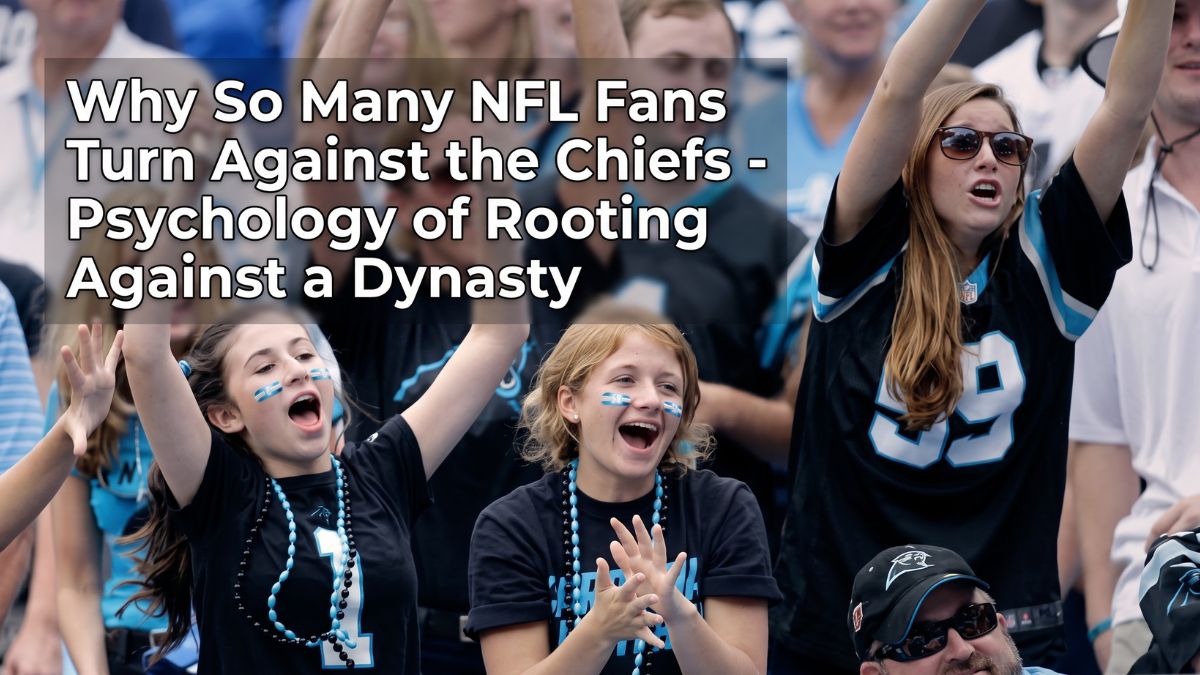
The reaction is not unusual in sports. When one team remains at the top for an extended period, admiration can gradually give way to fatigue. The same pattern appeared during the New England Patriots’ long run under Tom Brady and Bill Belichick and with Michael Jordan’s Chicago Bulls. Dominance can create its own opposition.
Fatigue
Mike Florio discussed the phenomenon on Pro Football Talk, describing what he called “Chiefs fatigue.”
“I think a lot of people are sleeping on the Chiefs,” Florio said. “It’s easy to do that because we had Chiefs fatigue. I think we’re more quick to embrace the demise of the Chiefs because we’d gotten sick of the Chiefs. There was that sense that football fans had enough.”
The idea of fatigue is important because sports fandom is not based entirely on loyalty to one team. Fans also respond to narratives. They want competition, uncertainty and the possibility that a different team might finally reach the top.
When the same franchise repeatedly occupies that position, supporters of other teams can begin to see its success as an obstacle rather than an achievement.
Kansas City’s success became particularly significant within the AFC because several elite quarterbacks have struggled to get past the conference’s biggest games.
Josh Allen has established himself as one of the league’s leading quarterbacks but has not yet won a Super Bowl. Joe Burrow reached the Super Bowl following the 2021 season and lost to the Los Angeles Rams. Lamar Jackson, a two-time MVP, has also been unable to reach the Super Bowl.
Florio captured that broader frustration when he said, “Give one of the other kids a turn, please. Let one of the other kids play in a Super Bowl.”
Rivalry
The reaction to Kansas City’s dominance is not simply about disliking successful teams. It also reflects the competitive structure of professional sports.
A championship run by one team necessarily closes a door for several others. Every Chiefs victory in a postseason game has meant another team’s season ended. Over several years, those losses accumulate in the memories of rival fanbases.
That can make a dominant team a convenient target for frustration.
There is also a psychological element to supporting an underdog. Fans often enjoy seeing an established power challenged because it creates uncertainty. A new champion offers a different story and gives supporters of other teams a reason to believe their own club could be next.
This does not mean every fan who roots against Kansas City is motivated by resentment. Rivalry, team loyalty and ordinary competitive preferences all play a role. But prolonged dominance can certainly change the emotional response to a successful franchise.
Decline
Kansas City’s 6-11 record in 2025 gave those feelings a major outlet.
The Chiefs finished with their worst record since 2012, creating a natural opening for predictions that their long period of dominance had finally ended.
Yet one poor season does not necessarily establish a permanent decline.
The team entered the 2026 season with important questions. Patrick Mahomes was returning from the ACL injury that had ended his 2025 campaign. The offense needed more reliable production around him, while the defense also had areas requiring improvement.
The secondary, in particular, had struggled against the pass in 2025, ranking 28th in the NFL in that category.
Those problems are significant. A return to championship contention is never guaranteed, particularly in a league where injuries, roster changes and salary-cap decisions can quickly alter a team’s prospects.
But the history of successful NFL teams also provides reason for caution before declaring a dynasty finished.
History
The Patriots offer a useful comparison.
During New England’s long period of success, predictions about the end of the team’s dominance appeared regularly. Yet Brady and Belichick repeatedly extended the run, finding ways to remain competitive despite changes to the roster and league landscape.
The Chiefs now face a different set of circumstances, but the broader lesson remains relevant. Sustained success creates high expectations, and a downturn can look more dramatic because it follows such a strong run.
A 6-11 season is certainly a major change from competing for championships. It is not, by itself, proof that a team can no longer contend.
Mahomes’ presence also gives Kansas City an important variable. Quarterback play does not solve every roster problem, but an elite quarterback can change how quickly a team recovers from a difficult season.
Comeback
The most interesting part of the Chiefs’ story may therefore be what happens after the backlash.
If Kansas City returns to contention in 2026, the same fans who celebrated the team’s decline could quickly become frustrated again. That would not necessarily be because the team had done anything unusual. It would simply reflect how expectations change around dominant franchises.
When a team wins repeatedly, fans begin looking for evidence that the run is ending. When that team finally struggles, the reaction can become disproportionately strong because years of accumulated frustration are released at once.
But competitive sports rarely follow a straight line.
The Chiefs’ 2025 season showed that even the NFL’s most successful recent teams can experience a substantial setback. Whether it represents the beginning of a longer decline or simply one difficult season remains to be determined.
For rival fanbases, that uncertainty may be part of the appeal. After years of seeing Kansas City near the top, they finally have a reason to believe the AFC could belong to someone else. The question is whether the Chiefs’ setback marks a genuine change in the league’s competitive order or merely a temporary interruption.
FAQs
Why do fans root against dominant teams?
Long periods of dominance can create fatigue among rival fanbases.
Why do people dislike the Chiefs?
Repeated success can make a team a focus of competitive frustration.
Did the Chiefs have a losing season in 2025?
Yes. Kansas City finished the 2025 season with a 6-11 record.
Why are the Chiefs important in the AFC?
Their recent success has repeatedly affected other AFC contenders.
Can the Chiefs return to contention?
Yes, although their 2026 recovery is not guaranteed.