
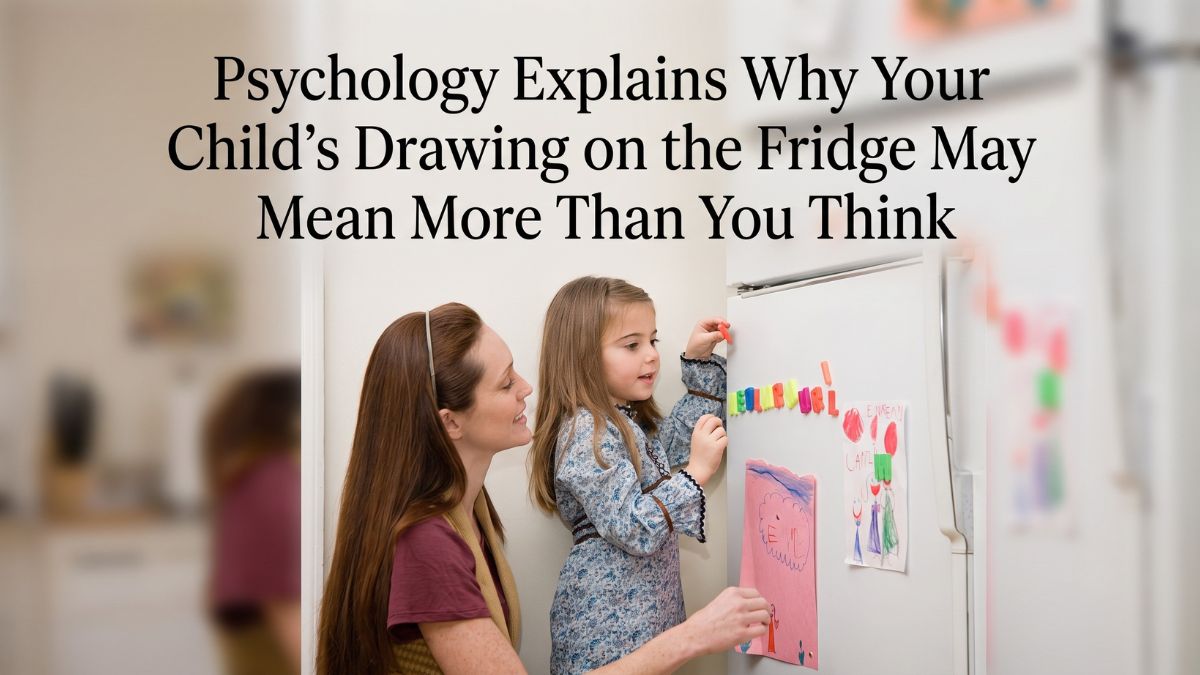
A family refrigerator can reveal something about how parents respond to their children’s everyday experiences. Alongside food lists and family photographs, it may hold a child’s drawing, school certificate, sports medal, or handmade craft. At first glance, these displays may simply appear to be expressions of parental pride. Psychology, however, offers a broader way to understand the habit.
When parents place a child’s work somewhere the family regularly sees it, they may be communicating that the child’s effort and experiences have been noticed. For a child, a drawing that an adult considers simple may represent imagination, concentration, and time spent creating something. Keeping it visible can therefore become a small form of recognition.
The meaning also depends on what parents emphasise. Praising effort, learning, and persistence sends a different message from focusing only on talent, grades, or winning.
Recognition
Children develop ideas about themselves partly through their interactions with important adults. When parents display a child’s artwork or achievement, they give visible attention to something the child considers meaningful.
A drawing that appears ordinary to an adult may represent considerable effort to a young child. Seeing it displayed can communicate that someone noticed what they created and considered it worth remembering.
This can be considered alongside self-determination theory, associated with psychologists Edward Deci and Richard Ryan. The theory identifies competence, autonomy, and relatedness as important psychological needs. Recognition within a supportive family can contribute to a child’s sense of competence and connection.
That does not mean placing artwork on a refrigerator automatically produces confidence. Rather, it can be one small part of a wider family environment in which children feel noticed and supported.
Praise
The language surrounding an achievement may be more important than the achievement itself.
Consider two children who return home with medals. One parent says, “You are naturally brilliant.” Another says, “You worked hard and kept practising.” Both statements can express pride, but they communicate different ideas about ability.
Research by Carol Dweck and colleagues has examined how different forms of praise can influence children’s beliefs about ability. Praise that recognises effort, strategies, learning, and persistence can support a more flexible view of ability, in which skills are understood as capable of developing.
This distinction can matter when children encounter setbacks. If a child learns that being naturally talented is central to their identity, failure may feel particularly uncomfortable. If parents also recognise practice and learning, difficulties can be understood as part of development.
A picture on the fridge does not have to communicate that a child is the best artist or that a medal makes them exceptional. It can simply mark an experience that involved effort and personal growth.
Memories
There is also a straightforward emotional reason parents preserve children’s work: memories.
A first drawing, school certificate, sports medal, or handmade card can be connected to a particular period in family life. An old picture may later remind parents of their child’s interests at a certain age or of an occasion the family experienced together.
The refrigerator is particularly suited to this because it is part of everyday household activity. Family members may see the items while preparing meals, eating, or moving through the kitchen.
For children, repeated visibility can also make these experiences feel like part of the family’s shared history. The display does not necessarily have to represent achievement. It can represent a moment that the family remembers and values.
Motivation
Recognition can also play a role in motivation.
When children receive attention and encouragement after practising a skill or completing a project, that response may encourage continued engagement. A parent who notices the time a child spends learning an instrument, preparing for a competition, or working on artwork is acknowledging the process as well as the outcome.
However, recognition can have different effects depending on the broader message at home.
If children regularly hear that their parents are proud only when they win, they may begin to associate approval with successful outcomes. By contrast, recognising preparation, persistence, improvement, and curiosity can give achievement a wider meaning.
The refrigerator itself does not determine this distinction. What matters is the pattern of communication around the achievement.
Connection
Parents may also display children’s work because it strengthens their own emotional connection with their children’s development.
A refrigerator covered with drawings, photographs, certificates, and crafts can gradually become a visual record of changing interests. A child’s artwork may evolve from simple shapes to detailed pictures, while certificates and photographs mark different stages of school and extracurricular activities.
For parents, these objects can therefore have sentimental value beyond their practical importance.
A handmade card, for example, may have little monetary or artistic value, but it can still remind a parent of a particular age, personality, or family moment. The display becomes less about the objective quality of the item and more about the person who created it.
Balance
Displaying a child’s achievements is not necessarily a sign that parents are trying to encourage competition or high performance. In many families, it is simply a familiar way of celebrating children’s experiences.
The more useful psychological question is what children learn from that recognition.
A medal can communicate that winning is worth celebrating. A drawing can communicate that creativity is appreciated. But when parents also recognise effort, learning, persistence, and curiosity, the message becomes broader.
This distinction can be especially relevant as children encounter failure. A child who understands that parents value only results may become concerned about disappointing them. A child who sees effort and learning recognised may have more room to treat mistakes as part of the process.
Ultimately, the psychology behind a refrigerator display is less about the refrigerator itself and more about the relationship surrounding it. A drawing, medal, or certificate can become a simple reminder that parents are paying attention to their child’s experiences. When recognition extends beyond winning or natural talent to include effort and growth, the display can carry a quieter message: the child is seen, their experiences matter, and their development is worth noticing.
FAQs
Why do parents display kids’ drawings?
It can show children that their creativity and effort are valued.
Can fridge displays build confidence?
They may support confidence as part of a warm family environment.
Why does effort-based praise matter?
It can encourage children to value learning, practice, and persistence.
Can medals create pressure?
They can if children learn that approval depends only on winning.
What does artwork represent to parents?
It can preserve memories and celebrate a child’s growth.