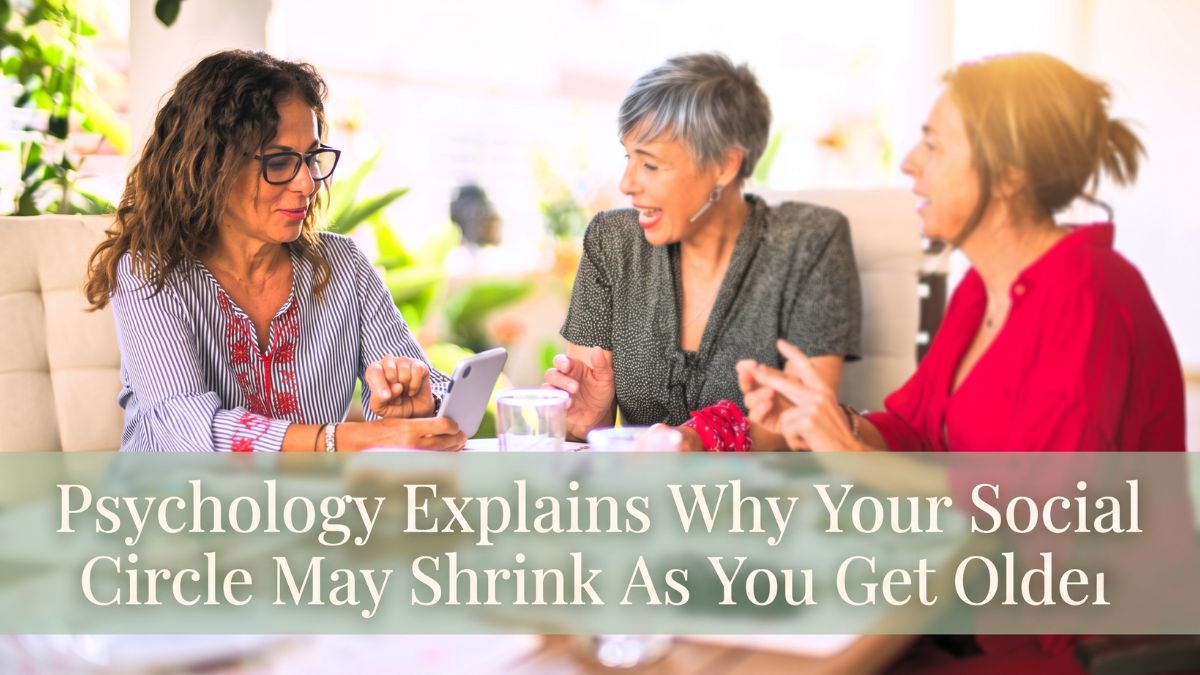
As people move through adulthood, their social circles often become smaller. Fewer casual meetups make it onto the calendar, some group chats gradually go quiet, and there may be less interest in maintaining relationships that feel one-sided or emotionally draining.
This change is sometimes interpreted as becoming antisocial or losing interest in people. Psychology offers a different explanation. As people become more aware that their time and energy are limited, they may become more selective about where they invest them.
That does not necessarily mean wanting fewer relationships altogether. It can mean placing greater value on relationships that feel meaningful, dependable and emotionally rewarding.
Time
Psychologist Laura Carstensen’s socioemotional selectivity theory provides one explanation for this shift. The theory proposes that people’s social goals can change when their perception of future time changes.
When the future feels open-ended, meeting new people and maintaining a broad network can have clear benefits. New acquaintances can provide information, experiences, opportunities and connections that may become useful later.
As people begin to perceive their future time as more limited, priorities can change. Emotional meaning and satisfying experiences in the present may become more important than collecting new social connections.
Research tracking social networks across adulthood has found that networks often expand during young adulthood and become smaller later. Importantly, the reduction does not appear to affect every relationship equally. More peripheral relationships tend to decline, while close relationships are often maintained more carefully.
Priorities
Age itself may not be the only factor behind this change.
Researchers have examined what happens when people’s perception of time is changed without changing their actual age. When younger adults are encouraged to imagine that they will soon move far away, for example, they can become more interested in spending time with emotionally close people rather than meeting unfamiliar individuals.
Conversely, when older adults are given a sense that their future has become more open-ended, their interest in novelty can increase.
This suggests that perceived time may be more important than the number of birthdays someone has had.
Major life events can create the same shift. Moving to another country, losing someone close, changing careers or facing a serious family situation can suddenly make time feel more limited. A person may then start reconsidering which relationships deserve regular attention.
Ambivalence
Not every difficult relationship is easy to leave.
Psychologists sometimes describe certain relationships as ambivalent ties. These are connections that contain both positive and negative experiences. Someone may be supportive one day and critical the next, or enjoyable to be around while also creating considerable stress.
Research by Bert Uchino and Julianne Holt-Lunstad has examined the effects of these mixed relationships. Their findings suggest that ambivalent relationships can be associated with greater physiological stress than relationships that are consistently positive or consistently negative.
The uncertainty may be part of the problem. With someone you strongly dislike, you generally know what to expect. With an unpredictable relationship, you may continue hoping for a positive interaction while also preparing for disappointment.
That emotional uncertainty can make a relationship more tiring than its occasional enjoyable moments suggest.
Quality
A large social network is not necessarily a sign of strong social health.
The long-running Harvard Study of Adult Development has repeatedly emphasized the importance of relationship quality. Its findings have linked warm, dependable relationships with better health and well-being later in life.
That does not mean having only a few friends is automatically healthier. Rather, the research suggests that the quality and reliability of important relationships matter greatly.
Think of social connection less like collecting contacts and more like maintaining a small garden. Having dozens of plants does not help if none receives enough water. A smaller number of well-maintained relationships can sometimes provide more support than a much larger network that receives little attention.
Balance
There is, however, an important distinction between becoming selective and becoming isolated.
Reducing unnecessary social obligations can free up time for meaningful relationships. But withdrawing from most social contact can have serious consequences. Research involving hundreds of thousands of participants has found a strong association between stronger social relationships and better survival outcomes.
Peripheral relationships also serve useful purposes. Acquaintances can introduce new ideas, information and opportunities. Talking to people outside your closest circle can provide perspectives that familiar friends may not offer.
For that reason, completely eliminating casual connections may not be the goal. A healthy social life can include both close relationships and lighter connections.
Selection
A useful way to think about changing friendships is to examine how a relationship feels over time rather than judging it after one difficult interaction.
Does spending time together generally leave you feeling supported or depleted? Is effort reasonably mutual across the year? Can you be honest with the person without worrying that vulnerability will be used against you?
The answers can reveal more than the number of years you have known someone.
A friendship does not have to be perfect to be valuable. People experience stressful periods, misunderstandings and unequal effort at different points in life. What matters is the broader pattern.
A relationship based entirely on history may continue because ending it feels uncomfortable, not because it remains meaningful.
Connection
Becoming more selective with age does not automatically mean becoming antisocial. In many cases, it may reflect a change in priorities.
People have limited time, attention and emotional energy. As those resources become more noticeable, they may choose to spend more of them on relationships that provide trust, affection, reliability and shared meaning.
The healthiest form of social pruning is therefore not about having the smallest possible circle. It is about making room for relationships that matter while retaining enough social variety to stay connected to the wider world.
A smaller circle can be perfectly healthy when it reflects thoughtful choices rather than withdrawal. The important question is not how many people remain in your life, but whether the relationships you continue to invest in genuinely support connection and well-being.
FAQs
Why does my social circle shrink with age?
People may prioritize meaningful relationships as their sense of time changes.
Does having fewer friends mean being antisocial?
No. A smaller circle can reflect greater selectivity rather than isolation.
Why do casual friendships often fade?
Peripheral relationships may receive less time as priorities change.
What are ambivalent relationships?
They are relationships that include both positive and negative experiences.
Can a small social circle be healthy?
Yes, when it includes supportive relationships and enough social connection.