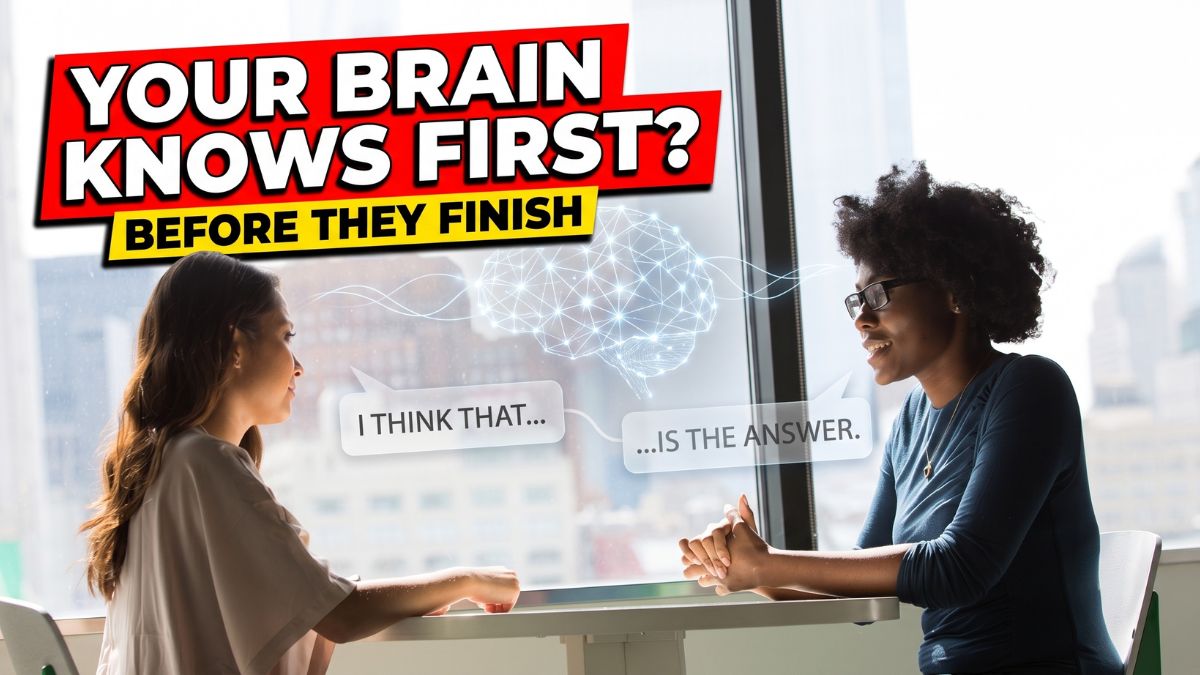
Have you ever known what a friend was about to say before they finished their sentence? Maybe someone starts telling a familiar story and you can already guess the ending. Or perhaps a coworker pauses during a meeting and you immediately begin preparing an answer before they finish asking the question.
Psychology suggests these experiences are not simply coincidences. During conversation, the brain constantly uses context, previous experience, language patterns, and knowledge about other people to anticipate what may come next.
Researchers studying language comprehension have found evidence that listeners generate predictions about upcoming words and meanings as conversations unfold.
A 2018 review by psychologists Martin J. Pickering and Chiara Gambi concluded that prediction can occur at multiple levels of language, from meaning to linguistic form. More recent research continues to examine how these predictions are generated and how much they vary between individuals.
Prediction
One important idea behind this phenomenon is predictive processing. The theory proposes that the brain does not simply wait for information to arrive and then react. Instead, it continuously uses previous knowledge and incoming information to generate expectations about what is likely to happen next.
In conversation, this could mean predicting the meaning of a sentence, the likely next word, or even the direction of another person’s thought.
For example, if someone says, “I went to the restaurant last night and the food was…” your brain may automatically activate possibilities such as “terrible,” “amazing,” or “expensive.”
You do not consciously list these options. Your language system is working ahead of the incoming speech.
Research reviews show that listeners can use contextual information to generate these types of predictions during language comprehension.
Experience
The brain’s predictions are not random. They are strongly influenced by context, memory, and previous experience.
If your best friend frequently says, “You won’t believe what happened,” before telling a funny story, you may immediately recognize the conversational pattern. You know the person, their vocabulary, and their typical storytelling style, so your brain has more information from which to make a prediction.
Research also suggests that speaker identity can influence language comprehension by shaping expectations. In other words, who is speaking can affect what listeners anticipate hearing.
This helps explain why conversations with close friends can sometimes feel relatively effortless. Familiarity gives your brain a large store of information about what that person is likely to say or mean.
Turn-taking
The brain is not only predicting what another person will say. It also appears to help us anticipate when we should respond.
This is important because everyday conversation moves quickly. People usually do not wait several seconds after every sentence before responding. Instead, listeners can begin preparing their own responses while the other person is still talking.
This is often examined through turn-taking research in psycholinguistics. Conversation can be understood as a coordinated social activity in which speakers and listeners continuously adjust to one another.
A 2026 review in Nature Reviews Psychology describes face-to-face conversation as a complex form of joint action in which language production and comprehension are closely connected.
Imagine someone asking, “What did you think about the movie?” Before they have completely finished the question, your brain may already be searching your memory for an opinion.
By the time they stop speaking, part of your response may already be prepared.
Meaning
It is important to distinguish between predicting meaning and predicting exact words.
Psychologists do not suggest that the brain always predicts the precise sentence another person will say. Prediction can operate at several levels.
You may anticipate the topic, emotional direction, general meaning, or likely response without knowing the exact words.
For instance, if a friend says, “I finally heard back from the company,” you may immediately expect them to explain whether they got the job.
You do not necessarily know the sentence that follows. Your brain has simply narrowed down the likely possibilities.
Pickering and Gambi’s review describes language prediction as operating across different linguistic levels and argues that people can use aspects of their own language-production systems to help anticipate what another speaker may say.
Efficiency
Constant anticipation may make communication more efficient.
If the brain had to process every conversation from scratch, waiting for each individual word before interpreting its meaning, everyday communication could become much slower.
Predictions allow listeners to combine incoming information with context and expectations. This can help the brain process language efficiently.
However, prediction also creates the possibility of prediction error.
When someone says something unexpected, the brain has to update its expectations. For example, if your normally quiet friend suddenly announces that they are moving across the country, the information may not fit your existing expectations.
You may need a moment to process the surprise before deciding how to respond.
Updating predictions is therefore an important part of communication.
Errors
Predictive processing does not mean the brain always knows what will happen.
Unexpected responses are a normal part of conversation. Research on language prediction continues to examine exactly how prediction works, including whether it is always necessary for comprehension or whether people rely on it more strongly in certain situations.
This helps explain why you might occasionally finish another person’s sentence correctly and feel as though you knew exactly what they were thinking, only to be completely wrong the next time.
Your brain is making an informed estimate based on available information. It is not accessing the future.
Familiarity
Familiarity gives the brain more information with which to make predictions.
Over time, you learn someone’s favorite expressions, sense of humor, opinions, speech patterns, and typical reactions. Repeated interactions can therefore make conversations feel smoother because you have more reliable expectations about what might happen next.
This may help explain why longtime friends can sometimes communicate with fewer words. A pause, facial expression, or unfinished sentence can carry meaning because both people have accumulated shared experiences.
These predictions can be accurate, but they can also be wrong. The important point is that the brain is continuously using what it already knows to interpret what is happening now.
Communication
The ability to anticipate what comes next is one part of how conversation becomes a coordinated activity. Your brain is processing the words it hears while also drawing on memory, context, speaker identity, and expectations about what might follow.
That does not mean people can literally predict the future or know exactly what another person is thinking. It means the brain can make educated predictions based on information already available.
The next time you find yourself preparing an answer before someone has finished speaking, your brain may simply be using the past to make a reasonable guess about what comes next.
Sometimes it gets the prediction right. Sometimes it needs to revise it. Both outcomes are part of ordinary human conversation.
FAQs
Why does the brain predict conversations?
It uses context, memory, and language patterns to anticipate what comes next.
Can you predict someone’s exact words?
Usually not; predictions often concern meaning or topic instead.
Does familiarity improve prediction?

Yes, knowing someone provides more information about their speech patterns.
Why do predictions sometimes fail?
Unexpected information can differ from what the brain expects.
Does predicting mean reading minds?
No, it involves making informed guesses from available information.