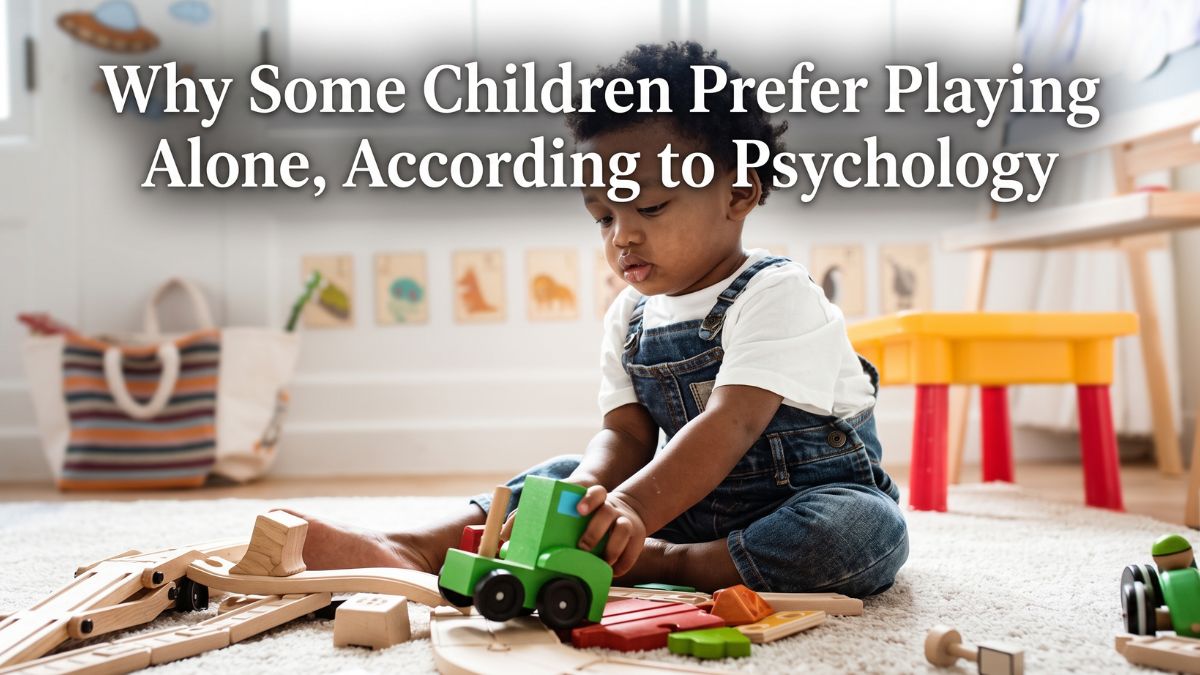
Not every child wants to spend every afternoon surrounded by friends. Some are perfectly content building with blocks, drawing, reading, arranging toys or creating elaborate imaginary worlds on their own. For parents, however, a child who frequently plays alone can sometimes raise questions. Is the child lonely? Are they struggling socially? Or do they simply enjoy their own company?
Psychology suggests that the answer depends less on how often a child plays alone and more on why they choose to do it.
Independent play can be a normal part of childhood development. Children differ in temperament, interests and comfort with social interaction, and some naturally prefer quieter activities. At the same time, solitude can have a different meaning when a child wants social contact but avoids it because of shyness, anxiety or fear of rejection.
Understanding that distinction can help parents avoid treating normal differences in personality as a problem while still recognizing situations in which a child may need additional support.
Development
Nearly a century ago, psychologist Mildred Parten studied children’s play and identified several forms of social participation, including solitary, parallel, associative and cooperative play.
Her work helped establish the idea that children can engage with their surroundings in different ways as their social development progresses. Modern research has since provided a more complicated picture than a simple progression from solitary play to increasingly social play.
Nonsocial play can remain part of childhood even as children develop friendships and become more socially engaged.
A 2018 study by Robert J. Coplan and colleagues examined 340 kindergarten and first-grade children. The researchers found that a preference for solitary play was not directly associated with emotional or school difficulties.
That finding is important because it suggests that a child who often chooses to play alone cannot automatically be assumed to be experiencing a problem.
Independence
For some children, playing alone provides freedom to decide what happens next.
A child building a tower does not have to negotiate which blocks another child gets to use. Someone drawing can change the picture whenever they want. A child creating an imaginary story can control every character and event.
This kind of play can give children an opportunity to explore ideas, practice skills and follow their curiosity without having to coordinate with others.
Independent play may also allow children to spend more time concentrating on activities they find interesting. One child may enjoy constructing elaborate buildings, while another prefers drawing or pretending with toys.
These preferences can reflect temperament and interests rather than a lack of social ability.
Solitude
Research also shows that different types of solitary behavior should not be treated as identical.
In a 1994 study, Robert J. Coplan, Kenneth H. Rubin, Nancy A. Fox, Susan D. Calkins and Susan L. Stewart observed 48 four-year-old children.
Their findings distinguished between different forms of nonsocial behavior. Solitary-active and solitary-passive play were not associated with anxiety in the same way as reticent behavior.
Reticent children were more likely to watch their peers or remain on the sidelines instead of joining activities.
That distinction matters. A child quietly reading a book alone is behaving differently from a child who wants to join a group but repeatedly stays away because they are uncomfortable.
Simply counting how much time a child spends alone therefore gives only part of the picture.
Temperament
Children have different natural preferences for stimulation and social interaction.
Some are highly comfortable in groups and quickly approach unfamiliar children. Others take longer to warm up and may prefer observing before participating. Some children genuinely enjoy spending periods of time by themselves.
A child who chooses solitary activities but communicates comfortably with parents, teachers and peers may simply have a quieter temperament.
The same child might happily join a game when something interests them. Their willingness to interact when they want to can provide useful context.
This is different from a child who consistently wants friendships but appears unable to participate because of fear or anxiety.
Shyness
One of the most important distinctions involves the difference between enjoying solitude and wanting social interaction but struggling to pursue it.
A socially disinterested child may be comfortable playing alone and may not feel particularly motivated to join peers. A shy or socially anxious child may want to participate but feel nervous about approaching others.
Research by Daniel C. Kopala-Sibley and Daniel N. Klein followed 493 children and found differences in the developmental patterns of conflicted shyness and social disinterest.
The distinction highlights why parents should look beyond the visible behavior. Two children can appear equally solitary while experiencing very different emotions.
One may be thinking, “I would rather play by myself.” The other may be thinking, “I want to join them, but I am afraid.”
From the outside, those situations can look remarkably similar.
Warning
Playing alone becomes more concerning when it is accompanied by signs of distress or a noticeable change in behavior.
Parents may want to pay closer attention if a child suddenly stops participating in activities they previously enjoyed, repeatedly expresses fear about being around other children, appears upset about being alone or consistently struggles to form relationships despite wanting them.
The context also matters. A child who has recently changed schools, experienced a family disruption or encountered bullying may respond by withdrawing socially.
In such cases, the behavior may be communicating that something has changed rather than simply reflecting a stable preference for solitude.
Balance
Healthy social development does not require children to be surrounded by peers at every moment.
Children can benefit from both social interaction and opportunities for independent activity. Playing with others can teach negotiation, cooperation and communication, while playing alone can give children space to concentrate, imagine and make their own choices.
The goal is therefore not to eliminate solitary play. Instead, parents can create opportunities for both forms of activity and observe how their child responds.
Does the child seem comfortable? Can they interact with others when they want to? Do they have opportunities to build friendships? Are they distressed by their isolation?
Those questions are often more informative than the amount of time spent playing alone.
Context
A child who happily builds, draws, imagines or explores independently is not necessarily lonely or socially disconnected. Psychology suggests that solitary play can be associated with temperament, curiosity, independence and personal interests.
The more useful question is what the behavior means for that individual child.
If a child enjoys their own activities while also being able to connect with others when they choose, solitary play may simply be part of their normal personality and development. If being alone is accompanied by anxiety, distress, persistent avoidance or an unfulfilled desire for friendships, it may be worth looking more closely at what is happening.
Knowing that difference allows parents to respond with reassurance rather than unnecessary concern, while also making it easier to recognize when a child may benefit from additional support.
FAQs
Why do some children prefer playing alone?
They may prefer solitude because of temperament, interests or independence.
Is playing alone normal for children?
Yes. Solitary play can be a normal part of childhood development.
Does playing alone mean a child is lonely?

No. Some children enjoy independent play without feeling lonely.
How is shyness different from solitude?
A shy child may want friends but feel too anxious to join them.
When should parents worry about solitary play?
Concern may be warranted when solitude causes distress or persistent avoidance.