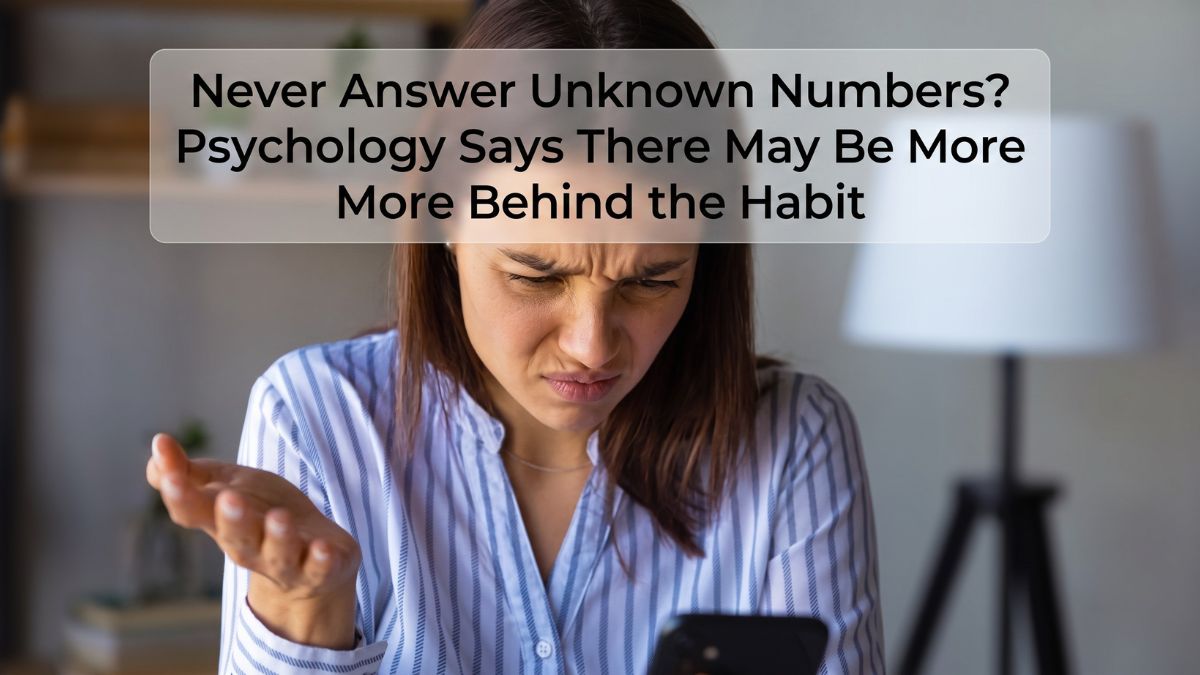
When an unfamiliar number appears on the screen, some people let the phone ring and wait for a voicemail or message. Others answer without hesitation. The difference is not necessarily about manners. For many people, avoiding unknown calls is simply a practical way to manage their time, privacy and attention.
Psychology offers several possible explanations for the habit. Some people dislike unsolicited calls or have become cautious because of spam. Others prefer texting because it allows them to respond at their own pace. In some cases, however, consistently avoiding unfamiliar calls may be associated with intolerance of uncertainty, telephone anxiety, threat perception or learned avoidance.
The behavior itself does not provide enough information to determine why someone avoids a call. The reason behind the choice is more important.
Uncertainty
An unfamiliar phone number introduces uncertainty. Before answering, you do not know who is calling, why they are calling or what they might expect from you.
For people who find uncertain situations uncomfortable, answering an unknown call can create a brief sense of tension. It may raise several possibilities at once: a salesperson, a wrong number, a work-related request or potentially important news.
Intolerance of uncertainty refers to a tendency to find uncertain situations difficult or threatening. A 2026 preregistered meta-analysis involving 28,693 participants found a strong relationship between intolerance of uncertainty and anxiety, with particularly strong associations involving generalized and nonspecific anxiety.
An unknown call can therefore become a small example of a broader psychological response to situations where the outcome is unclear.
Avoidance
Behavioral psychology also provides another explanation through negative reinforcement.
Negative reinforcement occurs when a behavior becomes more likely because it removes something unpleasant. For example, an unfamiliar number calls, a person feels uncomfortable, and they decide not to answer. Once the ringing stops, they may experience relief.
That relief can reinforce the decision to avoid similar calls in the future.
Over time, the pattern may become routine. The person may no longer consciously evaluate each call. They simply see an unfamiliar number and wait for a message.
Research on telephone phobia has examined avoidance-related telephone behavior and found that behavioral interventions can help modify such patterns. However, ordinary call screening should not automatically be interpreted as a phobia. Ignoring an unknown number can be a normal and reasonable choice.
Control
For some people, the preference is less about avoiding communication and more about maintaining control over it.
Phone calls require an immediate response. The conversation can move in an unexpected direction, leaving little time to consider what to say. Text messages, email and other written forms of communication provide more flexibility.
A person can read a message when convenient, think about the response and decide when to reply.
Research by Leanna T. Kim and Sang-Hwa Oh examined telephone anxiety and digital communication. Their 2023 study found that greater use of digital communication technologies was positively correlated with telephone anxiety. Telephone anxiety was also associated with a preference for communication methods other than telephone conversations.
This may explain why someone can communicate comfortably through messaging while rarely answering unexpected calls. Their difficulty may not be with communication itself. It may be with the immediate and less predictable nature of a phone conversation.
Privacy
Privacy is another straightforward explanation.
Communication Privacy Management Theory proposes that people develop rules about how personal information is shared and who is allowed access to it. These rules can extend to everyday communication.
Someone may answer calls from people in their contacts while allowing unfamiliar numbers to go to voicemail. In that situation, the person may simply want the caller to identify themselves before deciding whether to engage.
The behavior is similar to screening a visitor before opening the door. It does not necessarily indicate fear or distrust. It can represent a personal boundary about access to time and attention.
For some people, the rule is simple: if the number is unfamiliar, provide a reason for calling first.
Threat
Previous experiences can also influence how people interpret unexpected calls.
Cognitive appraisal focuses on how people interpret an event rather than simply reacting to the event itself. An unfamiliar call may seem neutral to one person but potentially problematic to another.
Someone who regularly receives scam calls may become more cautious about unknown numbers. A person who has previously received upsetting news by phone may also associate unexplained calls with negative outcomes.
These experiences can affect expectations. The person may begin thinking about possible problems before knowing whether the call is important at all.
This can contribute to anticipatory anxiety, which refers to discomfort or worry that occurs before an anticipated event.
Anxiety
It is useful to distinguish ordinary call screening from significant telephone anxiety.
A person who thinks, “I don’t recognize this number, so I’ll wait for voicemail,” is not necessarily experiencing anxiety. They may simply prefer to verify who is calling before responding.
A different situation exists when someone experiences substantial fear, physical symptoms, persistent dread or significant avoidance of necessary telephone communication.
Research involving 300 medical students in India found that 42% reported some level of telephobia, while 9% reported moderate-to-severe symptoms. Telephobia involves fear or avoidance associated with making or receiving telephone calls.
These findings should not be used to diagnose people based on one habit. Avoiding unknown numbers is common, and the underlying reason can vary considerably from person to person.
Boundaries
The psychology behind unknown-call avoidance often comes down to what a person is trying to manage.
Someone may be protecting their time from interruptions. Another person may be maintaining a privacy boundary. Someone else may prefer communication that gives them time to prepare a response.
For another individual, uncertainty or anxiety may play a larger role.
This is why the same behavior can have different psychological meanings. Looking only at whether someone answers a call does not reveal what they are experiencing internally.
If answering an unknown number feels unnecessary, screening the call may simply be an efficient choice. If it creates significant distress or leads someone to avoid important communication, there may be a different issue worth considering.
Ultimately, people who do not answer unknown numbers cannot be placed into one psychological category. The habit may reflect privacy, communication preferences, caution, time management or, in some cases, anxiety and avoidance. The more useful question is not whether the person is being rude, but what answering the call represents for them. In many cases, choosing not to answer is simply a way of deciding when and how to communicate.
FAQs
Is ignoring unknown calls rude?
Not necessarily; it can be a practical privacy or time boundary.
Why do unknown calls cause anxiety?
They can create uncertainty about who is calling and what they want.
Does ignoring calls mean social anxiety?
No. It may reflect privacy, convenience or communication preferences.
Why do people prefer texts?
Texts offer more control over timing, preparation and responses.
When can call avoidance be a problem?
It may matter when fear or avoidance disrupts necessary communication.