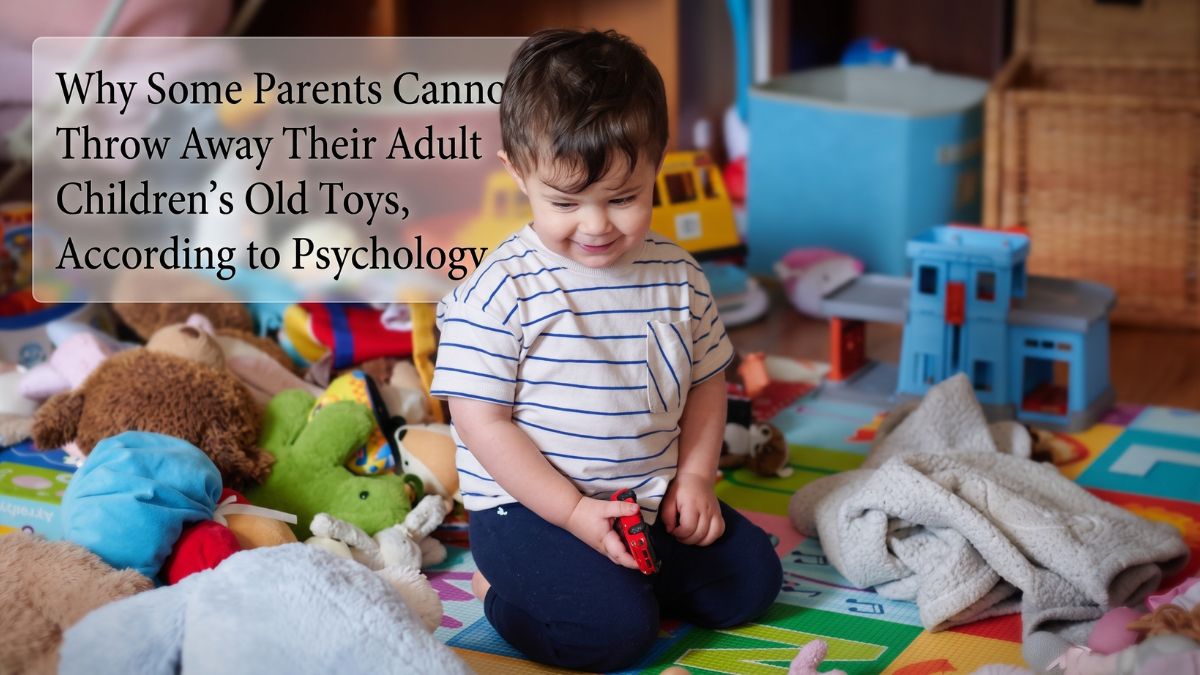
For some parents, an old toy remains difficult to discard long after a child has grown up. A faded teddy bear, worn-out doll, plastic car or favourite board game may have little practical use, yet it can still carry considerable emotional meaning.
Psychology suggests that this behaviour is often connected to memory, identity and emotional attachment rather than the material value of the object. An old toy can become a physical reminder of a particular child, a family home and a period of life that has already passed.
Research on possessions and memory indicates that meaningful objects can help people preserve and retrieve autobiographical memories. This means an old toy may be experienced as more than an object. It can serve as a cue for remembering everyday experiences, relationships and important stages of family life.
Identity
One explanation comes from psychologist and consumer researcher Russell Belk’s Extended Self Theory. Belk proposed that possessions can become extensions of a person’s identity. Objects may represent important relationships, experiences, places and periods of life.
This can help explain why a parent might preserve a toy that their adult child has not used for many years.
The parent may not consciously think of the toy as part of their identity. Instead, its importance can develop through years of association with family routines and caregiving.
A teddy bear, for example, may be connected with bedtime stories and childhood illnesses. A toy kitchen may recall hours spent watching a child play. The object becomes meaningful because of the experiences attached to it.
Research on cherished possessions has similarly found that personal objects can serve emotional, social and identity-related functions. Their meaning can also change as people move through different stages of life.
Nostalgia
Nostalgia provides another perspective. Psychologists Constantine Sedikides and Tim Wildschut have studied nostalgia as an emotion associated with the self, social relationships and a sense of continuity.
Their research suggests that nostalgic experiences can strengthen self-continuity, or the feeling that a person’s past and present are connected. Nostalgia has also been associated with greater social connectedness and psychological well-being.
For parents, an old toy can provide a direct reminder of an earlier period of family life.
Seeing a familiar teddy bear may bring back memories of a child sleeping with it. An old board game may recall weekends spent playing together. A battered toy car may remind a parent of watching a young child move around the living room.
The toy serves as a cue for memories that may otherwise remain less accessible in everyday life.
Parenthood
Parenthood can bring substantial changes to a person’s identity and daily responsibilities. Although being a parent remains important when children become independent adults, the practical experience of caring for them changes considerably.
An old toy can preserve a physical connection to an earlier stage of that relationship.
This relates to research on autobiographical memory. Psychologist Robyn Fivush has examined how people use personal memories to develop broader narratives about their lives. Individual experiences can become part of an ongoing understanding of who we are and where we have come from.
Childhood possessions can sometimes support that process.
The financial value of the object may have little relevance. A cheap plastic toy can be more meaningful than an expensive possession when it is connected to a significant period of family life.
Its value comes from the memories associated with it rather than its price or usefulness.
Ownership
Behavioural research also helps explain why giving up certain possessions can feel difficult.
The endowment effect describes the tendency for people to assign greater value to things they own. Research by Joann Peck and colleagues has also examined how psychological ownership and emotional attachment can influence people’s willingness to give up possessions.
This distinction can matter when a parent decides whether to discard an old toy.
Throwing away an unused household item may feel routine. Discarding a toy that belonged to a child can feel different because the object has accumulated years of personal associations.
The decision may be interpreted emotionally as giving up a physical reminder of the child’s early years.
As a result, the perceived loss can be greater than the practical value of the object would suggest.
Memories
Objects can be particularly effective memory cues because memories are often connected with details from everyday environments.
An old possession may bring back images, conversations, routines and emotions associated with the period when it was used. The object does not necessarily contain the memory itself, but seeing it can help prompt recollection.
This is one reason people sometimes experience a strong reaction when they open a storage box after many years.
A toy that appears ordinary to someone else may immediately remind a parent of a particular birthday, holiday, room or family routine.
In this sense, the object can function like a physical bookmark in a person’s life story. It marks a period that can be revisited through memory.
Balance
Keeping old toys does not automatically indicate unhealthy attachment, hoarding or difficulty accepting that a child has grown up.
For many parents, preserving a small number of meaningful childhood possessions is simply a way of maintaining family memories. The more important consideration is how the behaviour affects everyday life.
Someone who stores a few treasured toys and occasionally looks through them is different from someone who feels unable to discard most possessions, even when the accumulation causes significant problems with living space or daily functioning.
Psychology therefore cannot determine a person’s personality or mental health from this habit alone.
For many parents, an old toy has significance because of what it represents. It can connect the present with earlier family experiences and provide a tangible reminder of a child’s development. As children become adults and household routines change, these objects may become small but meaningful pieces of a family’s personal history.
FAQs
Why do parents keep old toys?
Old toys can preserve meaningful memories and family experiences.
Can toys trigger childhood memories?
Yes, familiar objects can act as cues for autobiographical memories.
Is keeping toys a sign of hoarding?
No, keeping a few treasured toys is not usually hoarding.
What is the endowment effect?
It is the tendency to value something more because we own it.
Why can nostalgia feel comforting?
Nostalgia can support connection, continuity and emotional well-being.