
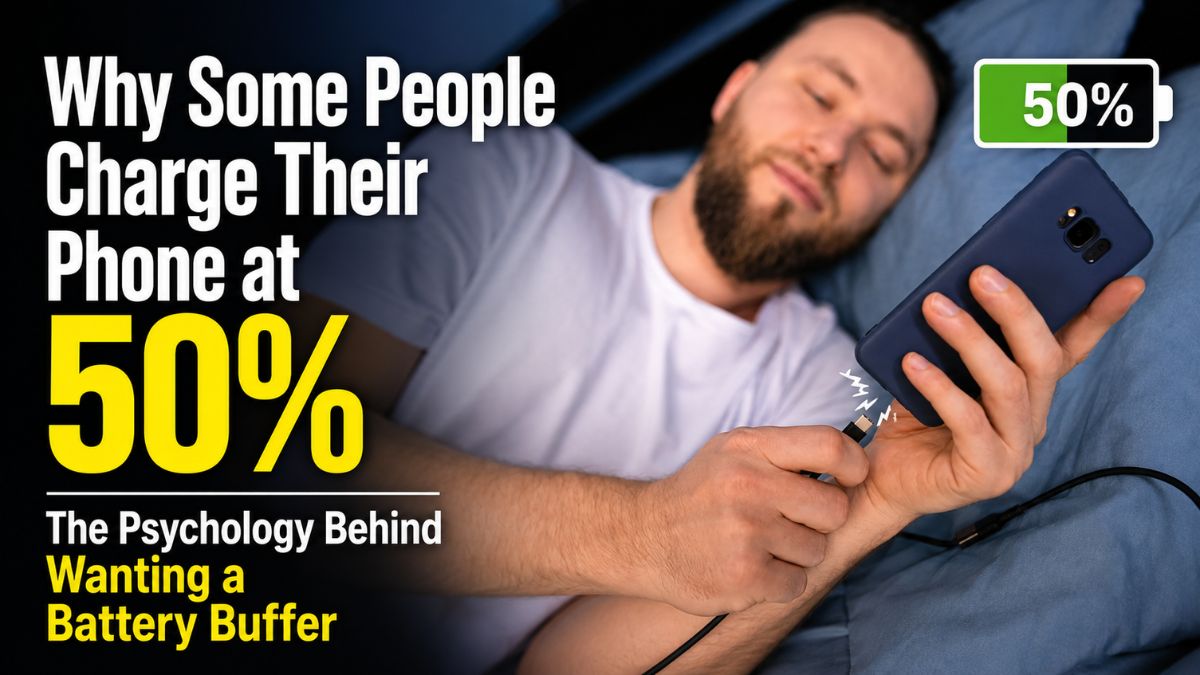
For some people, a phone battery falling to 40% barely matters. For others, it is an immediate reason to look for a charger. They may plug the phone in at 50%, 60% or even higher, even when they know the device still has hours of use available.
The behavior can look unusually cautious, but there are several possible explanations. Research on intolerance of uncertainty, worry and perceived control offers one framework for understanding why some people may feel more comfortable maintaining a large battery reserve.
That does not mean charging at 50% proves someone has a particular psychological trait. Work demands, travel, unreliable electricity, heavy phone use and previous experiences can all influence charging habits.
The more interesting question is what the behavior may represent when it appears as part of a broader pattern of wanting to reduce uncertainty.
Uncertainty
Psychologists including Michel Dugas, Mark Freeston and their colleagues have studied a concept known as intolerance of uncertainty, or IU.
Broadly, IU describes differences in how negatively people respond to situations that are uncertain or unpredictable. Contemporary research treats it as a broad construct that can occur across different situations and psychological difficulties rather than belonging to one specific disorder.
Consider two people whose phones are both at 45%.
One might think, “That’s plenty of battery.”
The other might think, “What if I need my phone later and cannot find a charger?”
The battery level is identical. The interpretation of the uncertainty is different.
For the second person, charging the phone removes one possible future problem before it develops.
Predictability
A phone battery provides an unusually clear example of uncertainty because its status can be measured.
At 80%, a person knows there is substantial capacity remaining. At 50%, there is still a reasonable buffer. At 20%, the remaining capacity feels more limited.
Charging early can therefore create a sense that a possible future problem has already been handled.
Research on the Intolerance of Uncertainty Scale has identified desire for predictability and active certainty-seeking as important aspects of the construct.
The significance of early charging may therefore have less to do with the specific number 50 and more to do with maintaining a comfortable margin.
The person knows that a potential problem is less likely to become urgent.
Prevention
Early charging can also resemble preventive coping.
Imagine someone leaving home for several hours with a phone at 52%. They might reasonably expect the battery to last. Still, they decide to charge it before leaving.
If an important call is expected, the decision is straightforward. Someone navigating an unfamiliar city may also benefit from having plenty of battery available.
The psychological question becomes more relevant when the person experiences considerable discomfort simply because the possibility of a low battery exists.
In that case, charging may serve not only a practical purpose but also a psychological one. It removes an uncertainty that the person finds uncomfortable.
Worry
The Intolerance of Uncertainty Model developed by Dugas and colleagues gives another way to understand the pattern.
Research in this area describes intolerance of uncertainty as involving beliefs and emotional reactions toward uncertain situations. Worry can be one response to that uncertainty.
The battery example can be reduced to a simple sequence.
The battery is falling.
What if I need the phone later?
What if there is nowhere to charge it?
Charging interrupts that chain by changing the immediate circumstances. The person does not need to know exactly what will happen later. They simply increase the available battery reserve.
The uncertainty has not disappeared completely, but one potential problem has become less likely.
Regulation
Research also suggests that people differ in how they respond to uncomfortable uncertainty.
A 2023 systematic review and meta-analysis covering 91 studies and more than 30,000 participants found a moderate association between intolerance of uncertainty and maladaptive emotion-regulation strategies. Adaptive strategies, including mindfulness, showed an inverse relationship.
That research does not establish that charging a phone early is an unhealthy coping strategy.
Instead, it illustrates a broader principle. People use different methods to manage uncertainty, and some may prefer actions that create a greater sense of predictability.
For one person, 30% battery is simply information.
For another, it represents a possible future inconvenience that can be prevented now.
Buffer
An early charger can effectively create a psychological safety margin.
If the battery reaches 10% while the person is far from a power source, they may feel exposed to a problem. If it remains above 50%, they may feel prepared.
Similar patterns appear in many ordinary behaviors.
One person leaves home early because they dislike the possibility of traffic delays. Another carries an umbrella because they dislike being caught in unexpected rain. Someone else keeps extra cash available because they do not want to risk being unable to pay.
The behaviors are different, but they can share one feature: reducing uncertainty before it becomes consequential.
The size of the buffer can vary considerably from person to person.
Experience
Past experiences can also shape how people perceive risk.
Suppose someone’s phone once died during an important journey. They may have missed a call, lost access to a digital ticket or been unable to use navigation.
After that experience, charging at 50% may seem entirely reasonable.
The person may not consciously remember the incident every time they connect a charger. However, previous experiences can influence how people evaluate potential risks and how much safety margin they prefer.
This helps explain why two people can see the same battery percentage and reach different conclusions about what it means.
For one, 30% might represent plenty of capacity. For another, it might represent an avoidable risk.
Context
It is important not to turn an everyday charging habit into a psychological diagnosis.
Charging a phone at 50% can simply be sensible planning. A person may have a long commute, unpredictable work schedule, heavy phone use, unreliable access to electricity or responsibilities that require their phone to remain available.
Likewise, one behavior cannot establish that someone has a low tolerance for uncertainty.
Intolerance of uncertainty is a broad psychological construct, and its definition and measurement continue to be examined in research.
A stronger indication would be a wider pattern. Does the person frequently seek certainty? Do unpredictable situations cause significant discomfort? Do they regularly take preventive steps to eliminate possible future problems?
If those behaviors occur together, early phone charging could be one small example of a broader preference for predictability.
Control
Perceived control may also be relevant.
A battery percentage is something a person can directly influence. If the number begins to fall, connecting the phone to a charger is an immediate action that changes the situation.
This can be different from uncertainties that cannot easily be controlled. A person cannot guarantee that traffic will be light, that a meeting will run on time or that another person’s plans will remain unchanged.
The battery offers a comparatively simple problem with a clear response.
Charge it, and the reserve increases.
That predictability may make the behavior particularly appealing to someone who prefers having a concrete way to manage possible future problems.
Comfort
People who charge their phones before the battery gets low are not necessarily unusually anxious or overly cautious.
They may simply prefer having a buffer.
At 20%, there is more uncertainty about how long the phone will remain useful. At 80%, the future appears easier to manage because there is considerably more capacity available.
That difference can provide a small sense of control.
The psychological interpretation becomes useful only when the charging habit is considered alongside broader patterns of behavior. A single battery percentage cannot reveal someone’s personality or mental health.
Still, the habit offers a simple example of how people manage uncertainty in everyday life. Sometimes the goal is not to solve an immediate problem but to make a possible future problem less likely.
For someone who strongly prefers predictability, keeping the battery comfortably above 50% may simply be one small way of maintaining that sense of security.
FAQs
Does charging at 50% indicate anxiety?
No. It can reflect planning, habit, work needs, or personal preference.
What is intolerance of uncertainty?
It describes discomfort with uncertain or unpredictable situations.
Can early charging reduce uncertainty?

Yes. A higher battery reserve can make future use feel more predictable.
Can past experiences affect charging habits?
Yes. Previous battery failures can influence perceived risk.
Does one habit reveal personality?
No. A single behavior cannot establish a psychological trait.