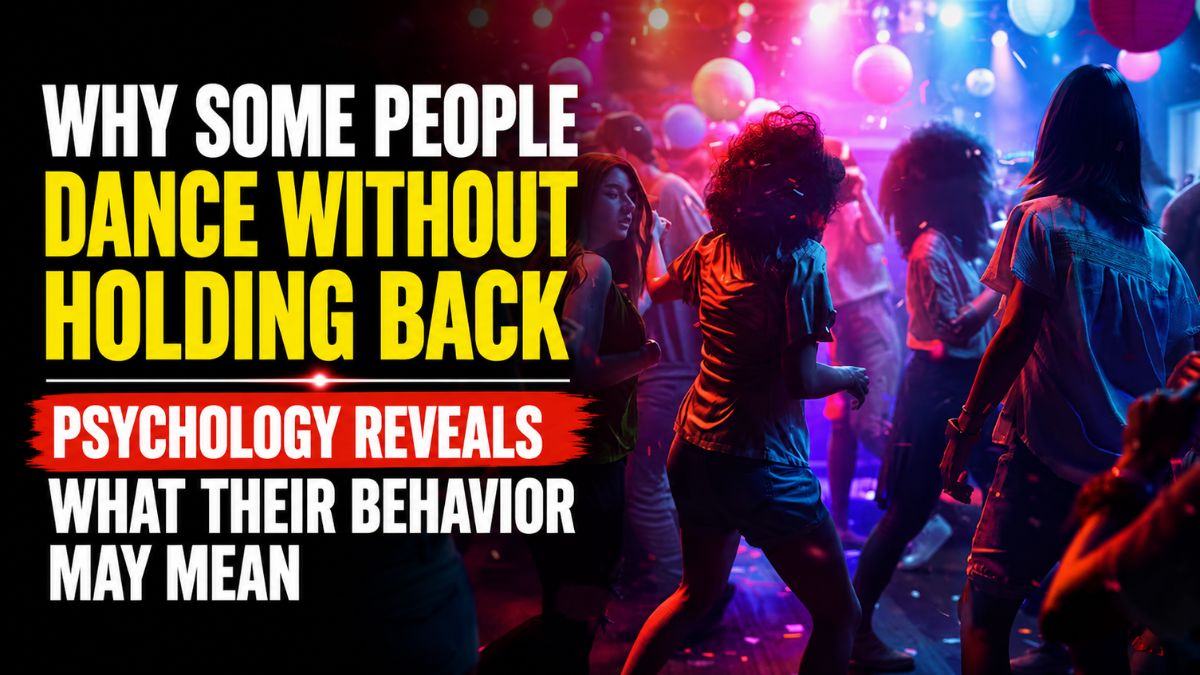
Some people barely move when music starts, while others immediately get involved, moving with enthusiasm and little concern about who is watching. At weddings, parties, concerts and festivals, energetic dancers often attract attention simply because their movements are more expressive.
It is easy to assume that someone dancing with full energy wants to become the center of attention. But that interpretation is not always accurate. Psychology suggests that dancing can serve several functions, including emotional expression, enjoyment, stress regulation and social connection.
The meaning behind the behavior depends on the person and the situation. For some, dancing is simply a response to music. For others, it may be a way to feel more relaxed, connected or emotionally free.
Expression
Dancing is one way people communicate without using words.
Human beings express emotions through facial expressions, gestures, posture and movement. Dance adds rhythm and music to that process. Someone who becomes highly expressive when a favorite song starts may simply be responding to the emotional experience created by the music.
Energetic movement can communicate happiness, excitement and celebration. It can also provide an outlet for emotions that are difficult to describe verbally.
This is why a person who appears reserved during conversation may become noticeably more expressive on a dance floor. The environment gives them a different way to communicate.
Emotion
Music has strong connections with emotion, memory and reward. A familiar song can bring back memories, change someone’s mood or create an urge to move.
Dancing adds physical movement to that emotional response. The combination can make the activity enjoyable in its own right.
Research into dance and well-being has generally found associations between dancing and positive emotional outcomes, although individual experiences vary. Movement can provide an opportunity to focus attention on the present activity rather than everyday concerns.
That does not mean dancing automatically improves someone’s mood every time. But for many people, it can be a useful form of emotional engagement.
Confidence
Energetic dancing can sometimes reflect confidence, but it is important not to assume that confidence is always the motivation.
Some people are naturally comfortable expressing themselves in public. Others become more relaxed when music and dancing create a socially accepting environment.
A person who normally worries about how they appear may feel less concerned about judgment when everyone around them is dancing. The shared activity can reduce the sense that they are being individually evaluated.
Confidence can also develop through participation. Someone does not necessarily need to feel completely confident before dancing. Becoming involved in an enjoyable activity can itself make a person feel more comfortable.
Flow
The concept of flow, developed by psychologist Mihaly Csikszentmihalyi, offers another perspective.
Flow describes a state of deep involvement in an activity in which attention becomes strongly focused on what a person is doing. People may become less aware of distractions and less concerned about how much time has passed.
Dancing can create conditions that encourage this kind of experience. A person may concentrate on the rhythm, movements and music rather than on the people around them.
This may explain why some energetic dancers appear to stop worrying about whether their movements look perfect. Their attention is directed toward the experience itself.
Connection
Dancing is also a social activity.
People often dance together at weddings, festivals, cultural events and celebrations. Coordinating movement, sharing music and participating in the same activity can create a sense of belonging.
This connects with ideas from social identity theory, which examines how people develop a sense of identity through membership in groups.
Group dancing can reinforce feelings of connection within families, friendship circles and communities. In some cultures, dancing is an important part of ceremonies and collective celebrations.
In these settings, energetic participation is not necessarily about individual attention. It can be about being part of the group.
Movement
The relationship between the body and emotions is another part of the explanation.
The concept of embodied cognition proposes that bodily states and mental processes can influence one another. While the theory is broader than dancing, it provides a useful framework for considering why physical movement can affect how people experience emotions.
Movement can change physiological arousal and attention. When someone is already happy or excited, that emotional state may encourage more movement. The movement can then reinforce the positive experience.
This creates a feedback process in which music, emotion and physical activity influence one another.
Stress
For some people, dancing is also a way to release tension.
Daily life involves work, responsibilities and repeated demands for attention. Physical activity can provide a temporary shift away from those concerns.
Dancing combines movement with music and, often, social interaction. That combination may make it an enjoyable way to step away from routine pressures.
Research on dance-based activities has reported potential benefits for mood and psychological well-being. However, dance should not be treated as a universal solution for stress or mental health difficulties. Its effects depend on the individual and the type of activity.
Culture
Culture can strongly influence how people understand and participate in dancing.
Some people grow up in families where dancing is a normal part of weddings, festivals or community gatherings. Others may have little exposure to it and therefore feel less comfortable participating publicly.
Cultural expectations can also shape which forms of movement are considered appropriate or expressive.
This means the same behavior can have very different meanings in different settings. A person dancing enthusiastically at a family celebration may simply be following a familiar cultural tradition rather than trying to attract attention.
Judgment
One of the clearest lessons from energetic dancing is that visible behavior does not always reveal a person’s intention.
A person who dances intensely may be seeking attention. But they may also be enjoying the music, expressing emotion, participating socially, relieving tension or simply feeling comfortable enough to move freely.
Without knowing the person’s motivation, it is difficult to determine which explanation is correct.
This is why psychological interpretation needs context. A single behavior rarely provides enough information to describe someone’s personality accurately.
Meaning
Dancing without holding back can reflect several overlapping experiences: enjoyment, emotional expression, confidence, social connection and immersion in the moment.
It does not automatically indicate a desire for recognition. Nor does it prove that someone is exceptionally confident.
For many people, the dance floor simply creates a setting where self-expression feels easier. Music provides the stimulus, movement provides the outlet and the surrounding social environment can make participation feel natural.
The next time someone dances with noticeably more energy than everyone else, their behavior may not be a performance for the crowd. They may simply be responding to the music, enjoying the moment or experiencing a form of connection that is difficult to express through conversation. Psychology suggests that the meaning of the movement lies less in how energetic it looks and more in the person, their environment and what the experience means to them.
FAQs
Does energetic dancing mean someone seeks attention?
No. It can reflect enjoyment, expression, confidence or social connection.
Can dancing improve mood?
Research suggests dancing can support positive mood and emotional well-being.
Why do some people dance more freely?
They may feel comfortable expressing emotions through movement and music.
What is flow in psychology?
Flow is deep involvement in an activity with reduced awareness of distractions.
Can dancing strengthen social connections?
Yes. Shared dancing can encourage participation, belonging and social bonding.