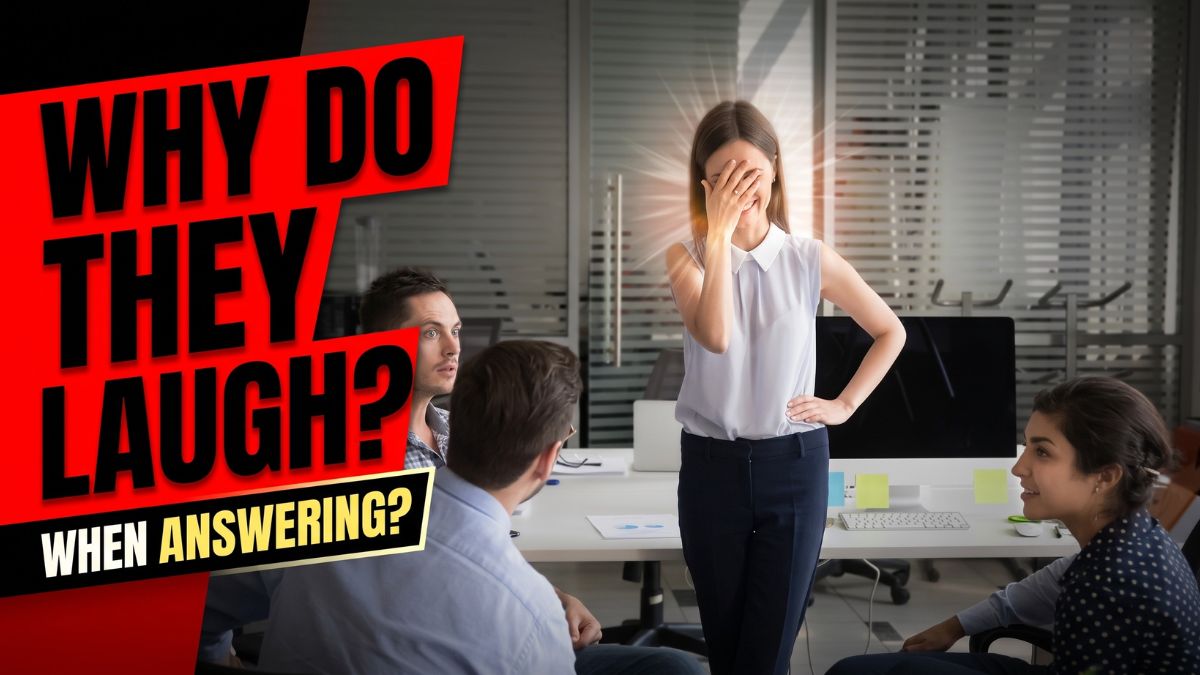
Someone asks a difficult question and, instead of answering immediately, you laugh. The question might be uncomfortable, unexpectedly personal, or simply difficult to answer on the spot. The laugh may last only a moment, but it can serve several possible psychological and social functions.
It does not necessarily mean the person thinks the question is funny. Psychology research suggests that laughter is a complex social behavior that can help regulate relationships, ease tension, and communicate emotional states.
At the same time, answering a difficult question requires cognitive work. The person needs to understand what was asked, decide what information to share, consider the social consequences, and plan how to phrase the response.
Recent research on language production shows that people plan the content and form of answers while conversations are unfolding, particularly when they have limited time to respond.
So, when someone laughs before answering, that brief moment may sometimes give them an opportunity to process the question, manage their emotional reaction, and prepare their response.
Laughter
One common misconception about laughter is that it automatically indicates amusement.
Psychologists studying laughter have found that it can serve social functions beyond reacting to something funny. Research by Ralph Adolphs, Sophie Scott, and colleagues describes laughter as a social behavior that can contribute to regulating relationships, easing social tension, and strengthening social bonds.
This helps explain why people sometimes laugh in situations that are not particularly humorous.
Someone may laugh after making a mistake. Another person may laugh when receiving criticism. Someone else might laugh when a friend asks an unexpectedly personal question.
In these situations, the laughter may be a response to the social tension surrounding the moment rather than the actual content of the question.
Processing
Answering a question is more complicated than it appears. The brain has to understand the question, retrieve relevant information, decide what response is appropriate, and formulate the words needed to communicate it.
Research on language production suggests that speakers plan responses incrementally rather than simply creating an entire sentence internally before speaking.
A 2026 study by Arella Gussow and Maryellen MacDonald examined how people plan responses under uncertainty and found that language production involves managing information while speech is being prepared.
Another 2026 study found that people begin planning both the content and form of an answer during the question-answer process, with response speed affected by how information is presented and by the length of the response.
That means a short pause before answering is not necessarily empty time. The person may genuinely be processing information.
Buffer
Imagine your manager asks, “Why was this project late?”
You briefly laugh and say, “Honestly, that’s a complicated story.”
The laugh does not necessarily mean you find the situation amusing. It may soften the tension before you provide an explanation.
This connects with the broader idea of social regulation. Laughter can help people navigate uncomfortable interactions by changing the emotional atmosphere.
A 2021 integrative review by Caleb Warren, Adam Barsky, and Peter McGraw found that laughter and amusement can emerge from several psychological processes, including situations where something is perceived as a violation but is also considered relatively benign.
In difficult conversations, however, laughter can occur without strong amusement. The social circumstances themselves may contribute to the response.
Stress
Nervous laughter may also be connected with emotional regulation. When people become uncomfortable, their physical and emotional reactions can occur before they consciously decide how to respond.
A laugh may become one way of managing that tension.
Research examining laughter and stress has provided evidence that laughter can influence physiological and psychological stress responses. A 2026 systematic review and meta-analysis of randomized controlled trials found that laughter-based interventions were associated with reduced stress, although the researchers noted substantial differences among the studies and variations in methodological quality.
Earlier research has also investigated spontaneous laughter and cortisol, a hormone associated with the body’s stress response.
This does not establish that every nervous laugh immediately reduces stress. It does suggest that laughter and stress regulation can be connected.
Timing
The idea that laughter can “buy time” should not be interpreted as a deliberate strategy in every case.
People are usually not consciously thinking, “I will laugh now so I have a few seconds to formulate my answer.”
The behavior may happen automatically.
Imagine someone being asked, “Are you actually planning to leave your job?”
They laugh. During that brief moment, they may be deciding whether the question is serious, considering how much information to reveal, searching for suitable words, or managing embarrassment.
The laugh becomes part of the transition between hearing the question and producing the response.
Responses
Response time can provide one window into cognitive processing. Psychologists have long examined how quickly people respond to different types of questions and judgments.
A 2026 study by Hanbei Zhou, Rui Zhe Goh, Ian Phillips, and Chaz Firestone found that response duration tracks confidence, with easier and more confident judgments generally produced more quickly.
This does not mean every delayed response reflects uncertainty. Conversation naturally contains pauses, and people differ considerably in their speaking habits.
Still, the research illustrates an important principle: the time taken to respond can contain information about the cognitive processes involved in producing an answer.
A laugh may simply be one behavior occurring during that processing interval.
Uncertainty
Some questions are difficult because the answer itself is complicated. Others are difficult because answering could affect a relationship.
Questions such as “Do you like my partner?”, “Are you happy with your relationship?”, “Did you actually disagree with me?”, or “How much money do you make?” require more than factual recall.
They can require social judgment.
The person answering may be considering how their response will affect the other person. They may want to be honest while also avoiding unnecessary conflict.
That can create interpersonal uncertainty. A laugh may become one way of navigating that uncertainty before the person commits to an answer.
Deception
A laugh before answering does not mean someone is hiding something.
This distinction is important because people can easily interpret unusual behavior as evidence of dishonesty. However, the same laugh can have many possible causes.
One person may laugh because they are nervous. Another may use humor naturally when uncomfortable. Someone else may laugh because they are surprised. A different person may simply have a conversational habit of smiling or laughing before responding.
Research examining humor and deception shows that laughter can interact with deceptive behavior in complicated ways. It does not provide a simple signal that someone is lying.
Therefore, interpreting one laugh as evidence of guilt or dishonesty goes beyond what the research can establish.
Context
The most useful clue is usually the broader pattern rather than the laugh itself.
If someone laughs, pauses, looks away, and then carefully answers a personal question, the combination may suggest discomfort or emotional processing. If they laugh, immediately provide a confident answer, and continue the conversation naturally, the laugh may simply be a habitual social behavior.
If someone laughs whenever conversations become tense, it may also be part of their usual coping style.
Psychology therefore encourages attention to context, timing, and repeated patterns rather than treating a single behavior as evidence of a hidden motive.
Meaning
A laugh before a difficult answer can make more sense when viewed through the psychology of communication.
Laughter is not exclusively a response to humor. It can help regulate social tension and shape interactions. At the same time, answering a difficult question requires cognitive planning, while emotional discomfort can make that process more demanding.
Response timing may also provide clues about the effort involved in producing an answer.
So, the next time someone laughs before responding to a difficult question, it is worth avoiding an immediate conclusion that they are hiding the truth. They may simply be navigating an uncomfortable moment while processing what to say.
Sometimes, that brief laugh is not the answer. It is the small transition between the question and the words that follow.
FAQs
Why do people laugh before answering?
They may be processing the question or managing social tension.
Does nervous laughter mean dishonesty?
No, nervous laughter does not prove someone is being dishonest.
Can laughter reduce tension?

Yes, laughter can help regulate social tension and interactions.
Does a pause show uncertainty?
Not always; people naturally vary in response time and speaking style.
Does laughter always mean amusement?
No, laughter can also reflect discomfort, surprise, or social tension.