
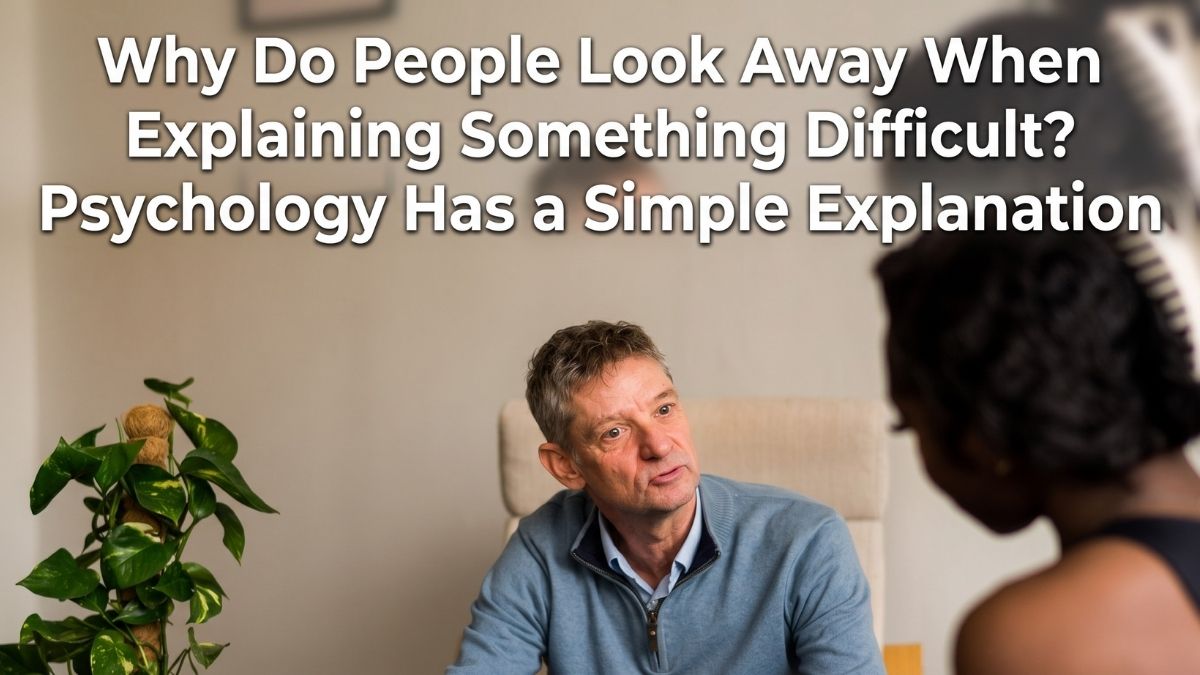
When someone breaks eye contact while trying to explain something complicated, it is easy to read the behavior as nervousness, discomfort or even dishonesty. A person may look toward the floor, ceiling or an empty space while searching for the right words.
Psychological research suggests there can be another explanation: they may simply be concentrating.
This behavior is known as gaze aversion. Researchers have observed it when people answer difficult questions, retrieve memories and perform mentally demanding tasks. Rather than always signaling disengagement, looking away can reduce competing visual information and allow attention to shift toward internal thinking.
Attention
Human attention has limits. During a conversation, the brain may process a person’s facial expression, eye movements, gestures and other visual information while simultaneously trying to construct an answer.
When a question becomes more difficult, that combination can become demanding.
Research by psychologist Gwyneth Doherty-Sneddon and colleagues found that both adults and children tend to avert their gaze more often when questions become cognitively demanding. The researchers suggested that looking away may help people manage the cognitive demands created by information in their surroundings.
So when someone looks away while explaining a complicated work issue, they may not be avoiding the conversation. They may simply be reducing the amount of information competing for their attention.
Thinking
Research by Arthur Glenberg, John Schroeder and David Robertson provides further evidence for this explanation.
In experiments involving moderately difficult questions, participants frequently looked away. Gaze aversion increased as the questions became more difficult, and the researchers found that looking away could improve performance.
The explanation is relatively straightforward. By temporarily reducing attention to the surrounding environment, people may be able to devote more mental resources to the task itself.
Consider someone being asked, “Can you explain exactly what happened during that meeting three months ago?”
They may look directly at you at first and then turn their gaze toward the side while trying to reconstruct the event. That change in gaze could reflect an effort to retrieve information rather than discomfort with the person asking the question.
Memory
Gaze aversion is particularly relevant when people are trying to remember something.
A 2023 study published in Acta Psychologica examined gaze behavior while participants answered questions about autobiographical memories. The researchers found that gaze aversion occurred early during memory retrieval and was associated with greater retrieval effort. It was less common when memories came to mind spontaneously.
This suggests that looking away can accompany a shift from external attention toward internal processing.
In everyday conversation, this may happen when someone is asked to recall a specific detail. A question such as “What exactly did she say that day?” may prompt a person to look away while searching through their memory.
The person may not be uncomfortable with the question or the person asking it. Their attention may simply have moved inward.
Difficulty
The connection between question difficulty and gaze aversion has appeared across different types of mental tasks.
Researchers have observed the behavior during arithmetic problems, verbal reasoning tasks and autobiographical memory questions. Doherty-Sneddon and Phelps found that the difficulty of a question influenced how often people looked away.
Other research has similarly suggested that gaze aversion can help adults and children respond to challenging mental arithmetic and verbal reasoning questions.
This makes the behavior more interesting than the common assumption that looking away means someone has stopped paying attention.
In some situations, the opposite may be true. The person may be concentrating more intensely on the task.
Eye Contact
Eye contact carries important social information. When you look directly at another person, you are not only seeing their eyes. You are also processing facial expressions, reactions and other social signals.
That information is useful during ordinary conversation. However, when someone is trying to formulate a complicated answer, processing those signals may compete with the mental task.
Research on gaze aversion has therefore considered whether looking away can serve as a form of attentional disengagement. If visual information is not necessary for completing a task, reducing attention to it may help limit competing cognitive demands.
For instance, someone explaining a complicated personal decision might look toward the floor while organizing their thoughts. The reduced eye contact does not necessarily mean they are less engaged with the conversation.
Strategy
A 2017 study by Dekel Abeles and Shlomit Yuval-Greenberg examined gaze aversion during auditory mental arithmetic.
Participants looked away more frequently and for longer periods when distracting visual movement was more noticeable and when the mental task was more difficult.
The researchers described gaze aversion as an active attentional disengagement mechanism.
This distinction is useful. Looking away does not necessarily happen because someone has become distracted. It can also help a person reduce distraction.
In other words, the eyes can temporarily move away from the social environment while the mind focuses more closely on the problem.
Deception
The findings are also relevant to a common misconception about eye contact.
Popular culture often treats eye contact as a simple indicator of honesty. Someone who avoids looking directly at another person may be described as nervous or deceptive.
Psychological research does not support such a straightforward interpretation.
People can look away for many reasons. They may be thinking, remembering, embarrassed, emotionally affected or responding to a difficult question. Some people may also naturally make less eye contact during conversation.
Because gaze aversion has been associated with cognitive difficulty and memory retrieval, treating one instance of looking away as evidence of lying can be misleading.
Context matters. A single eye movement cannot reliably reveal someone’s intentions.
Context
The next time someone looks away while answering a difficult question, what happens afterward may provide more useful information than the eye movement itself.
If the person pauses, looks elsewhere and then gives a detailed explanation, the gaze shift may have been part of their thinking process.
Their attention may have temporarily moved away from the external conversation because they needed to focus on an internal task, such as retrieving a memory or organizing a complicated explanation.
Psychology therefore provides a more measured way to understand gaze aversion. Looking away does not always mean someone is avoiding a conversation. In some situations, it may simply be one way the mind reduces visual demands while concentrating on what needs to be said.
FAQs
Why do people look away when thinking?
Looking away can reduce visual distractions during difficult thinking.
Is gaze aversion a sign of lying?
No, looking away alone does not reliably indicate deception.
What is gaze aversion?

Gaze aversion means temporarily looking away from another person.
Does memory retrieval cause gaze aversion?
Research links gaze aversion with greater effort during memory retrieval.
Can looking away improve concentration?
Yes, it may reduce competing visual information during difficult tasks.