
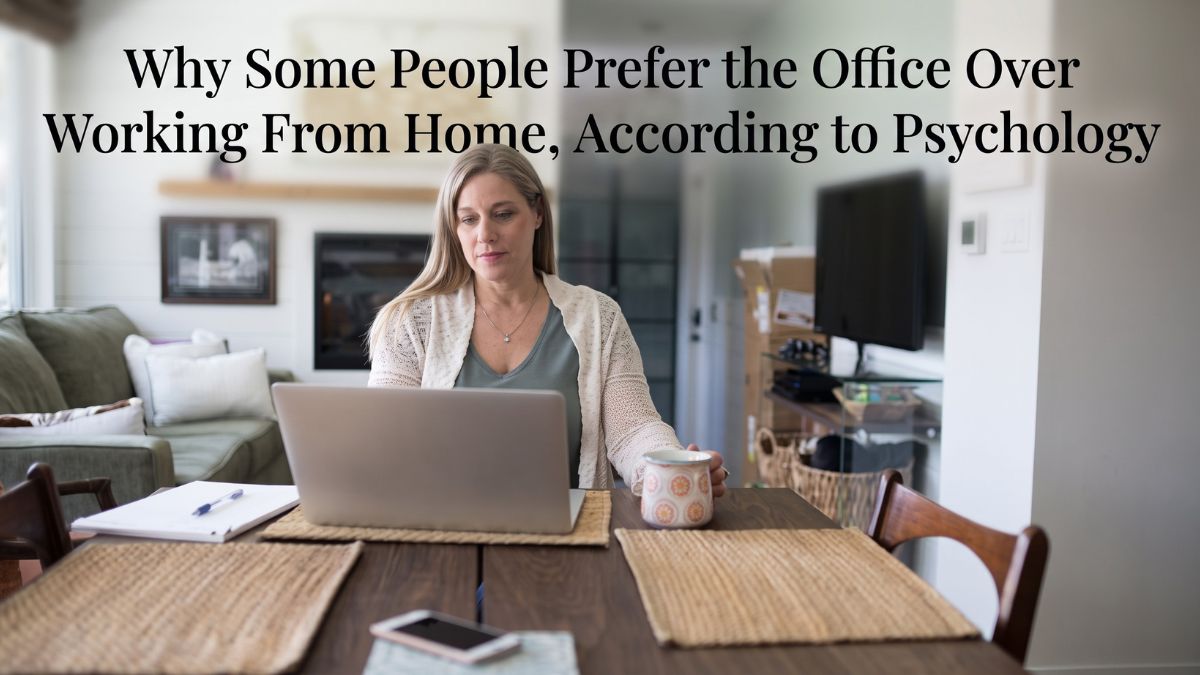
For some employees, working from home offers an ideal arrangement. There is no daily commute, fewer interruptions from colleagues and more freedom over the working environment. Yet other people feel more comfortable and productive when they are in an office.
They may prefer face-to-face conversations, find it easier to concentrate around colleagues or feel that home should remain separate from professional responsibilities. This preference is not necessarily about resistance to change or a lack of adaptability.
Psychology suggests that people’s responses to remote work can differ because of their preferred boundaries, need for social connection, reliance on structure and the degree to which their environment suits the way they work.
Boundaries
One useful explanation comes from Boundary Theory, associated with researcher Susan Clark and later research into work and family boundaries.
People differ in how they manage separate areas of their lives. Some prefer segmentation, keeping work and personal life clearly apart. Others are more comfortable with integration, allowing the two areas to overlap.
For someone who prefers strong separation, working from the living room can create an uncomfortable psychological overlap. The same space used for watching television, eating or relaxing becomes a workplace during the day.
Research on teleworkers has examined how people use physical spaces, time, technology and communication to manage transitions between work and home. These boundaries can help explain why some employees struggle to mentally finish work after the laptop is closed.
Cues
The office provides clear environmental signals that can help people enter and leave a professional role.
Walking into an office building, sitting at a designated workstation, greeting colleagues and following a familiar morning routine can all signal that the working day has started. Leaving the building can then mark the end of that role.
At home, those signals may be less obvious.
An employee might finish a video meeting in the evening, close their laptop and immediately return to the same sofa where they spend their free time. The physical surroundings have remained unchanged even though the person’s role has shifted.
Research into teleworking has considered the importance of rituals and environmental cues in helping people manage these transitions.
Connection
Social connection may also influence how someone experiences remote work.
Self-Determination Theory, developed by psychologists Edward Deci and Richard Ryan, identifies autonomy, competence and relatedness as basic psychological needs. Relatedness refers to the need to feel connected with and supported by other people.
Remote work can provide greater autonomy, but it may reduce spontaneous interaction for some employees. An office allows for informal conversations, shared meals, quick questions and everyday contact with colleagues.
That does not mean every office-oriented employee needs constant conversation. For some, simply having other people nearby can make the workday feel more connected.
Research examining workplace loneliness through a Self-Determination Theory framework has considered how remote work can affect the balance between autonomy and relatedness.
Structure
The home environment can also contain competing demands.
Household chores, family members, pets, deliveries, television and other distractions can interrupt concentration. Some people are better at ignoring these cues than others.
An office, by contrast, often provides external structure. The surroundings communicate that the primary purpose of the space is work.
This may be particularly helpful for people who rely on routines to organise their attention and working day.
Research on perceived job control and boundary management also suggests that having flexibility does not automatically mean that every employee experiences that flexibility positively. The ability to work anywhere and the preference for working anywhere are not necessarily the same thing.
Collaboration
For some employees, work is inherently social.
A physical workplace can make spontaneous collaboration easier. A colleague can answer a quick question, offer an idea during an informal conversation or provide immediate feedback without requiring another scheduled meeting.
This can matter in jobs that depend heavily on mentoring, teamwork, creative discussion or rapid problem-solving.
Video calls and messaging platforms can reproduce some of these interactions, but they do not always create the same experience as being physically present with colleagues.
The importance of relatedness in Self-Determination Theory also provides a framework for understanding why social interaction can contribute to workplace motivation and wellbeing.
Recovery
Home may have an important psychological function beyond being a place to live. For some people, it represents rest and recovery.
It is where they spend time with family, eat meals, sleep and disengage from professional responsibilities. Turning part of that environment into a permanent workstation can make the distinction between work and personal life less clear.
Research on work-family borders suggests that greater permeability between the two areas can contribute to conflict when people have limited control over those boundaries.
This may help explain why someone can willingly accept a commute in exchange for a clear transition between professional and personal life. The journey may take time, but it can create a psychological gap between the two roles.
Fit
There is no single work arrangement that suits everyone.
Research on telework, autonomy and purpose suggests that the relationship between work location and job satisfaction can depend on psychological resources and individual circumstances. Remote work may provide important benefits for one person while creating difficulties for another.
Someone who prefers the office may value clearer boundaries, social connection, predictable routines or environmental cues. Another employee may value quiet, flexibility and independence above those factors.
The preference itself does not necessarily indicate that one person is more motivated, independent or adaptable than another. It may simply reflect person-environment fit.
For some employees, the office provides more than a desk and a place to attend meetings. It creates a clear psychological setting for work, with boundaries, routines and human interaction built into the environment. For them, going to the office may make it easier to concentrate during work hours and disconnect when the working day ends.
FAQs
Why do some people prefer office work?
They may prefer structure, social connection and clearer work boundaries.
Can working from home blur boundaries?
Yes, home and work responsibilities can become harder to separate.
Does office work improve productivity?
It can for some people, but preferences and circumstances differ.
What is boundary management?
It is how people separate or combine work and personal life.
Why can colleagues matter at work?
Social contact can support connection, collaboration and workplace wellbeing.