
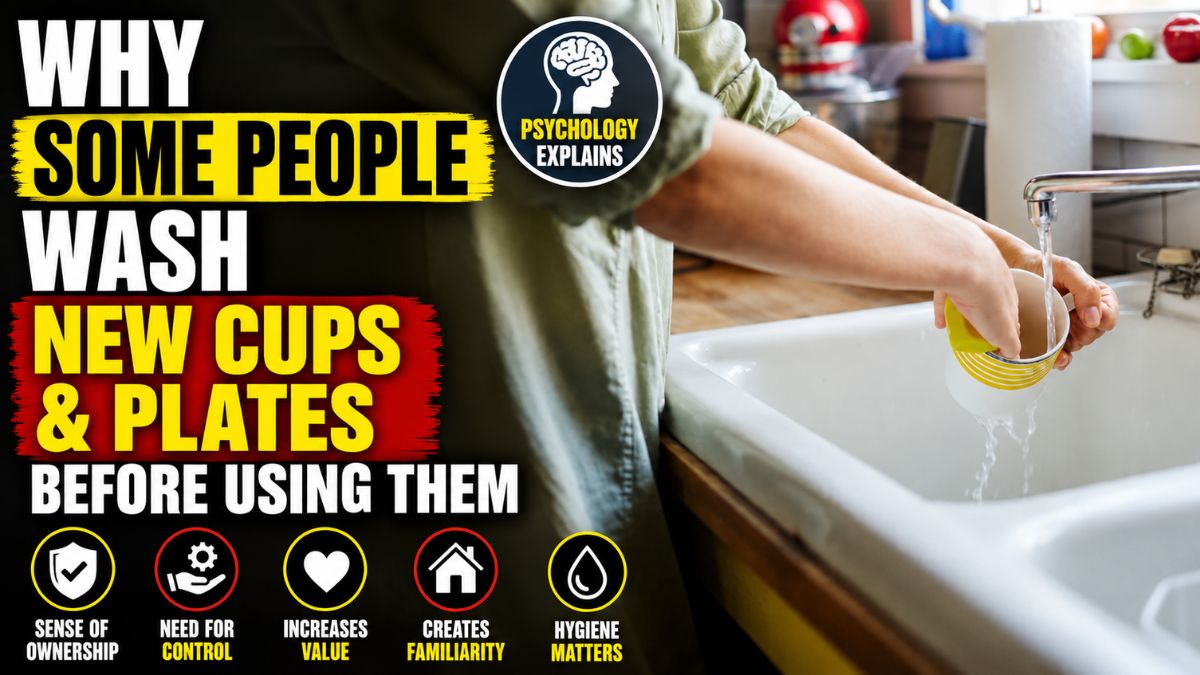
A brand-new cup comes out of its packaging, a new plate is still wrapped in paper, and yet some people instinctively wash it before using it. At first glance, the behavior may seem entirely practical. The person may want to remove dust, packaging residue or anything that could have accumulated during manufacturing and transport.
But sometimes the object already looks perfectly clean.
Psychology offers another possible explanation. For some people, washing, touching, arranging or preparing a new possession may help create a sense that the object has finally become theirs. This idea connects with psychological ownership, a feeling of possession that can exist independently of legal ownership.
Ownership
Psychological ownership was developed as a theoretical concept by organizational psychologists Jon L. Pierce, Tatiana Kostova and Kurt Dirks. Their work describes psychological ownership as the feeling that something is “mine” or “ours.”
This distinction is useful because legal ownership and psychological ownership are not identical.
You may legally own a new cup as soon as you purchase it. Psychologically, however, it may still feel like an unfamiliar object that has just come from a store. Washing it, deciding where to keep it and using it for the first time can help incorporate it into everyday life.
For example, someone may buy a new coffee mug, wash it, dry it and place it beside their regular mugs. The cleaning may be practical, but the sequence can also create familiarity and a small sense of personal control.
Control
Control is one of the routes to psychological ownership identified by Pierce and colleagues. When people can influence, handle or exercise control over something, they may develop a stronger feeling that it belongs to them.
Washing a new plate is a straightforward form of interaction. The person handles it, cleans it and prepares it for use.
That can create a subtle transition. The object is no longer simply a plate purchased from a shop. It becomes a plate that the person has handled, prepared and chosen to use.
This does not mean that everyone who washes new dishes has an unusually strong need for control. It is simply one possible reason why a small action can feel satisfying.
Value
Research by psychologist James K. Beggan on the mere ownership effect found that people can evaluate objects more positively because they own them. The research suggests that ownership can create a psychological association between a person and an object.
This can help explain why a new possession may become more meaningful after repeated interaction.
Imagine buying two identical cups. One remains unopened in a cupboard, while the other is washed, used every morning and gradually becomes a favorite.
The physical differences may be minimal, but the psychological relationship with the objects can become very different.
Through repeated use, one cup has acquired personal associations.
Endowment
The endowment effect provides another perspective on the importance of possession.
Behavioral economists Daniel Kahneman, Jack Knetsch and Richard Thaler studied how people can place greater value on an object once they perceive it as belonging to them. Their experiments included everyday consumer items such as coffee mugs.
This research does not establish that washing a new cup directly causes the endowment effect. Instead, it helps illustrate how ownership can influence the way people perceive ordinary possessions.
Once an object becomes psychologically connected to the self, even a simple plate, mug or water bottle can become more personally significant.
That may be one reason people become particular about how new possessions are introduced into their routines.
Familiarity
A new possession can initially feel unfamiliar because it has not yet become part of someone’s established habits.
A small ritual can change that. Washing the item, drying it, choosing a particular place for it and using it for the first time can create a sense of transition.
Consider someone receiving a new water bottle. They wash it, fill it with water and place it beside their laptop each morning. After a few days, the bottle becomes associated with their routine.
The initial washing may have been practical, but the repeated interaction helps personalize the object.
Over time, possessions can become connected with routines and aspects of a person’s self-concept. This is one reason everyday objects can sometimes carry more personal meaning than their practical function would suggest.
Hygiene
It is important not to overinterpret this behavior.
Washing a new cup or plate is a common and reasonable hygiene practice. Products can pass through manufacturing, packaging, transportation and storage before reaching a home. Someone may simply prefer to clean anything before using it.
Psychology cannot reliably determine a person’s personality from one ordinary habit.
A broader interpretation may be more relevant when washing new possessions appears alongside a strong preference for personal items, discomfort when others use them, careful organization of belongings or particular rituals surrounding possessions.
Even then, these behaviors do not automatically indicate anxiety, obsessive behavior or a psychological disorder.
For many people, the explanation is simply cleanliness.
Personalization
What makes the behavior interesting is the possibility that an ordinary action can also mark a psychological transition.
A new cup begins as a manufactured product. After someone washes it, chooses where it belongs and repeatedly uses it, the object can gradually become part of the person’s environment and routine.
That is the broader idea behind psychological ownership. “Mine” is not always only a legal category. It can also describe a subjective feeling of connection to an object.
So when someone carefully washes a perfectly clean new plate before using it, there may be nothing unusual happening. They may simply want to remove residue or follow a familiar hygiene habit.
At the same time, the act can, for some people, be part of making an unfamiliar possession feel familiar and personally connected. A small ritual can be the first step in turning a new object into something that feels distinctly their own.
FAQs
Why do people wash new cups?
They may want better hygiene or to make the item feel familiar.
What is psychological ownership?
It is the feeling that an object is personally yours.
Can washing create a sense of control?

Handling and preparing an object can sometimes increase perceived control.
Does this habit indicate anxiety?
No. Washing a new item is usually a normal everyday behavior.
Can possessions become meaningful?
Yes. Repeated use can connect objects with routines and identity.