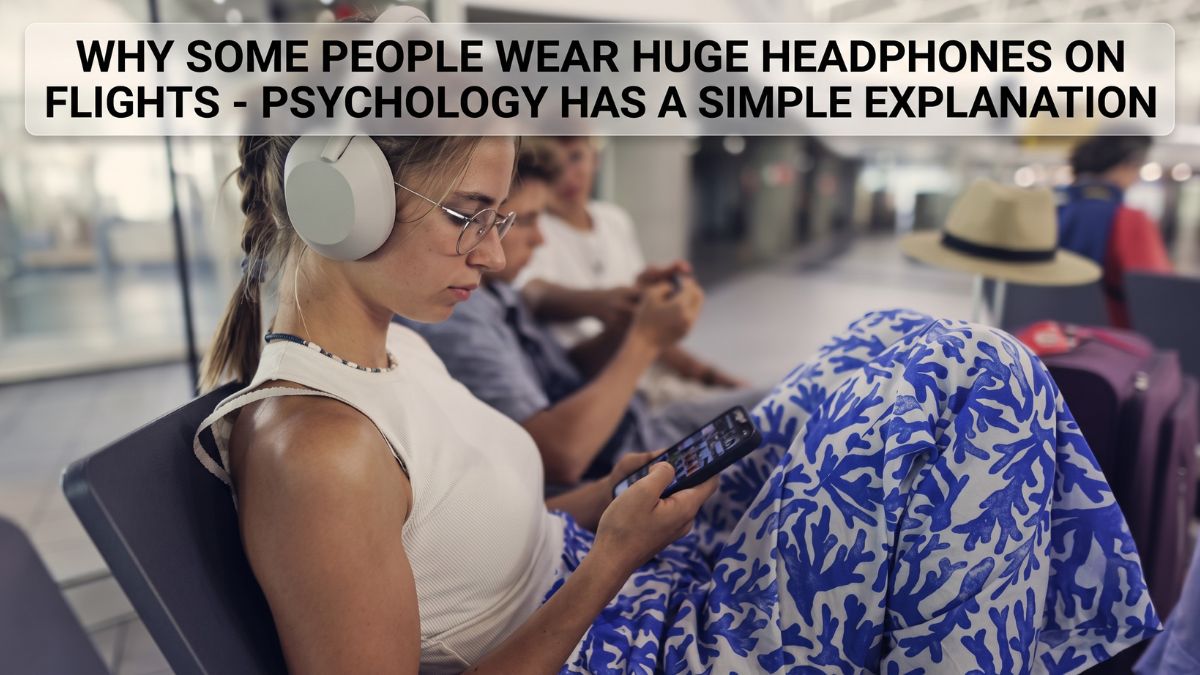
If you notice a passenger wearing oversized headphones from the moment they board a flight until they land, it is easy to make assumptions. They may appear uninterested in the people around them or determined to avoid conversation.
But psychology offers several other explanations.
For some passengers, large over-ear headphones are simply a practical way to manage noise, focus attention and create a sense of personal space. An aircraft cabin can expose people to engine noise, announcements, conversations, movement and crying children for hours. Passengers also have little control over who sits nearby or what sounds occur around them.
Headphones provide one thing they can control: what they hear.
The behavior can therefore be connected to personal boundaries, sensory management and selective attention. It does not necessarily indicate that someone is antisocial, unfriendly or uncomfortable around people.
Regulation
Wearing headphones can be a form of self-regulation. A passenger may already know that crowded, noisy environments make it harder for them to relax. Using headphones before that discomfort builds can be a way to manage the situation proactively.
This does not require someone to dislike social interaction.
A person may enjoy spending time with friends and family while still wanting several hours of quiet during a flight. Similarly, someone who normally enjoys conversation may prefer to listen to music, watch a movie or sleep while traveling.
The behavior is therefore better understood in context rather than treated as evidence of a particular personality type.
Noise
An airplane cabin contains several competing sources of sensory information.
There is the continuous sound of the engines, conversations between passengers, announcements from the crew, movement in the aisles and occasional unexpected noises. Passengers may also be dealing with the physical discomfort and restrictions associated with air travel.
Large headphones can reduce some of this sensory input, particularly when they include effective noise cancellation.
For people who are sensitive to noise, reducing the number of sounds reaching their attention may make the environment easier to manage.
Even passengers without particular sensitivity may simply prefer a quieter setting.
Boundaries
Headphones can also serve a social purpose.
A passenger sitting beside a stranger for several hours may not want to engage in repeated conversation. Saying this directly can feel unnecessarily awkward. Wearing headphones offers a simple nonverbal signal that the person is occupied.
Large over-ear headphones are particularly visible. Unlike small earbuds, they can be noticed from a distance, making the social message relatively clear: the passenger is listening to something and may not be available for conversation.
That does not mean the person wants to avoid everyone. They may still respond politely if someone speaks to them or asks a reasonable question.
Control
Air travel involves many circumstances passengers cannot control.
They cannot choose the volume of the aircraft engines. They cannot determine every announcement. They cannot control conversations in nearby seats or decide who occupies the seat next to them.
Headphones provide a small area of personal control.
The passenger can choose music, a podcast, an audiobook, a film or silence. That choice can create a sense of agency in an environment where many other decisions have already been made for them.
The headphones do not change the physical space around the person, but they can change part of their sensory experience of that space.
Attention
Another relevant psychological concept is selective attention.
People are constantly exposed to more information than they can consciously process. The brain has to prioritize some information while filtering out other stimuli.
On a flight, a passenger might want to concentrate on a film while ignoring nearby conversations. Someone else might listen to music while reading. Another passenger might use noise cancellation simply to make the cabin feel quieter.
Headphones can help direct attention toward a chosen source.
This can reduce the need to consciously filter every sound occurring nearby. For some people, that may make it easier to relax or concentrate.
Environment
Environmental psychology also provides useful context.
This field examines how people’s surroundings influence their behavior and experience. Personal space is one relevant concept because people generally have expectations about how close others should be.
An airplane challenges those expectations. Economy-class passengers can spend hours sitting very close to strangers, often with limited opportunities to move elsewhere.
Headphones can function as a symbolic boundary within that confined environment. They do not create physical distance, but they can help establish a small psychological space.
In that sense, they can work somewhat like an invisible wall. The passenger remains physically surrounded by other people while creating a degree of separation through sound and attention.
Reasons
There is no single reason why someone might choose oversized headphones on a flight.
Common possibilities include:
| Reason | Possible function |
|---|---|
| Noise reduction | Limits unwanted cabin sounds |
| Music | Provides entertainment or relaxation |
| Social boundary | Signals limited interest in conversation |
| Focus | Helps direct attention toward one activity |
| Comfort | Some people prefer over-ear designs |
| Sleep | Creates a quieter environment |
| Movies or podcasts | Provides controlled entertainment |
The same behavior can therefore have completely different meanings for different passengers.
One person may use headphones because they dislike noise. Another may simply prefer the sound quality of over-ear equipment.
Study
The broader psychological principle here is proactive self-regulation.
Instead of waiting until a noisy environment becomes overwhelming, people can sometimes take steps beforehand to make it easier to manage. Headphones are one example of this approach.
Similar behaviors occur in everyday life. Someone might silence phone notifications, choose a quiet workspace, listen to white noise or spend some time alone after a busy day.
These actions do not necessarily represent social avoidance. They can simply be ways of regulating attention and sensory input.
At the same time, headphones alone cannot reveal what someone is thinking or feeling. There is no reliable basis for concluding that a person is antisocial simply because they wear large headphones.
Context
The most useful lesson is that visible behavior does not always have a single psychological explanation.
A passenger wearing oversized headphones might want to avoid small talk. They might be sensitive to noise. They might be watching a movie, listening to music, trying to sleep or simply enjoying the comfort of their headphones.
The behavior can be understood as one possible method of managing sound, attention and personal boundaries in a setting where passengers have limited control over their surroundings.
So, the next time you see someone boarding a plane with large headphones already in place, it may be worth resisting the assumption that they are trying to shut everyone out. They may simply be creating a little control and quiet within an environment where neither is easy to find.
FAQs
Why do people wear large headphones on flights?
They may reduce noise, support focus, comfort or personal boundaries.
Do headphones mean someone is antisocial?
No. Headphone use does not indicate that someone is antisocial.
Can headphones help manage sensory input?
Yes. They can reduce sounds and help control auditory stimulation.
Why do headphones create personal space?
They can act as a visible signal that someone prefers limited interaction.
How can headphones affect attention?
They can help people focus on selected audio while filtering distractions.