
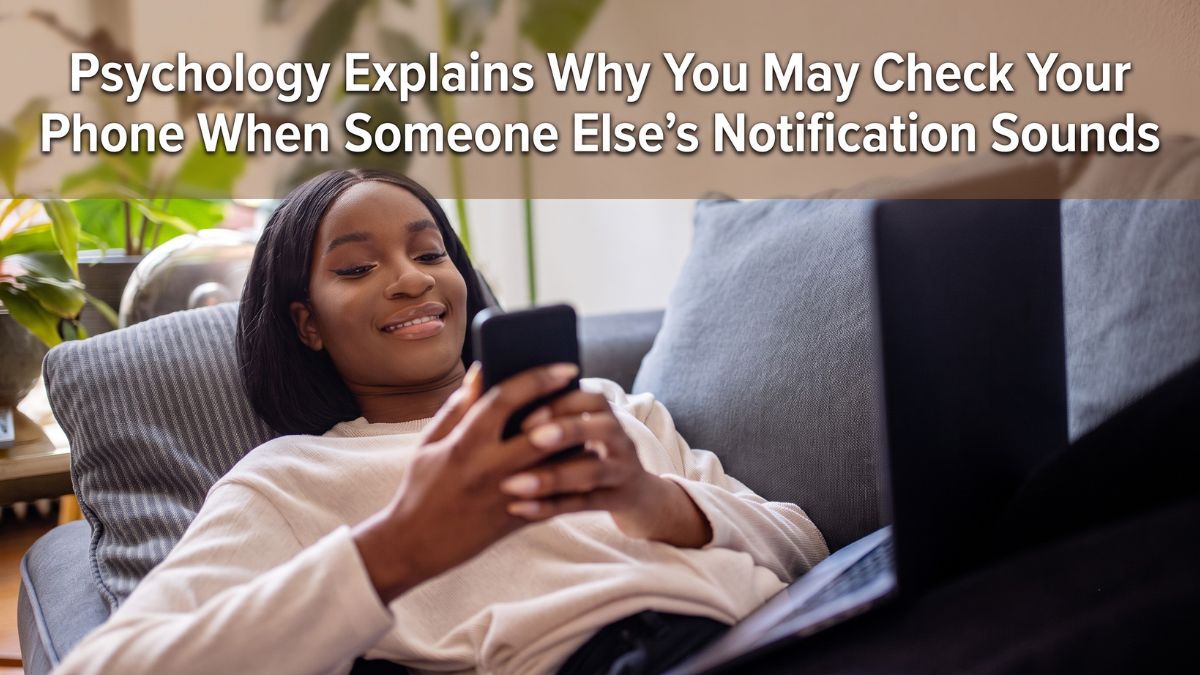
Have you ever been sitting with someone when their phone makes a familiar notification sound, only to find yourself checking your own phone a moment later? You may know the sound came from another device, yet your attention shifts toward your phone almost automatically.
Psychology offers several possible explanations for this behavior, including attentional capture, associative learning, expectancy and habit automaticity. The reaction does not necessarily indicate that someone is unusually distracted or dependent on their phone. Instead, repeated experiences can teach the brain that certain sounds may signal information worth noticing.
Over time, a notification sound can become more than an ordinary noise. It can function as a learned attention cue associated with messages, reminders, social updates or other events that previously required a response.
Attention
The first explanation involves attentional capture.
Human attention is selective, but it is not entirely under conscious control. Certain sensory events can interrupt an ongoing activity because they are sudden, distinctive or potentially relevant.
Psychologists Polly Dalton and Nilli Lavie have studied how distinctive sounds can capture auditory attention even when those sounds are unrelated to the task a person is performing. Their experiments found that unexpected auditory stimuli could interfere with performance.
A smartphone notification has several characteristics that can make it attention-grabbing. It is usually brief, recognizable and associated with information. If you have heard the same sound repeatedly before checking your phone, the sound can become especially meaningful.
As a result, your attention may shift toward the sound before you have consciously decided that it matters.
Learning
Associative learning provides another possible explanation.
A notification sound does not necessarily have psychological meaning when you hear it for the first time. It is simply a sound. Its significance develops through repeated experience.
Consider the sequence:
Sound.
You check your phone.
There is a message.
The same sound occurs again.
You check.
There is an email, reminder or social update.
After enough repetitions, the sound can become associated with the possibility of information.
This is consistent with broader principles of associative learning. It would be too simplistic to describe every phone notification as a straightforward classical conditioning response, but repeated pairing between a cue and a meaningful event can make that cue increasingly significant.
Eventually, the sound itself may be enough to attract attention.
Habits
Habit automaticity adds another part to the explanation.
Psychologists Wendy Wood and Dennis Rünger describe habits as behaviors that develop through repeated responses in recurring contexts. Once established, these behaviors can become relatively automatic.
Researchers Sheina Orbell and Bas Verplanken have also examined habitual behavior through the idea of cue-response associations.
Applied to smartphone use, the sequence can become familiar:
A notification sounds.
Attention shifts.
The phone is checked.
The information is processed.
The person returns to the original activity.
When this sequence occurs repeatedly, checking can require less conscious deliberation. The sound itself can make the response more likely.
Reaction
This helps explain why someone might reach for their own phone even after hearing another person’s notification.
The initial response may be triggered by the sound rather than by a conscious conclusion that the notification came from their own device.
Your brain may effectively register, “That sound could be relevant.”
Only afterward does conscious reasoning establish that the sound came from somewhere else.
Research on auditory attentional capture has shown that irrelevant sounds can draw attention away from an ongoing activity. Researchers Robert Hughes and colleagues have also examined how auditory events can influence attention and task performance.
The important point is that attention can move before a person has fully evaluated the source of the sound.
Expectancy
Expectations can make the response even stronger.
The brain uses previous experiences to anticipate what might happen next. When a particular sound has repeatedly been followed by something meaningful, that sound can become a predictive signal.
This means you may not simply hear a notification. You may respond to the possibility that information is waiting.
Research into auditory attention suggests that learned expectations can influence distraction and attention. When an incoming sound fits or violates what a person has learned to expect, it can affect where attention is directed.
For smartphone users, the learned sequence may become simple: notification means something may be waiting.
Example
Imagine someone who checks their phone dozens of times each day.
While working at a desk, they hear a familiar notification and immediately look at their screen. The same pattern happens repeatedly over weeks or months.
Eventually, the connection between the sound and the checking behavior becomes well practiced.
Now place that person in a café. Someone nearby receives a notification using a similar sound.
The person’s attention shifts. They may touch their phone or glance toward it before realizing that their own device did not make the sound.
This does not necessarily mean they consciously believed their phone had received a message. The response may simply have been triggered by a familiar cue.
Social
Phone notifications can be especially powerful attention signals because they often relate to other people.
A notification might indicate a message from a friend, a family member, a colleague or an employer. It can represent communication, information or an opportunity to respond.
That gives the sound a different meaning from an arbitrary beep produced by an appliance.
Fear of missing out, commonly called FoMO, may also be relevant for some people. Research has associated smartphone checking with concerns about missing socially relevant information and maintaining connection.
This does not mean that every automatic phone check is caused by FoMO. The behavior can occur simply because the notification sound has become familiar and attention-grabbing.
Possibility
There is a subtle difference between thinking, “My phone just received a notification,” and thinking, “That sound could mean I have something to check.”
The second response requires much less certainty.
Your brain does not necessarily need to determine who received the notification before orienting toward it. It may be enough that the sound has historically been associated with something worth investigating.
That helps explain why the reaction can feel strange afterward. You may look at your phone and wonder why you checked it in the first place.
The behavioral response can occur before you consciously construct an explanation for it.
Automatic
Automatic behavior should not be confused with a psychological disorder.
Checking your phone after hearing another person’s notification does not by itself indicate smartphone addiction, anxiety or an attention problem.
Humans are naturally sensitive to unexpected and potentially relevant sounds. Auditory attention research has repeatedly shown that sounds can influence attention even when they are unrelated to the current task.
The behavior becomes more concerning when checking is extremely frequent, difficult to control or consistently interferes with work, sleep, conversations and other important activities.
In ordinary situations, the reaction may simply demonstrate how effectively repeated experience can shape behavior.
Attention
Habits are interesting partly because they reduce the need for deliberate decision-making.
When a behavior has been repeated in response to the same type of cue many times, the cue can make the response easier to initiate. Research by Wendy Wood and colleagues has examined how recurring contexts can activate habitual responses.
This does not mean the person has completely lost control over the behavior. Rather, the first impulse may occur with very little conscious planning.
A familiar notification sound can therefore become a small trigger for a familiar action: check the phone.
Learning
The broader lesson is that attention is shaped by experience.
Every time a notification is followed by a message, update or reminder, the brain receives another example that the sound may be worth monitoring. Over time, the cue can become more strongly associated with the possibility of something meaningful.
That learned association can explain why a similar sound from another person’s phone may briefly trigger the same response.
You hear it.
You orient toward the sound.
You reach for your phone.
Then you realize the notification was not yours.
The entire sequence can happen in seconds.
Meaning
Checking your phone after hearing someone else’s notification is a small example of how attention, learning and habits can interact.
A distinctive sound can capture attention. Repeated experiences can give that sound meaning. The resulting expectation can make the cue more noticeable, while repeated checking can strengthen the connection between the sound and the behavior.
So if you instinctively check your phone when someone else’s device buzzes, it may not simply be a moment of distraction. Your brain may have learned that this particular sound can signal something worth noticing.
In that sense, the reaction reflects an ordinary feature of learning: experiences can shape what captures our attention, sometimes before we have consciously decided where to look.
FAQs
Why do I check my phone when others get notifications?
A familiar sound can automatically capture your attention.
Can notification sounds become learned cues?
Yes. Repetition can associate sounds with meaningful information.
Does this mean I am addicted to my phone?
No. This reaction alone does not indicate phone addiction.
Why are notification sounds distracting?
They can be distinctive and associated with potentially relevant information.
Can habits make phone checking automatic?
Yes. Repeated cue-response patterns can become relatively automatic.