
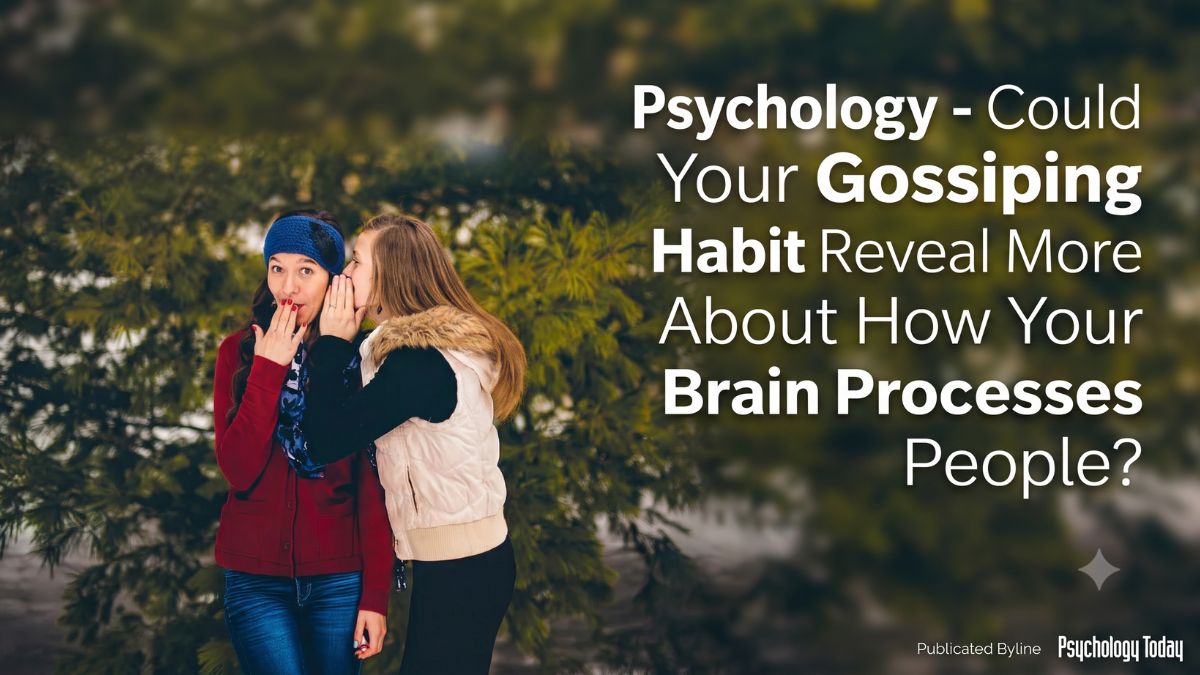
Gossip is rarely described as an admirable habit. In workplaces and social groups, talking about people who are not present can easily be viewed as petty, distracting or unproductive. Yet psychologists and evolutionary researchers have long argued that conversation about other people can serve important social functions.
Research suggests that humans spend a substantial amount of conversational time discussing absent third parties. A 2024 study published in Language and Cognition reported that conversations can contain a high proportion of references to people who are not present, although the exact share depends on how gossip and third-party talk are defined.
That does not mean gossip is a sign of high intelligence. Instead, the psychological value may depend on what someone does with social information. There is an important difference between simply judging another person and trying to understand the reasons behind their behavior.
Purpose
Evolutionary anthropologist Robin Dunbar has argued that social conversation plays an important role in maintaining relationships and managing large social groups.
Humans live in complex networks where it is impossible to personally observe everyone’s behavior. Information about reputation, relationships and cooperation can therefore help people decide whom to trust, support or avoid.
In this sense, talking about other people is not necessarily meaningless conversation. It can function as a form of social information processing.
People may discuss who can be trusted, who has helped someone in the past, who is in conflict with whom or why a particular person behaved in a certain way.
The same basic process can occur in modern workplaces, although the environment is very different from the small communities in which humans evolved.
Mapping
Following social information requires mental organization.
If someone tells you that a colleague is having a disagreement with a manager, you may automatically place that information into an existing mental map. You might consider their previous relationship, the people involved, their responsibilities and the possible reasons for the disagreement.
Research on social cognition suggests that humans are capable of maintaining remarkably detailed representations of relationships. Remembering who knows whom, who trusts whom and who has conflicting interests can require considerable cognitive processing.
However, social complexity should not be confused with intelligence. Someone can be highly attentive to social information without necessarily reasoning accurately about it.
The quality of the reasoning matters.
Curiosity
There is a meaningful distinction between gossip that seeks understanding and gossip that simply seeks confirmation.
Consider two people discussing why a colleague made an unusual decision.
One person might immediately conclude that the colleague is selfish or incompetent. From there, every additional detail is interpreted as evidence supporting that judgment.
Another person might ask what circumstances could have influenced the decision. Perhaps there were financial pressures, conflicting instructions, workplace incentives or information that other employees did not have.
The second approach requires more uncertainty. Instead of immediately settling on an explanation, the person keeps several possibilities open.
That type of thinking resembles a broader psychological skill: considering alternative explanations before reaching a conclusion.
Simulation
Understanding another person’s behavior often requires mentally reconstructing circumstances that are not directly visible.
Suppose a colleague suddenly rejects a project that they previously supported. One explanation might be that they have become difficult. But other possibilities could include a change in management, concerns about resources, pressure from another department or information that has not been shared with the wider team.
Trying to distinguish between these explanations involves a kind of mental simulation.
You are effectively asking: If those circumstances were true, would the person’s behavior make more sense?
This does not require exceptional intelligence, but it does involve perspective-taking, causal reasoning and the ability to hold multiple possibilities in mind.
Ambiguity
One potentially useful characteristic of thoughtful social reasoning is comfort with uncertainty.
People naturally prefer clear explanations. Saying “she did it because she is selfish” provides a quick answer. It also closes the investigation.
A more cautious response might be, “There could be several reasons, and we do not know enough yet.”
That answer can feel less satisfying, but it leaves room for new information.
Psychological research on reasoning and judgment has repeatedly shown that people can be vulnerable to confirmation bias, the tendency to favor information that supports beliefs they already hold. Social conversations can reinforce this tendency when people collectively search for evidence against an absent person.
Curiosity works differently. It treats the initial explanation as a hypothesis rather than a final verdict.
Judgment
Not all gossip serves the same function, and it would be misleading to describe gossip generally as evidence of intelligence.
Talking about another person can strengthen social bonds, exchange useful information or help a group understand complicated relationships. It can also spread misinformation, damage reputations and reinforce unfair judgments.
The difference may partly lie in how information is handled.
Someone who asks questions, considers alternative explanations and acknowledges uncertainty is engaging in a more reflective form of social reasoning than someone who immediately assigns negative motives and searches only for supporting evidence.
Even then, these behaviors should not be used as a simple test of intelligence. Cognitive ability is multidimensional, and conversational habits provide only limited evidence about it.
Context
Modern social networks make this issue particularly relevant. People routinely navigate workplaces, families, friendships and online communities containing overlapping relationships and competing interests.
Understanding these networks requires more than remembering individual facts. People also need to interpret motives, relationships and changing circumstances.
That may explain why conversation about absent people is so common. Social information is useful because relationships affect cooperation, trust and access to shared resources.
But useful social tracking requires accuracy. If the information is wrong, or if people interpret every action through a predetermined judgment, the same conversational process can become harmful.
Balance
The most interesting lesson from psychology is not that gossipers are secretly more intelligent. Rather, it is that conversations about other people can involve sophisticated cognitive processes when they are used to understand relationships, motives and social dynamics.
The difference between thoughtful social curiosity and destructive gossip may come down to the way information is processed. Asking why, considering competing explanations and accepting that some facts remain unknown can encourage better reasoning. Quickly labeling someone and treating every new detail as proof of that judgment does the opposite.
So if you find yourself discussing someone who is not in the room, the more revealing question may not be whether you are gossiping. It may be what your mind is doing with the information – building a more accurate picture of the social world or simply looking for reasons to confirm what you already believe.
FAQs
Does gossip mean someone is highly intelligent?
No. Gossip alone is not a reliable measure of intelligence.
Why do humans discuss absent people?
It can help people exchange information about relationships and reputations.
What is thoughtful gossip?

It involves curiosity, perspective-taking and considering multiple explanations.
Can gossip be harmful?
Yes. It can spread misinformation and damage people’s reputations.
Why is ambiguity important in social reasoning?
It allows people to consider new evidence before reaching firm conclusions.