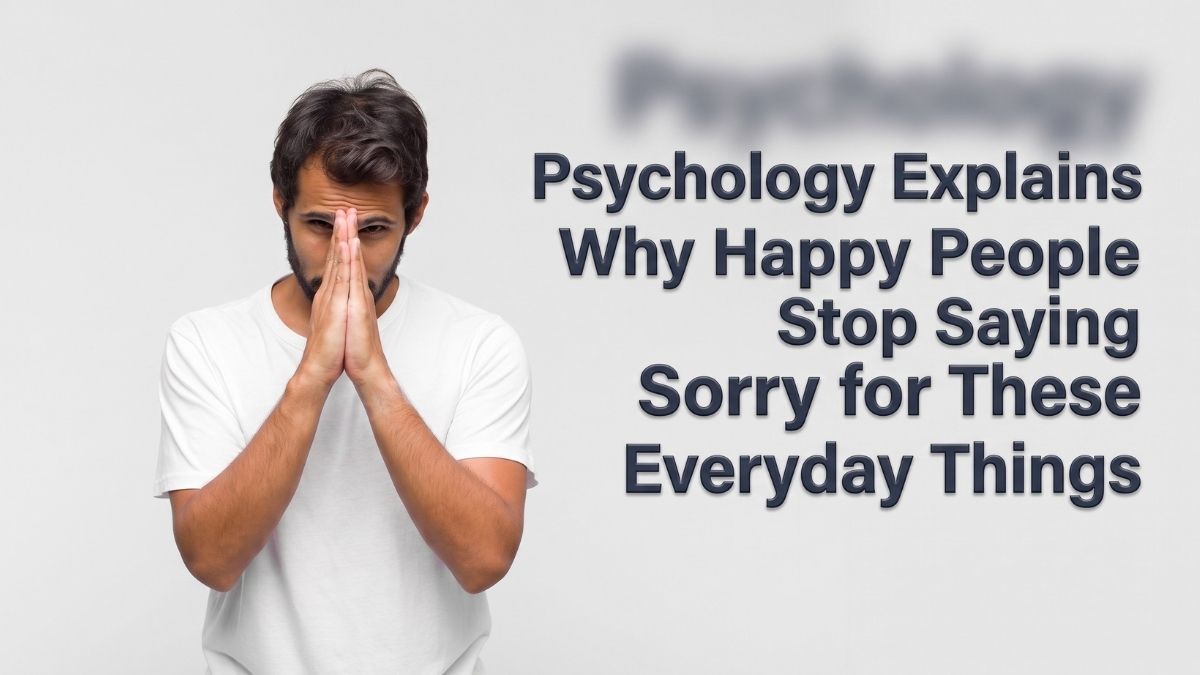
Many people apologize far more often than the situation requires. They say sorry for needing rest, asking for help, declining an invitation, expressing an opinion or setting a personal boundary. While apologizing can be a healthy way to acknowledge genuine mistakes, psychology suggests that repeatedly apologizing for harmless behavior may reflect something different.
The issue is not simply about becoming more confident or deciding to stop saying sorry altogether. Instead, it can involve how a person judges everyday situations and whether they see ordinary needs or preferences as something that requires forgiveness. Knowing that distinction offers a more useful way to think about the psychology of over-apologizing.
Threshold
Over-apologizing is sometimes treated as a simple sign of insecurity, but research offers a more specific explanation. In studies examining differences in apologizing behavior, researchers Karina Schumann and Michael Ross found that people who apologized more often tended to have a lower threshold for deciding that an apology was appropriate.
In other words, they may interpret more situations as offenses that require an apology. This does not necessarily mean they are more remorseful or that they have done something wrong more frequently.
Consider someone saying, “Sorry for bothering you,” when they are simply asking a reasonable question. The person may have learned to interpret ordinary social behavior as something that inconveniences others.
This perspective changes how over-apologizing can be understood. Rather than treating it as a character flaw, it can be viewed as a tendency to set the internal standard for wrongdoing too low.
Silencing
There is another side to the issue that has greater implications for wellbeing. Frequent apologies can sometimes accompany a broader tendency to suppress personal needs, thoughts and feelings to avoid upsetting other people.
Psychologist Dana Jack’s Silencing the Self framework has been influential in research on this pattern. Studies examining self-silencing have associated the suppression of personal needs and emotions in relationships with poorer psychological wellbeing and higher levels of depressive symptoms.
This does not mean that every person who says sorry frequently is experiencing a mental health problem. However, it highlights why the habit can deserve attention when it becomes part of a larger pattern of putting everyone else’s comfort ahead of your own.
For example, repeatedly apologizing for needing time alone may eventually make someone less likely to ask for that time at all. The apology is then only the visible part of a deeper habit of withholding legitimate needs.
Boundaries
One area where people may benefit from changing their language is personal boundaries. Saying no to a request that you cannot reasonably fulfill does not automatically require an apology.
There is a meaningful difference between “Sorry, I can’t help” and “I can’t help this time.” The first can suggest that having a limitation is itself a wrongdoing, while the second simply communicates a fact.
The same applies to taking a break, protecting personal time or declining an invitation. These choices can disappoint someone without necessarily harming them. Disappointment and wrongdoing are not the same thing.
Learning to recognize that distinction can make communication clearer. It also allows people to acknowledge other people’s feelings without automatically treating their own needs as a problem.
Feelings
People also sometimes apologize for having perfectly ordinary emotions. They may say sorry for being upset, needing reassurance or expressing that something hurt them.
Emotions themselves are not usually moral failures. A person remains responsible for how they behave, but experiencing anger, sadness, frustration or disappointment is different from deliberately treating someone badly.
That distinction can be useful in relationships. Instead of apologizing for having a feeling, someone might explain what caused it and discuss what they need. This approach keeps the conversation focused on understanding rather than unnecessary guilt.
It also avoids turning emotional honesty into something that must always be softened or withdrawn.
Accountability
Stopping unnecessary apologies should not be confused with avoiding responsibility. Genuine mistakes still deserve genuine apologies.
If someone insults another person, breaks a promise, behaves unfairly or causes avoidable harm, acknowledging it matters. A specific apology can communicate responsibility and help repair trust.
The healthier goal is therefore not to eliminate the word “sorry.” It is to use it more accurately.
A person can say sorry when they have caused harm while refusing to apologize for needing sleep, having a reasonable boundary or holding a different preference. In that sense, fewer apologies can sometimes make the meaningful ones more sincere.
Balance
There are many reasons someone may develop an over-apologizing habit. Personality, anxiety, family dynamics, cultural expectations and past relationships can all influence how people respond to social situations.
That is why the solution is unlikely to be as simple as adopting a more forceful communication style. Someone who has spent years worrying about other people’s reactions may need time to recognize that not every uncomfortable moment requires personal blame.
A useful question is straightforward: “Did I actually do something wrong?” If the answer is no, there may be no need for an apology. A person can instead state what they need, explain their position or simply continue the conversation.
Ultimately, the psychology of over-apologizing is less about becoming someone who never says sorry and more about developing a clearer sense of responsibility. Happy or psychologically healthy people are not necessarily those who avoid apologies. They may simply become better at separating genuine mistakes from ordinary parts of being human. Knowing when to apologize, and when an apology is unnecessary, can make communication more honest and personal boundaries easier to maintain.
FAQs
Why do some people apologize too much?
They may have a low threshold for seeing situations as needing an apology.
Is over-apologizing a sign of low confidence?
It can be linked to insecurity, but it has several possible causes.
Should you stop saying sorry completely?
No. Genuine mistakes and harm still deserve sincere apologies.
Is setting a boundary something to apologize for?
Not usually. Reasonable boundaries do not automatically require an apology.
Can over-apologizing affect wellbeing?
Persistent self-silencing has been associated with poorer psychological wellbeing.