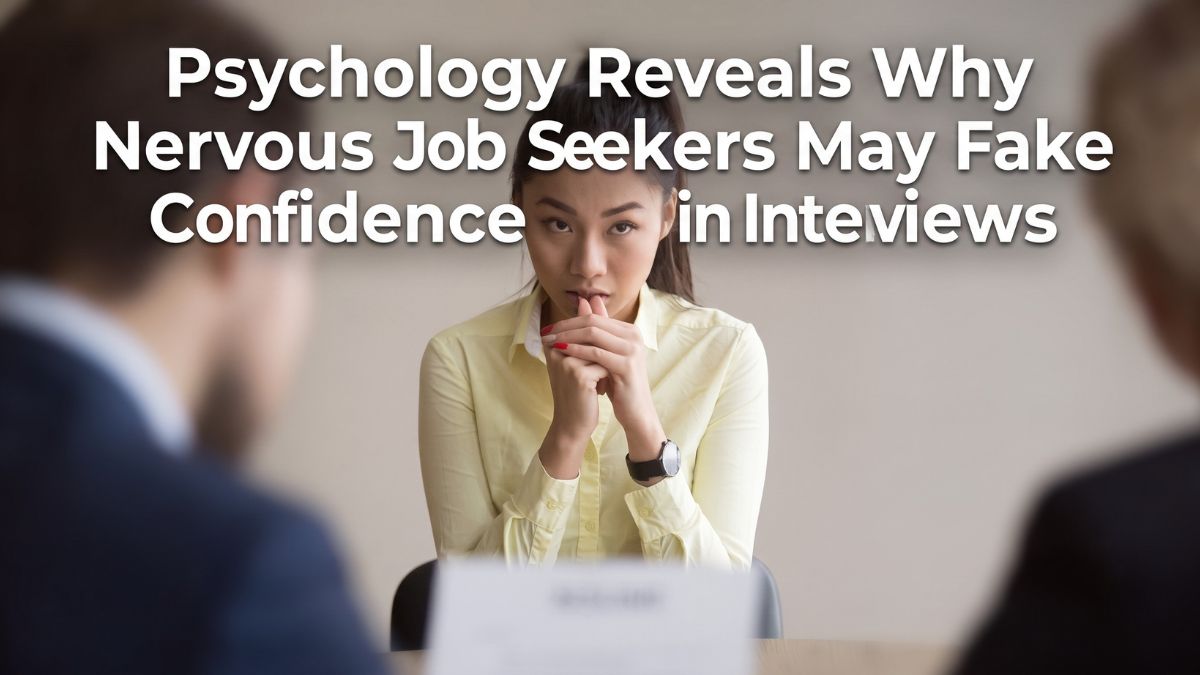
A job interview can turn confidence into a performance. For some applicants, the pressure of being judged may be so intense that presenting themselves honestly no longer feels sufficient. Psychological research suggests that anxiety about how they are perceived may push some candidates to exaggerate or construct a more favorable professional image.
A 2020 study by Deborah Powell of the University of Guelph and researchers from other Canadian institutions, published in the Journal of Business and Psychology, examined the relationship between interview anxiety and deceptive impression management. The researchers found that applicants who reported greater anxiety during interviews were also more likely to report using deceptive tactics to influence how interviewers perceived them.
The finding does not mean that nervous applicants are automatically dishonest. Instead, it points to a more complicated psychological process in which anxiety, self-presentation and fear of negative evaluation can interact.
Anxiety
Unlike many situations in which people simply have to demonstrate what they know, a job interview combines performance with intense social evaluation.
Candidates are expected to answer questions, communicate clearly, appear confident, establish rapport and convince an interviewer that they are competent, interested and suitable for the role. At the same time, they know that the interaction could determine whether they receive a job offer.
Psychologists describe part of this pressure through the concept of self-presentation, or the attempt to influence the image other people form of us.
That can create a difficult psychological situation.
A candidate may want to appear confident and capable while simultaneously believing they lack the experience, communication skills or personality needed to create that impression naturally. The gap between how someone sees themselves and how they think they need to appear can increase anxiety.
For some people, presenting a more favorable version of themselves may then seem like a way to manage that pressure.
Deception
The researchers distinguished deceptive impression management from ordinary self-promotion.
Honest impression management involves emphasizing genuine strengths and presenting real accomplishments in a favorable way. Deceptive impression management involves exaggerating or fabricating information about one’s qualifications, experience or personal characteristics.
The distinction is important because interviews naturally encourage candidates to present themselves positively.
Saying that you handled a difficult project successfully, when you actually did, is ordinary self-promotion. Claiming responsibility for an achievement you did not contribute to is something different.
The study focused on the second category because it may become more likely when applicants believe there is a substantial gap between their actual image and the image they think an interviewer expects.
Applicants
The research involved 202 students who had applied for a real research assistant position. Participants completed actual interviews and were subsequently invited to take part in the study.
The participants had an average age of about 21, and 82.7% were women.
After the interviews, they completed questionnaires assessing several factors, including interview anxiety, personality characteristics and their use of deceptive impression-management tactics.
The researchers measured interview anxiety across multiple dimensions. These included communication anxiety, appearance anxiety, social anxiety, performance anxiety and behavioral anxiety.
Behavioral anxiety referred to physical signs associated with nervousness, such as a racing heart or sweaty palms.
This allowed the researchers to look beyond a general feeling of nervousness and examine the different ways interview anxiety can appear.
Results
The findings supported the researchers’ central hypothesis.
Overall interview anxiety was positively associated with deceptive impression management. The strongest relationships appeared between deceptive impression management and social anxiety and communication anxiety.
The correlation between overall interview anxiety and deceptive impression management was moderate. Social anxiety showed a correlation of 0.30 with deceptive impression management, while communication anxiety showed a correlation of 0.26.
These figures should not be interpreted as proof that anxiety causes people to lie.
A correlation indicates that two variables are related. It does not establish that one directly produces the other.
Still, the pattern suggests that applicants who feel particularly anxious about social interaction and communication may be more likely to report using deceptive strategies during interviews.
Personality
Personality also appeared to play a role.
The researchers found that people higher in extraversion generally reported lower levels of interview anxiety. Extraversion was negatively correlated with overall interview anxiety at r = -0.38, with an especially strong relationship involving social anxiety.
One possible explanation is that socially confident individuals may feel more capable of creating the impression they want during an interview.
They may already feel comfortable speaking with unfamiliar people, maintaining conversations and responding to social feedback. As a result, they may feel less pressure to construct an alternative version of themselves.
Someone who is uncomfortable in social situations may have a different experience. They may worry that nervous speech, hesitation or visible anxiety will cause the interviewer to judge them as less capable than they actually are.
That concern can create pressure to compensate by appearing more confident.
Protection
One of the more useful insights from the research is that interview deception may not always come from a straightforward desire to manipulate another person.
In some cases, it may function as a form of psychological self-protection.
A candidate who strongly wants a job may worry that their natural presentation will not create the impression they need. Exaggerating an achievement or overstating a skill could then feel like a way of protecting their chances.
The stakes of an interview can make that pressure particularly strong.
The candidate is not only facing social evaluation. They may also be thinking about income, career progression, financial security and future opportunities.
When a single conversation appears to carry significant consequences, the motivation to control the outcome can become stronger.
Paradox
This creates an interesting confidence paradox.
The person who appears most confident during an interview may not necessarily feel the most confident internally.
Someone who is genuinely comfortable with social evaluation may have little reason to exaggerate because they already believe they can make a positive impression without doing so.
An anxious candidate, however, may believe that revealing their actual nervousness will hurt their chances. They may therefore try to compensate by speaking with greater certainty, presenting themselves as more experienced or projecting a personality that feels more socially desirable.
From the outside, that behavior can look like excessive confidence.
Internally, it may be connected to insecurity and fear of negative judgment.
Limits
The findings should also be considered within the limits of the research.
The study involved a relatively young sample of students applying for a research assistant position. Participants also reported their own behavior after the interviews, which means the findings do not establish how often deception actually occurred across the wider job market.
The research also does not show that socially anxious people are inherently deceptive. Nor does it suggest that nervousness inevitably leads to dishonest behavior.
Many anxious applicants respond to interview pressure in completely different ways. They may prepare more carefully, practice answers, seek advice or simply experience visible nervousness while remaining completely truthful.
The study instead highlights one possible response to the pressure of self-presentation.
Confidence
The broader lesson is that confidence during an interview is not always as simple as it appears.
A candidate who sounds certain may genuinely feel confident. Another may be carefully managing an image because they are worried about how they will be judged. The same outward behavior can therefore have very different psychological explanations.
For employers, this suggests that interviews may not always provide a perfect picture of someone’s underlying abilities. For applicants, it also shows why preparation can be valuable. The more familiar candidates are with common questions, their own experience and the requirements of a position, the less they may feel compelled to create an artificial version of themselves.
Psychology does not suggest that every nervous job seeker is likely to fake confidence. Instead, the research points to a more specific possibility: when people fear that their authentic presentation will lead to negative evaluation, some may use deceptive impression management as a way of protecting their desired image and their chances of success.
FAQs
Can interview anxiety lead to fake confidence?
It can be associated with deceptive impression management.
Does nervousness mean a candidate will lie?
No. Anxiety does not automatically lead to deception.
What is deceptive impression management?

It means exaggerating or fabricating information to shape perceptions.
Why might anxious candidates exaggerate?
They may fear that their genuine image will be judged negatively.
Does confidence always reflect real confidence?
No. Some confident behavior may be used to manage impressions.