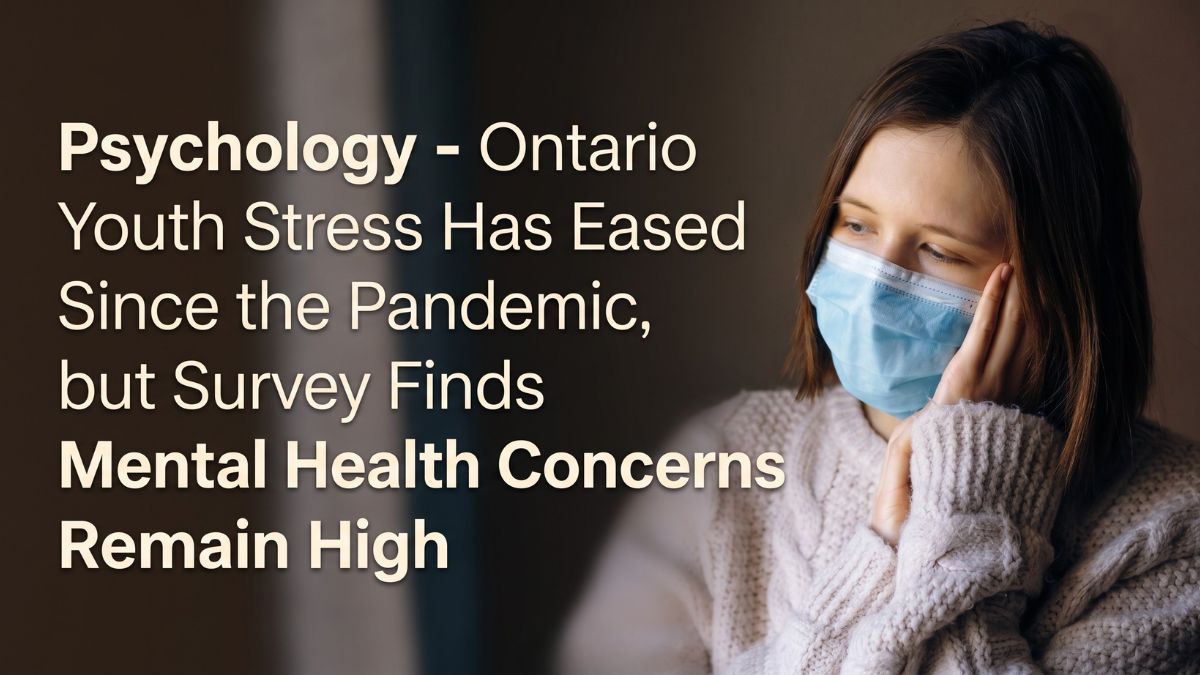
Psychological distress among young people in Ontario appears to have declined since the pandemic, according to the latest Ontario Student Drug Use and Health Survey. However, the findings also show that a substantial share of students continue to report mental-health difficulties.
The Centre for Addiction and Mental Health (CAMH) found that 46% of students in grades 7 to 12 reported a moderate to serious level of psychological distress in 2025. That compares with 51% in the previous survey conducted in 2023.
Researchers describe the decline as encouraging, while noting that reported distress remains considerably higher than it was more than a decade ago. The survey also points to changing patterns in substance use and a sharp increase in sports betting among students.
Distress
The 2025 survey suggests that psychological distress among Ontario students has moved lower from its recent peak.
Lead investigator Hayley Hamilton described the decrease as encouraging, but emphasized that the overall level remains high. Nearly half of surveyed students reported moderate to serious psychological distress, meaning the issue continues to affect a large part of the student population.
The findings also need to be considered over a longer period. Although distress has fallen since 2023, current levels remain above those recorded many years ago.
This longer-term pattern makes the results more complicated than a simple improvement or decline. The latest figures suggest some recovery from the pandemic period, while also indicating that youth mental health remains an important concern.
Stigma
There are several possible explanations for the long-term increase in reported mental-health problems.
Hamilton said social media may be one factor, although the survey cannot establish that social media directly caused the changes. At the same time, young people may now be more willing to discuss mental-health difficulties than they were in the past.
Reduced stigma can affect survey results in an important way. If students previously avoided discussing psychological distress, fewer reports in older surveys may partly reflect underreporting rather than better mental health.
Greater awareness can therefore produce two effects at once. More people may recognize psychological difficulties, while more people may also feel comfortable reporting them.
Substances
The survey found encouraging changes in youth substance use.
Fewer students reported using alcohol and drugs compared with earlier years, and students were also waiting longer before trying these substances for the first time.
These findings suggest that the factors influencing youth health are not moving in a single direction. While psychological distress remains elevated, some traditional substance-use measures have improved.
Understanding these patterns is important because mental health, substance use, social environments and other behaviors can overlap. A change in one area does not necessarily predict what will happen in another.
Gambling
One of the most notable findings involved online sports betting.
In 2025, about one in 10 students reported placing sports bets. That compares with approximately one in 100 students in 2017.
The survey also found that almost one-quarter of students had seen or heard advertising for online gambling sites every day.
Hamilton, who is co-director of CAMH’s Institute for Mental Health Policy Research, linked the rise in online gambling with changes to Ontario’s regulatory environment that allowed private, non-government betting sites to operate.
Although gambling platforms have age restrictions, Hamilton said students are still finding ways to participate.
The sharp increase is significant because online betting is easily accessible through smartphones and other connected devices. Advertising can also make gambling more visible to young people who might otherwise have had limited exposure to it.
Survey
The Ontario Student Drug Use and Health Survey has been conducted every two years since 1977 across school boards in Ontario. This long history allows researchers to compare youth health and behavior across different periods.
The 2025 survey included 11,108 students in grades 7 to 12. They represented 1,147 classes across 246 schools and 42 school boards.
Students completed anonymous online questionnaires between December 2024 and June 2025.
The survey covers a broad range of issues, including mental health, substance use and other health-related behaviors. Because the survey has been conducted for decades, its results can also provide information about how patterns among Ontario students change over time.
Context
The survey’s results should be interpreted with some methodological caution.
The Canadian Research Insights Council, the professional body representing Canada’s polling industry, notes that online surveys cannot be assigned a conventional margin of error when participants are not selected through random sampling.
That does not make the findings meaningless. It means the results should be understood as survey estimates rather than as measurements with the same statistical properties as a randomly sampled population.
The 2025 findings nevertheless provide useful information about reported experiences among participating Ontario students and highlight several areas that warrant continued attention.
Outlook
The decline in psychological distress since 2023 offers some positive news, particularly after the disruption associated with the pandemic. However, with 46% of surveyed students still reporting moderate to serious psychological distress, the broader picture remains mixed.
At the same time, declining alcohol and drug use contrasts with the rapid growth in reported sports betting. These trends illustrate why youth health cannot be understood through a single measure.
The latest survey suggests that Ontario youth may be experiencing some improvement in psychological distress, but the overall level remains substantial. Continued monitoring, open conversations about mental health and careful attention to emerging behaviors such as online gambling will be important for understanding how these trends develop.
FAQs
Has youth distress decreased in Ontario?
Yes, reported distress fell from 51% in 2023 to 46% in 2025.
Is youth psychological distress still high?
Yes, 46% reported moderate to serious psychological distress in 2025.
Has youth substance use decreased?

The survey found fewer students reporting alcohol and drug use.
How common is sports betting among students?
About one in 10 students reported placing sports bets in 2025.
How many students joined the survey?
The 2025 survey included 11,108 students in grades 7 to 12.