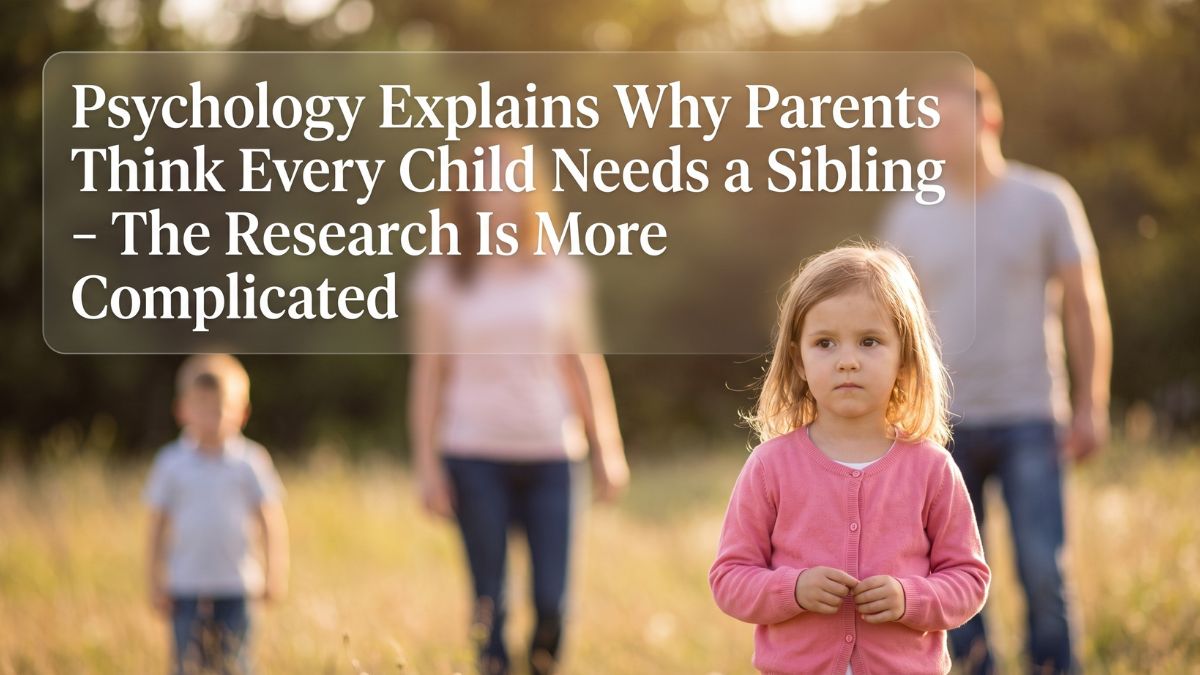
For some parents, having another child is about more than wanting a larger family. A common belief is that a child needs a brother or sister to develop important social and emotional skills.
Parents may picture siblings growing up together, sharing experiences, arguing over toys, learning to compromise and eventually becoming close companions. Because sibling relationships are so common, having a sibling can sometimes be treated as though it were a developmental requirement.
Psychological research presents a more nuanced picture. Siblings can create valuable opportunities for children to practise communication, emotional regulation, cooperation and conflict resolution. But simply having a brother or sister does not guarantee better development. The quality of the relationship and the wider family environment can be just as important.
Interaction
Psychologist Lev Vygotsky’s sociocultural theory emphasises the role of social interaction in children’s development. From this perspective, siblings can provide a regular setting in which children communicate, imitate one another, negotiate and solve everyday problems.
Consider two young siblings who both want the same toy. Neither may get exactly what they want. They have to communicate, wait, negotiate or seek help from an adult.
These ordinary disagreements can create opportunities to practise social skills. Unlike interactions with parents, sibling interactions often involve children at different but relatively close developmental stages, which can make their exchanges particularly frequent and immediate.
Research reviews have consequently identified sibling relationships as an important context for children’s social and emotional development, including learning about emotions, self-regulation and relationships.
Regulation
Sibling relationships can also provide repeated opportunities to experience and manage strong emotions.
Two children might argue over a game, become frustrated and temporarily stop speaking to each other. Later, they may find a way to resume playing together. These experiences can give children opportunities to practise perspective-taking, emotional control and conflict management.
However, conflict should not automatically be considered beneficial.
A large meta-analysis involving 34 studies and more than 12,000 children and adolescents found that greater sibling warmth was associated with fewer internalizing and externalizing problems. Greater sibling conflict and differential treatment, meanwhile, were associated with more problems.
The distinction is important. A disagreement between siblings can be a learning experience when children have opportunities to resolve it safely. Persistent hostility or unequal treatment can have a different effect.
Loneliness
Parents may also want another child because they worry about their existing child’s future.
Some imagine an only child growing up without someone close to share childhood experiences with. This can make the idea of a sibling psychologically connected with companionship, belonging and social support.
Attachment theory, developed by psychologist John Bowlby, highlights the importance of close emotional relationships in human development. A sibling can become an important relationship within a child’s social world.
But having a sibling does not automatically provide emotional security. Brothers and sisters can be affectionate and supportive, but they can also compete, reject one another or remain relatively distant.
The quality and consistency of relationships matter more than the mere presence of another child in the household.
Modeling
Children also learn by watching other children.
Albert Bandura’s Social Learning Theory proposes that people can acquire behaviors by observing and modelling others. Within families, older siblings can therefore become informal behavioral models for younger children.
A younger child might become interested in reading after repeatedly seeing an older sibling enjoy books. They may copy the way an older sibling organises schoolwork, plays sports or interacts with other people.
However, modelling is not always positive. Children can also imitate aggression, disruptive behavior or unhealthy habits.
This is one reason researchers describe sibling relationships as having the potential to function as both protective and risk factors. The influence depends partly on what children observe and how the family responds.
Family Size
The assumption that more siblings automatically produce better development becomes harder to support when family size is considered.
A 2023 longitudinal study using three decades of data examined relationships between changes in sibship size and children’s cognitive and sociobehavioral development. The researchers did not find a simple pattern in which having more siblings produced better outcomes. They reported net decreases in cognitive test scores as family size increased, with effects varying according to birth position.
There are several possible reasons why family size can matter. Parents have finite amounts of time, attention and financial resources. As the number of children increases, those resources may need to be distributed among more people.
Older children may gain greater independence and more opportunities to help younger siblings, but they may also experience competition for parental attention.
This is sometimes discussed through the concept of resource dilution, in which family resources are spread across a larger number of children.
Relationship
Recent research increasingly focuses on the quality of sibling relationships rather than treating sibling status as a simple developmental advantage.
A 2024 evidence map examining 277 empirical studies on sibling relationships identified characteristics such as warmth, affection, cohesion, positive engagement, hostility, power, conflict and conflict management.
That approach reflects the complexity of sibling relationships. Two children can live in the same household while having very different experiences of one another.
For parents, this means the goal should not necessarily be to create a sibling relationship simply because a child is an only child. It is more useful to consider whether children have supportive relationships and opportunities to develop social skills in different settings.
Birth Order
Popular ideas about birth order often add another layer to the discussion. Firstborn children are sometimes described as more responsible, while later-born children are often portrayed as more sociable or flexible.
Large-scale research has challenged some of these broad stereotypes.
One large study involving more than 20,000 participants found a small association between birth order and intelligence but did not find lasting birth-order effects on major Big Five personality traits such as extraversion, emotional stability, agreeableness and conscientiousness.
This suggests that having a particular position within a family does not automatically determine a child’s personality.
Similarly, being an only child does not mean a child will lack empathy, social skills or emotional resilience.
Balance
The research does not support the idea that every child needs a sibling to become socially or emotionally healthy. Children can develop communication skills, empathy and resilience through relationships with parents, relatives, teachers, friends and other peers.
At the same time, a supportive sibling relationship can provide something valuable. Siblings may offer companionship, opportunities for cooperation, exposure to different perspectives and repeated practice in managing disagreements.
The important distinction is between having a sibling and having a healthy sibling relationship. The two are not the same.
For parents considering another child, psychology therefore offers no universal rule that one family size is best. A sibling can become an important part of a child’s developmental environment, but the quality of family relationships, parental attention and the way conflict is handled can matter considerably.
In the end, the strongest lesson is not that every child needs a brother or sister. It is that children benefit from meaningful relationships in which they can connect, cooperate, disagree safely, repair relationships and feel valued. A sibling can provide many of those experiences, but so can a wider network of healthy relationships.
FAQs
Does every child need a sibling?
No. Children can develop well through many supportive relationships.
Can siblings improve social skills?
They can provide regular opportunities to practise social skills.
Is sibling conflict always harmful?
No, manageable conflict can provide practice in resolving disagreements.
Can siblings influence behavior?
Yes, children can learn behaviors by observing their siblings.
Does birth order shape personality?
Research finds limited evidence for lasting birth-order personality effects.