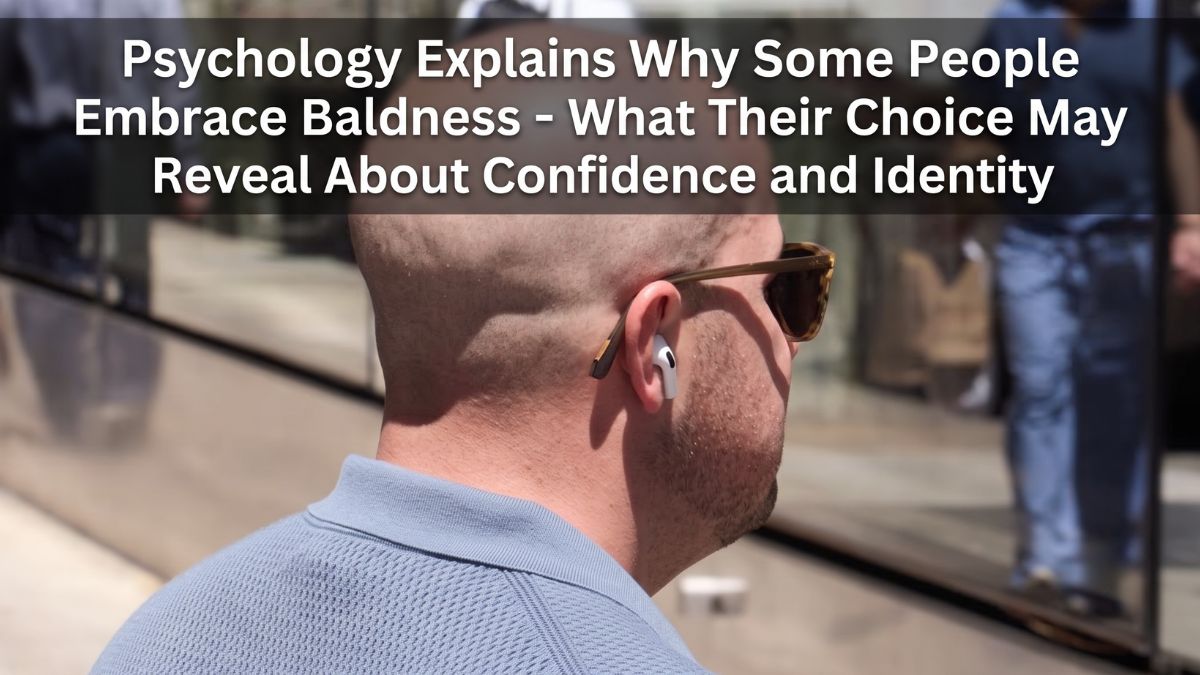
Going bald can be an emotional experience, but not everyone sees hair loss as something that needs to be concealed. For some people, embracing a bald look is simply practical. For others, it may reflect growing self-acceptance, confidence or a preference for presenting themselves in a way that feels authentic.
Psychology research suggests that the way people respond to changes in appearance can matter more than the change itself. Studies of hair loss have examined self-image, psychological distress, social confidence and acceptance, creating a more nuanced picture than the common assumption that baldness automatically causes insecurity.
Importantly, research does not establish that people who choose a bald appearance share one particular personality type. Their decision may instead reflect how they manage appearance, identity and changing expectations about how they should look.
Acceptance
One of the clearest themes in research is acceptance.
Psychologist Dirk Kranz studied 160 young men between 18 and 30 years old with different degrees of androgenetic alopecia. His 2011 study, published in Body Image, compared three approaches to coping with hair loss: compensation, avoidance and acceptance.
The study found that acceptance was associated with lower psychological distress, particularly among men experiencing more advanced hair loss.
This does not mean that bald people are automatically more confident. Instead, the findings suggest that accepting an appearance change may be psychologically healthier than continuously trying to conceal or compensate for it.
For someone who decides to shave their head, the choice can therefore represent a shift in perspective. Rather than allowing hair loss to dictate how they feel about themselves, they may decide that it no longer deserves so much attention.
Expression
Hair is not simply a physical feature. It can also become part of the way people communicate identity and personal style.
A 2026 qualitative study by Elly Anastasiades, Jennifer Todd, Elizabeth Kirk and Viren Swami explored positive relationships with hair through interviews with 21 adults. The researchers identified themes including personal choice, authenticity and the use of hair as a form of self-expression.
The study was not specifically focused on bald men, so its findings should not be treated as direct evidence about baldness. However, it provides useful context for understanding why appearance choices can feel personally meaningful.
When people make decisions about their appearance according to personal preference rather than social pressure, they may experience a greater sense of control.
For someone embracing baldness, shaving the head may therefore be less about giving up on hair and more about choosing how to respond to its absence.
Perception
Baldness can also influence how other people perceive someone.
University of Pennsylvania researcher Albert E. Mannes examined whether a man’s hairstyle could affect perceptions of his personality and physical presence. Participants viewed photographs of the same men in different versions, including images with hair and images in which their heads had been shaved.
The experiment found that men with shaved heads were consistently perceived as more dominant than when those same men appeared with hair. Participants also rated them as bigger and stronger.
This is an important distinction. The study examined social perceptions, not whether bald men are actually more dominant, successful or physically powerful.
In other words, a shaved head may change the visual signals other people associate with a man. The appearance itself can influence first impressions, even though those impressions may not accurately describe the person.
Confidence
It can be tempting to conclude that someone who embraces baldness must have particularly high self-confidence. Psychology research does not support such a simple interpretation.
People respond to hair loss differently. One person may experience considerable distress, while another may quickly decide that shaving their head is easier and more comfortable.
A person’s response can also change over time. Someone may initially struggle with thinning hair but eventually become less concerned about it. Another person may continue to feel uncomfortable despite choosing a shaved appearance.
Confidence, therefore, should not be treated as an automatic explanation for the bald look. The decision may reflect acceptance, convenience, personal style, changing priorities or several factors at once.
Research
A 2025 experimental study by Glen Jankowski and colleagues involving 350 balding men examined whether presenting baldness in a less medicalized way could encourage greater acceptance.
Participants who received demedicalized information reported feeling more informed and accepting, although the intervention did not produce measurable differences in distress.
The finding highlights an important point about appearance and psychology. Changing how people understand an appearance difference may influence acceptance, but it does not necessarily remove the emotional difficulties associated with it.
Baldness can be experienced differently depending on a person’s circumstances, expectations and relationship with their appearance.
Identity
Keeping a bald look does not come with a fixed personality profile.
Someone may shave their head because they like the style. Another person may prefer a low-maintenance appearance. Someone else may decide that constantly worrying about thinning hair is no longer worth the effort.
For some, the choice may also represent a broader shift in how they think about social expectations. Instead of trying to maintain an appearance associated with youth, they may become more comfortable allowing their appearance to change naturally.
That does not mean everyone who embraces baldness has reached complete self-acceptance. Appearance choices can be complicated, and people can feel both comfortable and self-conscious about the same feature.
The broader psychological lesson is that confidence does not necessarily involve maintaining a particular appearance. It can also involve becoming more comfortable with change and making personal choices without allowing social expectations to determine self-worth.
As attitudes toward aging, grooming and appearance continue to evolve, the bald look can be understood as one of many ways people choose to present themselves. What it reveals about personality depends far more on the individual than on the absence of hair itself.
FAQs
Does choosing baldness mean someone is confident?
Not necessarily. It can reflect preference, acceptance or practicality.
Can baldness affect social perception?
Yes, studies suggest shaved heads can influence first impressions.
Is baldness linked to personality?
Research does not show that bald people share one personality type.
Can accepting hair loss reduce distress?
Some research links acceptance with lower psychological distress.
Why do some men shave their heads?
Reasons include style, convenience, acceptance and personal preference.