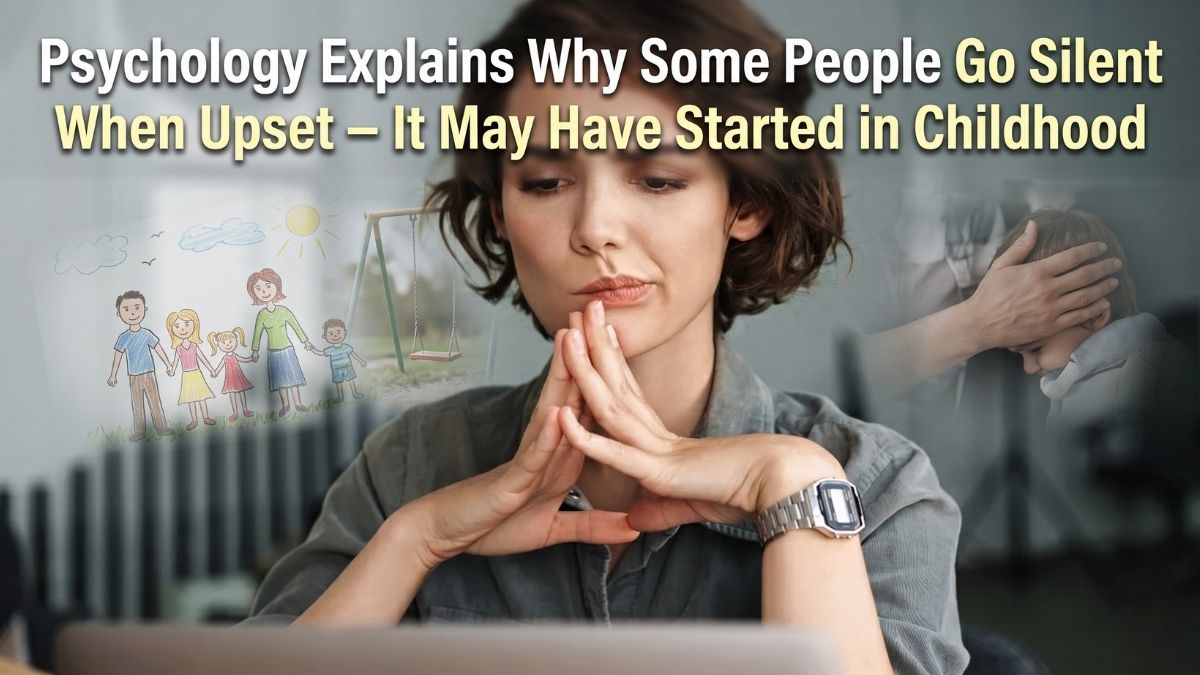
Someone asks their partner what is wrong. They get a shrug, followed by a flat “nothing.” Then comes twenty minutes of silence, with the person sitting quietly on the other side of the sofa.
From the outside, the behavior can look deliberate. It may seem like punishment, avoidance or an attempt to make the other person feel uncomfortable.
But psychology offers another possibility. For some people, going quiet during conflict is less about withholding and more about becoming overwhelmed. In certain cases, the habit may also have roots in childhood, particularly when expressing emotions or speaking openly could change the atmosphere at home.
Flooding
John Gottman’s research on relationships describes one form of this behavior as stonewalling. During intense conflict, some people become physiologically overwhelmed, a state often referred to as flooding.
Gottman’s work suggests that flooding can involve a rapid increase in heart rate and activation of the body’s stress response. When that happens, a person may find it harder to think clearly, listen carefully or explain what they are feeling.
That can make silence look intentional when it is actually a form of emotional shutdown.
A person in this state may not be planning a hurtful response or deliberately trying to control the conversation. They may simply need time for their nervous system to settle before they can communicate effectively.
Childhood
The habit can sometimes have deeper roots.
Patrick Davies and Mark Cummings developed emotional security theory to explain how children’s responses are shaped by conflict between parents. Research in this area suggests that children exposed to intense or hostile parental conflict can become more vigilant, fearful or avoidant.
For some children, paying close attention to the emotional atmosphere at home becomes a way of staying safe. They may notice changes in tone, facial expressions or tension before anyone says anything directly.
Later research has described some children in these environments as hypervigilant. They can become highly attentive to signs that conflict is about to escalate.
Over time, this can create a pattern in which managing the emotional atmosphere feels more familiar than openly expressing personal feelings.
Emotions
Another factor is how parents respond to children’s emotions.
Researchers John Gottman and Lynn Katz studied what they called parental meta-emotion philosophy, essentially the way parents understand and respond to feelings such as anger, sadness and fear.
Some parents treat difficult emotions as useful information. They acknowledge them, help children name them and use the moment as an opportunity to teach emotional regulation.
Other parents may respond differently. They may become uncomfortable with strong emotions and try to stop them as quickly as possible.
A child who repeatedly learns that anger makes things worse, sadness creates tension or disagreement threatens family stability may become cautious about expressing feelings.
The lesson is not necessarily conscious. The child may simply learn that silence is safer.
Ostracism
There is another side to silence that should not be ignored.
Psychologist Kipling Williams has spent years researching ostracism and social exclusion. His work suggests that being ignored can affect important psychological needs, including belonging, self-esteem, control and the feeling that one matters.
This creates an important distinction.
A person can withdraw because they are overwhelmed and have no intention of hurting their partner. But the person experiencing that silence may still feel rejected or punished.
Intent and impact are not always the same.
Someone sitting silently may be trying to prevent an argument from escalating, while their partner experiences the silence as abandonment. Both experiences can be genuine at the same time.
Pattern
The problem becomes especially clear when one person’s withdrawal triggers another person’s pursuit.
One partner wants an explanation and starts asking more questions. The other becomes increasingly overwhelmed and retreats further. The first partner becomes more anxious and presses harder, which makes the second person withdraw even more.
This is commonly described as the demand/withdraw pattern.
Paul Schrodt and colleagues examined the pattern in a meta-analysis covering 74 studies and more than 14,000 participants. Their findings showed a meaningful association between demand/withdraw dynamics and poorer relationship outcomes, including satisfaction, closeness and communication.
The pattern can become self-reinforcing. Each person may believe the other started the problem, while both are actually responding to the other’s behavior.
Regulation
For someone who tends to shut down, the goal is not necessarily to force themselves to continue talking while overwhelmed.
A more useful approach can be to explain what is happening and give the other person a clear time to resume the conversation.
For example, saying, “I am overwhelmed and need 20 minutes. I will come back at 9,” communicates two important things: the person needs space, but they are not abandoning the conversation.
That distinction matters.
A defined break can be a form of emotional regulation. An unexplained disappearance can feel like rejection.
Gottman’s relationship guidance has commonly recommended taking a break of at least 20 minutes during intense conflict to allow physiological arousal to settle.
Response
The other partner also has a role.
Continuing to demand answers from someone who is visibly overwhelmed may make communication harder. Giving them a short, clearly defined break can create space for both people to regulate.
That does not mean accepting indefinite silence. A relationship still requires communication, and repeatedly refusing to return to difficult conversations can become harmful.
The healthier middle ground is space with accountability: pause, regulate and return.
Relearning
For adults who recognize themselves in this pattern, the childhood explanation can offer context without becoming an excuse.
Managing the emotional atmosphere may have been an effective skill in a difficult household. A child who learned to stay quiet, read people’s moods and avoid escalating conflict was adapting to their environment.
Adulthood can require a different skill.
The same sensitivity that once helped someone detect tension can become hypervigilance. The same silence that once prevented conflict can later make a partner feel shut out.
Learning to say what is happening internally can gradually replace the old strategy. “I am upset and I need some time” communicates much more than “nothing.”
Going quiet when upset does not automatically mean someone is cold, manipulative or uncaring. Psychology suggests that emotional flooding, learned family patterns and the desire to prevent conflict can all contribute to withdrawal. But understanding the reason for the silence does not remove its impact on other people. The healthier goal is not to eliminate the need for space, but to make that space understandable, temporary and connected to a return to the conversation.
FAQs
Why do some people go silent when upset?
They may feel overwhelmed and need time to regulate.
Can childhood affect emotional withdrawal?
Yes. Childhood conflict can shape how people handle emotions.
Is silence always a form of punishment?
No. Some people withdraw because they feel emotionally flooded.
What is demand/withdraw communication?
One person pursues discussion while the other retreats.
How can someone pause a difficult conversation?
Explain the need for space and agree on a time to return.