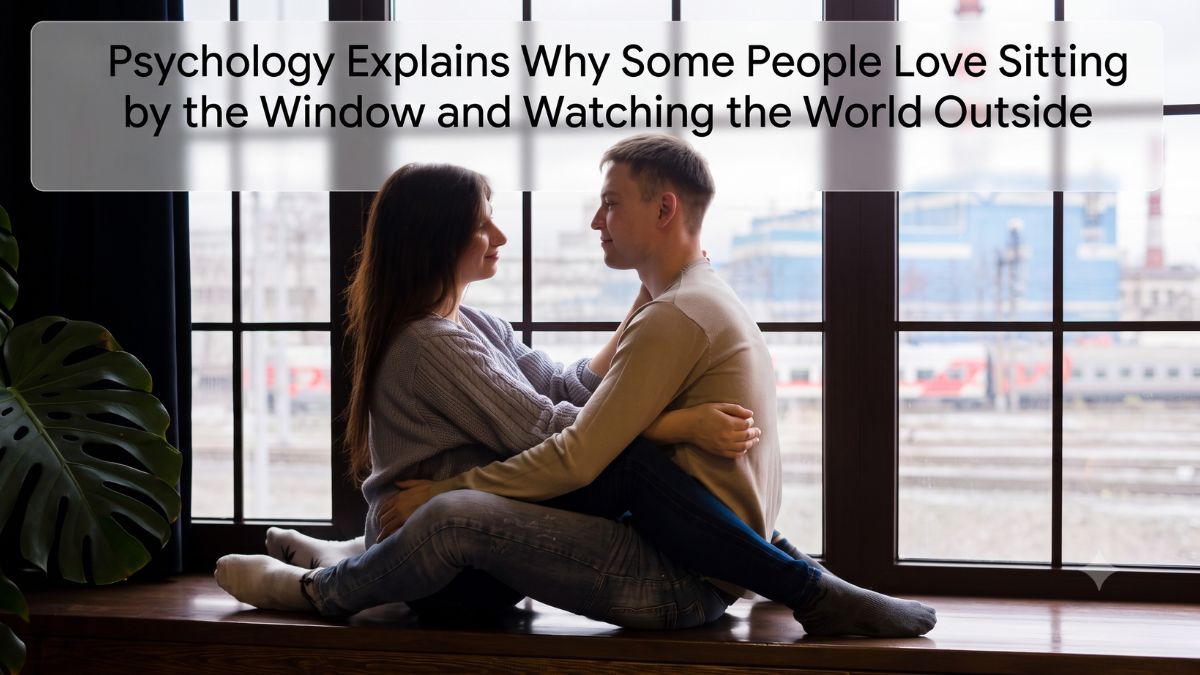
For some people, sitting by a window and watching the world outside is a surprisingly enjoyable habit. They may drink coffee while observing pedestrians, notice a neighbor leaving home, watch the weather change, or simply follow the rhythm of a street becoming busy and quiet.
It can look like idle time, but psychology offers several possible explanations. Curiosity, attention to the environment, visual exploration, social observation, and restoration can all play a role.
Research by environmental psychologist Rachel Kaplan has also examined how views from home may contribute to psychological restoration, particularly when those views include natural features.
That does not mean everyone who enjoys looking through a window has a particular personality type. The same behavior can have different motivations. For some people, however, the window provides a comfortable way to stay connected with the outside world without actively participating in it.
Curiosity
One explanation comes from George Loewenstein’s information-gap theory of curiosity. The theory proposes that curiosity can emerge when people recognize a gap between what they know and what they would like to know.
A window can provide an almost endless supply of small information gaps.
Who is that person walking down the street?
Why has the neighbor parked somewhere different?
Where is that delivery driver going?
Why is the normally quiet road suddenly crowded?
Most of these questions have little practical importance. Yet curiosity does not always require an important mystery. Small uncertainties can be enough to attract attention.
Someone who enjoys observing their surroundings may simply find these minor changes interesting enough to keep watching.
Movement
A window provides a constantly changing visual scene. Unlike a television program or social media feed, there is no predetermined storyline. Something unexpected can happen at any moment.
A dog might run across the street. A cyclist might pass. Dark clouds may appear. A familiar person may walk by. Traffic may suddenly increase.
This gives the observer a stream of environmental information without requiring active participation.
Window watching therefore allows someone to remain in a familiar and comfortable environment while still engaging with what is happening outside. They can monitor the world without having to enter it.
Refuge
Another possible explanation comes from Jay Appleton’s Prospect-Refuge Theory.
Appleton proposed that people may find environments appealing when they provide both prospect, meaning an opportunity to see and survey the surroundings, and refuge, meaning a protected place from which to observe.
A window offers a straightforward example of this combination. A person can remain indoors, protected from weather, traffic, and other demands of the outside environment while maintaining a clear view.
In simple terms, the window provides observation without participation.
Research examining prospect-refuge preferences has produced mixed evidence, so the theory should not be treated as a complete explanation for why everyone likes window views. Still, it provides one useful framework for understanding why a comfortable vantage point can be appealing.
People
Humans are particularly interesting subjects to observe because everyday behavior contains a large amount of information.
From a distance, someone might notice a person’s walking speed, posture, clothing, gestures, facial expressions, or interactions with others. The observer may then begin wondering about the relationship between two people or what someone might be doing.
That does not mean these assumptions are accurate. People frequently make judgments about other people’s intentions and relationships using limited information.
The interest may partly come from the mind trying to make sense of incomplete information. This connects naturally with curiosity: when information is missing, there can be a desire to fill the gap.
Restoration
Not every person who looks through a window is trying to understand what other people are doing. Sometimes the activity may simply provide a break from concentrated work.
Rachel Kaplan’s research on views from home examined the relationship between window views, natural features, neighborhood satisfaction, and aspects of well-being. Her findings suggested that natural elements in views could be associated with more positive environmental experiences.
Consider someone who has spent several hours looking at a computer screen. Looking outside at trees, clouds, changing daylight, or passing pedestrians introduces a different visual experience.
The person may not be searching for anything specific. They may simply be allowing their attention to move away from the task in front of them.
Attention
This connects with Attention Restoration Theory, associated with environmental psychologists Rachel and Stephen Kaplan.
The theory proposes that some environments can help restore directed attention, the effortful type of attention required for demanding tasks. Natural environments are often relevant because they can contain softly engaging stimuli that attract attention without requiring intense concentration.
A window showing trees, sky, birds, or changing daylight may therefore provide a gentler visual experience than a demanding work task or screen.
However, simply looking through a window does not guarantee psychological restoration. The quality and content of the view matter, and individual responses can differ.
Distance
Looking through a window can also provide a form of psychological distance.
Going outside requires action. You have to decide where to go, deal with weather, interact with people, and respond to whatever happens around you.
Looking outside requires very little effort.
Someone can observe a busy street while remaining physically separated from it. For people who enjoy quieter environments, this may provide a useful middle ground between complete isolation and active social participation.
They remain connected to what is happening around them without having to become part of it.
Habit
The behavior can also become a routine.
Someone may initially sit beside a window because it is comfortable or because they enjoy the view. If the experience repeatedly feels calming, interesting, or refreshing, they may begin returning to the same spot whenever they need a break.
Over time, the window can become associated with particular feelings or activities, such as relaxation, reflection, curiosity, or taking a pause from work.
This does not indicate a specific psychological condition. It may simply be a learned routine supported by positive associations with the environment.
Meaning
It is easy to describe people-watching as nosiness, but psychology provides several broader explanations.
One person may be satisfying curiosity. Another may be taking a break from concentrated work. Someone else may enjoy observing everyday social behavior. Another may simply appreciate natural light, changing scenery, or the rhythm of the street.
The same behavior can therefore have very different motivations.
For some people, a window offers a useful combination of refuge, visual access, curiosity, and distance. It allows them to experience a changing world while remaining in a familiar space.
If someone regularly finds themselves sitting by the window and watching the outside world, they may not simply be passing time. They could be satisfying curiosity, monitoring changes in their environment, taking a restorative pause, or enjoying the unusual comfort of being close enough to observe the world without needing to participate in it. Psychology does not provide one explanation for the habit, but it does suggest that something as ordinary as looking through a window can involve several interesting processes at once.
FAQs
Why do people enjoy watching from windows?
Curiosity, relaxation, observation, and environmental attention may play roles.
Does window watching mean someone is nosy?
Not necessarily. People may watch for many different psychological reasons.
Can looking outside reduce mental fatigue?

Certain views may provide a gentle break from demanding attention.
What is prospect-refuge theory?
It suggests people may value views combined with a sense of protection.
Why can people watching feel interesting?
Incomplete social information can stimulate curiosity and interpretation.