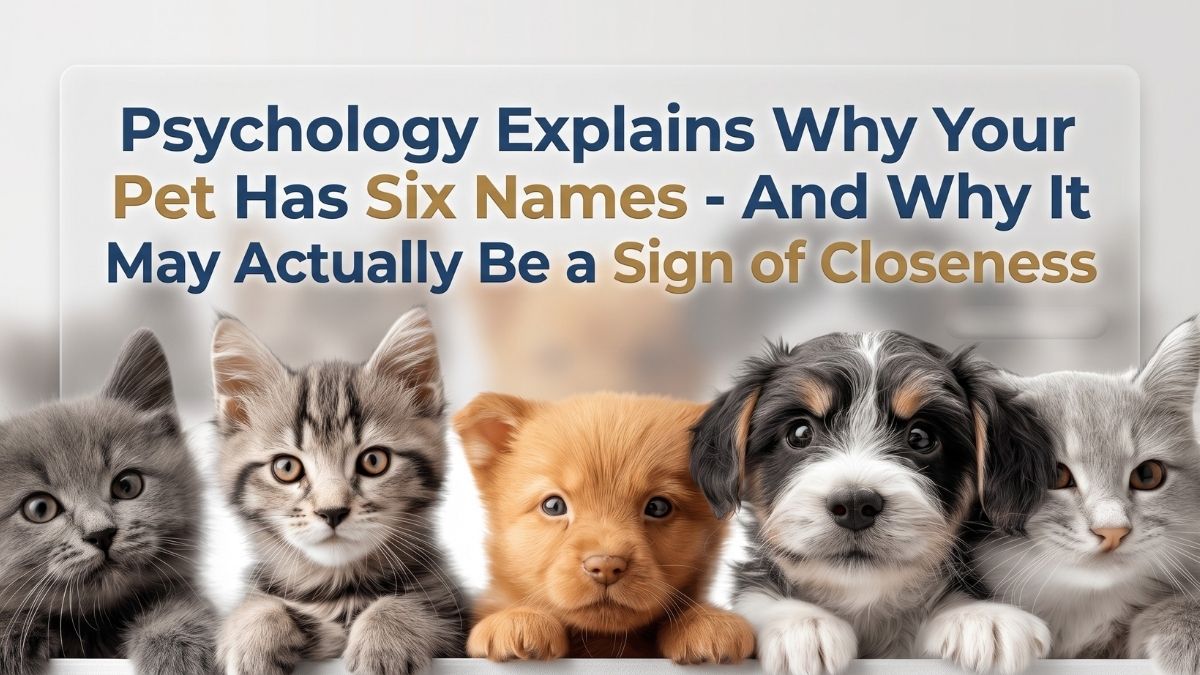
Somewhere right now, an otherwise perfectly ordinary adult is calling a nine-kilogram dog Sir Wigglebottom, even though the animal’s official name is Max. Max has probably not heard his government name in years.
It can look excessive from the outside. But psychology suggests that giving a pet a collection of silly nicknames may be less about being overly attached and more about the way people create intimacy through private language.
Humans routinely develop words, phrases, gestures and voices that make sense only within their closest relationships. Pets can become part of that same pattern.
Couples
People in close relationships often develop their own vocabulary. A 1987 study involving 100 romantically involved couples asked participants to list words, phrases or gestures that had meanings understood only by the two partners.
Together, the couples reported 647 examples. Nicknames were among the common forms of this private communication, along with teasing expressions and other shared references.
That works out to roughly six or seven private expressions per couple. Researchers also found that couples with more of these shared forms of communication tended to report greater love, commitment and closeness.
The finding needs some context. It shows an association, not that creating nicknames automatically makes a relationship stronger. Still, it provides an interesting comparison for people who have accumulated half a dozen names for one pet.
Nicknames
Private nicknames can serve a simple social function. They create a small language shared by two members of a relationship.
The word itself may have little meaning to anyone else. Within the relationship, however, it can carry memories, affection or humor. That is why a nickname from years ago can survive long after the original reason for creating it has been forgotten.
The same process can occur between people and their pets. A dog’s nickname may begin with a physical trait, a funny behavior or an accidental mispronunciation. Over time, it can develop into several variations.
The result may sound ridiculous to an outsider while being completely natural to the people involved.
Baby Talk
The voice people use with pets can attract even more attention than the names themselves. Adults may raise their pitch, stretch certain sounds or speak in an exaggerated, gentle tone.
Psychological research on this type of communication provides a more nuanced picture. A 1996 study examining baby talk among adults found that people who used it with romantic partners and close friends tended to show greater attachment security and lower avoidance.
That does not mean baby talk is automatically healthy or unhealthy. It does suggest that using an exaggerated affectionate voice should not, by itself, be interpreted as evidence of emotional immaturity.
In close relationships, people often adopt communication styles that would sound unusual in ordinary social situations.
Dogs
Dogs may also respond differently depending on how humans speak to them. In a 2018 study conducted by researchers at the University of York, dogs were exposed to different combinations of dog-directed speech and content.
The researchers found that dogs showed greater attention and more positive responses when people used the familiar sing-song style associated with speaking to animals while also using content relevant to dogs.
When the researchers separated those elements, the preference was reduced. A cheerful tone paired with irrelevant words, or relevant words delivered without the distinctive tone, did not produce the same response.
The research came from a specific experimental setting and should not be treated as universal proof of how every dog behaves. It does, however, suggest that dogs can respond to both the emotional style of speech and the information contained in it.
That makes the familiar stream of nicknames more interesting. The dog may not understand every invented word, but it can recognize the tone, context and patterns surrounding the interaction.
Anthropomorphism
There is some evidence behind the idea that people sometimes treat animals as if they were human. A 2007 psychological theory of anthropomorphism identified three broad reasons people may attribute human qualities to non-human entities.
One involves the way human cognition works. People naturally use what they already know about human behavior to interpret unfamiliar creatures.
Another involves the desire to understand and predict what an unpredictable animal might do. Assigning human-like intentions can make behavior easier to interpret.
The third involves social connection. People who experience greater social disconnection may be more likely to anthropomorphize.
That final point provides some support for the common joke that someone who talks constantly to a pet should spend more time with people. But it is only one part of a broader explanation. Anthropomorphism can also arise from ordinary cognitive processes and the simple desire to understand an animal’s behavior.
Meaning
The number of names a pet has is therefore not particularly useful as a measure of unhealthy attachment.
A person can have six nicknames for a dog and maintain strong friendships, family relationships, work responsibilities and interests outside the home. In that situation, the names may simply reflect affection and familiarity.
The more important question is whether the relationship with the pet complements a person’s wider social life or has become its only meaningful source of connection.
Private language is one of the ways people mark relationships as special. Families develop expressions that outsiders do not understand. Couples create jokes that make no sense to anyone else. Long-term friends preserve nicknames that originated decades earlier.
A pet cannot participate in language in exactly the same way as another person, but it can still become part of a familiar communication routine. The animal recognizes voices, tones, words, gestures and repeated situations, while the human attaches personal meaning to the interaction.
So if Max has gradually become Maxie, Wiggles, Sir Wigglebottom and several names that make even less sense, psychology offers little reason to regard the nickname collection alone as eccentric. It may simply be another example of how affection creates its own private language.
FAQs
Why do people give pets many nicknames?
Nicknames can express affection and create a private form of communication.
Is pet baby talk normal?
Yes, playful speech is common in close human and pet relationships.
Do dogs respond to baby talk?
Research suggests dogs can respond positively to dog-directed speech.
Does anthropomorphism mean loneliness?
Not necessarily; several psychological factors can explain anthropomorphism.
Are many pet nicknames unhealthy?
The number of nicknames alone does not indicate unhealthy attachment.